




Guwahati, 06 November (HS): From the sound of gunfire that once echoed across its hills and forests to the prospect of bullet trains racing through its landscape, Assam is witnessing a remarkable shift in its development narrative. A state that spent decades grappling with insurgency, violence and geographical isolation is increasingly positioning itself as a gateway to India's economic and infrastructure ambitions.
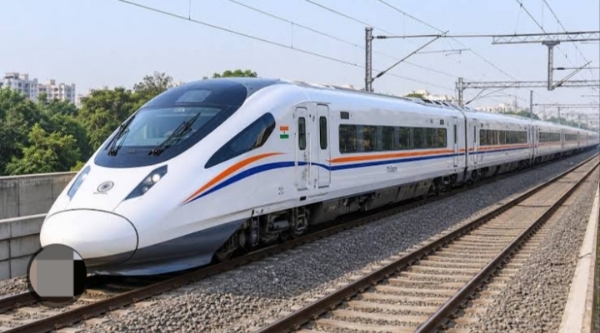
The latest milestone in this journey is the approval to extend the proposed Northern High-Speed Rail Corridor from Delhi to Guwahati, bringing Assam and the wider Northeast closer to India's ambitious bullet train network. The proposed connectivity promises to reduce the travel time between Delhi and Guwahati to less than eight hours, potentially transforming the way the region connects with the rest of the country.
For Assam, the significance goes beyond faster trains. It represents a larger transition from a region often associated with conflict and remoteness to one aspiring to become a destination for investment, industry, tourism and modern infrastructure.
The proposed high-speed corridor, spanning approximately 1,500 km, is expected to connect Delhi with Guwahati through major cities, including Agra, Kanpur, Lucknow, Ayodhya, Varanasi, Prayagraj, Patna and Siliguri. The Delhi-Siliguri journey is estimated to take around six hours, while the extension to Guwahati is expected to bring the national capital within an eight-hour journey.
However, the ambitious project also faces a significant engineering challenge. The Siliguri Corridor, popularly known as the Chicken's Neck, provides the crucial land connection between mainland India and the Northeast. At certain stretches, the corridor is barely 16 to 22 km wide, with existing highways and railway infrastructure already occupying the narrow passage.
Assam Chief Minister Himanta Biswa Sarma has pointed out that engineers will have to examine whether the high-speed railway line should pass underground or through an elevated alignment. Detailed surveys, route identification and technical planning are still required before construction can begin. Thus, the approval marks an important beginning rather than the commencement of construction.
The bullet train proposal is part of a much wider transformation taking place across Assam's railway infrastructure.
Under the Northeast Frontier Railway (NFR), several projects are aimed at increasing railway capacity, improving passenger convenience and strengthening connectivity within the region. The 194-km Furkating-New Tinsukia railway doubling project, estimated to cost around ₹3,634 crore, is expected to significantly improve railway movement in Upper Assam by addressing capacity constraints on the existing single-line sections.
Closer to Guwahati, the Kamakhya-Guwahati third railway line and the proposed second rail-cum-road bridge over the Brahmaputra at Saraighat are among the major infrastructure initiatives. These projects are expected to ease congestion, improve operational efficiency and strengthen the city's position as the principal railway hub of the Northeast.
The expansion is not limited to conventional railway infrastructure. The proposed Kokrajhar-Gelephu railway line is expected to strengthen connectivity between Assam and Bhutan, opening new possibilities for cross-border trade, tourism and economic cooperation.
Electrification has also emerged as an important component of railway modernisation. The extensive electrification of railway routes across the Northeast is reducing dependence on conventional diesel operations and improving the efficiency of railway services.
Meanwhile, newer-generation trains are changing the passenger experience. Vande Bharat and Amrit Bharat services are expanding connectivity between Assam and several major destinations across the country. Proposed premium services, including the Vande Bharat Sleeper on the Kamakhya-Howrah route, are expected to add another dimension to long-distance rail travel.
The transformation carries particular significance for a region whose geographical challenges have historically affected its economic integration. Assam's rivers, hills, forests and international borders have made infrastructure development a complex exercise. Better railway connectivity can help local industries access larger markets, facilitate tourism, improve logistics and create employment opportunities for young people.
The contrast between the past and the emerging future is particularly striking. For decades, insurgency and security challenges shaped much of Assam's public narrative. Today, infrastructure, industrial investment, improved connectivity and economic opportunities are increasingly becoming central to its development aspirations.
A bullet once symbolised fear, violence and uncertainty. A bullet train, by contrast, represents speed, technology, ambition and the possibility of a more connected future.
The journey from bullets to bullet trains is, therefore, not merely about the evolution of transportation. It reflects Assam's larger aspiration to move beyond its difficult past and participate more prominently in India's growth story.
The proposed high-speed rail corridor is still at the planning stage and several engineering and financial challenges remain. But its proposed extension to Guwahati has already placed Assam on a new infrastructure map.
For a state that has long sought to overcome the barriers of geography and history, the prospect of a bullet train reaching its doorstep carries a message that goes far beyond the railway tracks: Assam wants to move forward, faster.------------
Hindusthan Samachar / Sriprakash