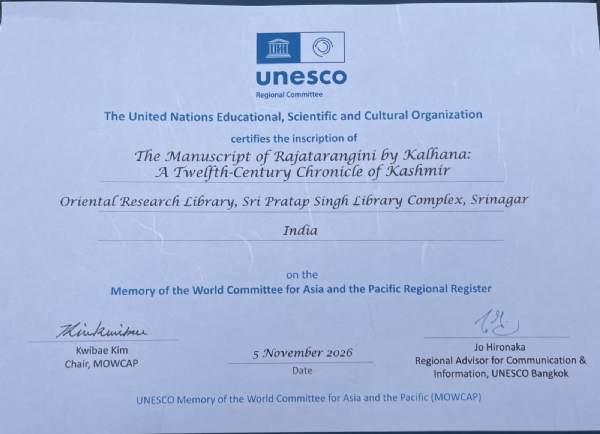
New Delhi, November 5 (H.S.): Three major Indian literary and intellectual works - Rajtarangini, Mahabharata and Kautilya's Arthashastra - have been included in UNESCO's Memory of the World Regional Register for Asia and the Pacific (MOWCAP), recognising their historical and cultural significance.
The recognition was conferred during the 11th session of the MOWCAP Register held in Jakarta, Indonesia. The information was shared by Dr. Sachchidanand Joshi, Member Secretary of the Indira Gandhi National Centre for the Arts (IGNCA), which played a key role in preparing the nomination dossiers for the three works. With these additions, India now has a total of six entries in the regional register.
Composed by 12th-century Kashmiri historian Kalhana, Rajtarangini is a historical account of the kings of Kashmir, political developments and the region's social and cultural life. Its systematic approach to recording history through evidence, traditions and critical observation makes it a significant work in the Indian historiographical tradition.
The Mahabharata, one of the major epics of Indian literature, explores questions of duty, justice, power, human relationships and moral responsibility. Its philosophical and ethical themes have influenced cultural and intellectual traditions across South Asia and beyond.
Kautilya's Arthashastra deals with governance, state administration, economic policy, diplomacy and military strategy. The work offers insights into ancient Indian political thought and administrative practices and continues to be an important reference in the study of statecraft.
The inclusion of the three works recognises different strands of India's intellectual heritage, spanning historical writing, epic and philosophical thought, and political and administrative theory.
The press release also highlighted the Gyan Bharatam Mission, an initiative aimed at identifying, preserving, digitising and making India's manuscript heritage accessible to future generations. It said the initiative seeks to use modern technology to connect India's knowledge traditions with younger generations and the international community.
The UNESCO recognition places the three works among the region's documented heritage of historical and intellectual significance.
---------------
Hindusthan Samachar / Indrani Sarkar
18 Aug 2026