New Delhi, 03 November (H.S.): Defence Minister Rajnath Singh on Tuesday emphasised the need to ensure adequate financial resources for the modernisation of the armed forces, stating that the government had consistently increased the modernisation budget over the years and ensured its effective utilisation.
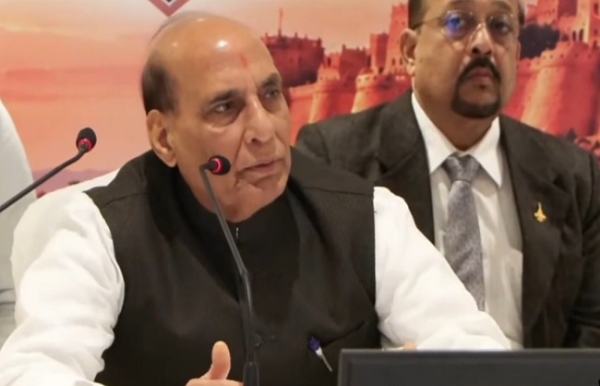
Speaking at a meeting of the Parliamentary Consultative Committee of the Ministry of Defence in Jaisalmer, Rajasthan, Rajnath Singh said technology had become an integral component of warfare amid rapidly evolving global security dynamics. He noted that new weapons systems and missiles were being tested, while the armed forces were fully aware of the government's commitment to meeting their requirements. He added that the services were also prioritising critical requirements to ensure the optimum utilisation of allocated funds.
Rajnath Singh said the government's objective was not merely to acquire modern equipment but to establish a robust defence ecosystem in which technologies were developed in line with the operational requirements of the armed forces, participation by Indian industries was expanded and the country's strategic dependence on external sources was reduced.
He underlined that modernisation extended far beyond the procurement of new weapons and equipment. It also involved strengthening the operational preparedness of the armed forces, equipping them with advanced technologies and developing indigenous capabilities that the country could rely on over the long term.
In this context, he said the government's commitment to Aatmanirbhar Bharat (Self-Reliant India) assumed particular significance. Strategic autonomy and indigenous technological capabilities, he stressed, were essential imperatives in matters of national security.
The Defence Minister further observed that human resources remained the greatest strength behind success in warfare. The rapid transformation of warfare and military systems across the world had made it necessary to reassess whether the structure and formations of the armed forces were adequately aligned with the requirements of modern combat.
Keeping these evolving requirements in view, all three services had been continuously undertaking reforms and restructuring their organisational frameworks and formations, he said.
Citing examples from the Indian Army, Rajnath Singh referred to the newly established Asni, Bhairav and Shaktibaan platoons, stating that these formations were proving highly relevant to contemporary operational requirements and the changing nature of warfare.
Rajnath Singh also highlighted the growing contribution of the private sector to India's defence manufacturing capabilities. He said the government had actively encouraged private participation in the production of weapons and missiles, with enterprises ranging from micro, small and medium enterprises (MSMEs) to large corporations now making significant contributions to the sector.
He said the country's progress towards self-reliance in defence was reflected in the substantial growth of domestic defence production and exports.
India's defence production, which stood at Rs. 46,429 crore in the financial year 2014-15, had increased to a record Rs. 1.78 lakh crore in 2025-26. Similarly, defence exports, which were valued at less than Rs. 2,000 crore in 2014, had grown to nearly Rs. 40,000 crore.
The government has set a target of increasing defence production to Rs. 3 lakh crore and defence exports to Rs. 50,000 crore by 2029, he said.
Highlighting the increased financial allocation for the defence sector, Rajnath Singh said the total defence budget for the financial year 2026-27 had risen to Rs. 7.85 lakh crore. Of this, a capital outlay of Rs. 2.19 lakh crore had been earmarked for modernisation and capital procurement.
He said the enhanced allocation reflected the government's approach of meeting the operational requirements of the armed forces while simultaneously encouraging Indian industries and strengthening domestic manufacturing capabilities.
Reiterating the government's commitment to military modernisation, Rajnath Singh said the modernisation budget had been increased consistently over the years, with a focus on ensuring its effective utilisation. He emphasised that the broader objective was to develop a strong and self-reliant defence ecosystem that would foster indigenous technological innovation, expand the participation of Indian industries and reduce the country's strategic dependence on external sources.
Hindusthan Samachar / Jun Sarkar

18 Aug 2026