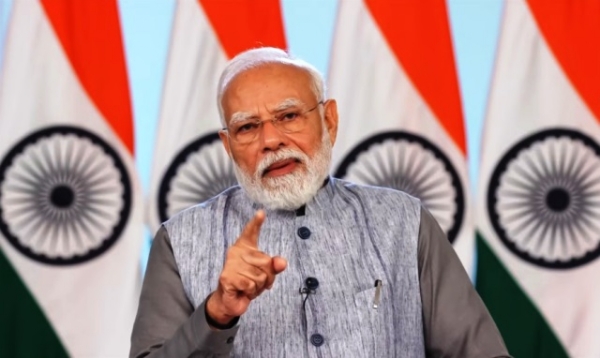
New Delhi, 03 November (H.S.): Prime Minister Narendra Modi on Tuesday inaugurated and laid the foundation stone for Pune Metro projects worth approximately Rs. 21,800 crore through video conferencing, marking a major push towards strengthening the city's urban transport infrastructure.
The projects include the inauguration of the nearly 23-km-long Pink Line of Pune Metro, constructed at a cost of more than Rs. 8,300 crore, and the laying of the foundation stone for four additional metro corridors under Phase II, with an estimated investment of around Rs. 13,500 crore.
Addressing the occasion, PM Modi said the expansion of Pune Metro would provide fresh momentum to the city's development while making everyday life more convenient for its residents. He observed that the joy of festivals became even greater when new facilities and amenities were added to people's lives. Describing the occasion as a moment of happiness for Pune, he extended his congratulations to the people of the city and Maharashtra.
The Prime Minister recalled that he had the opportunity to lay the foundation stone for the first phase of Pune Metro nearly a decade ago. He said the establishment of metro connectivity between Hinjawadi and Shivajinagar would significantly improve access to Pune's major information technology (IT) hub. The newly announced corridors, meanwhile, would further strengthen connectivity between the city's older and newly developed areas.
PM Modi said Pune had always been a centre of ideas that had given new direction to the nation and society. Today, the city was also contributing to the aspirations and energy of a developed India. With its strong presence in sectors such as information technology, automobiles, pharmaceuticals, startups, innovation and manufacturing, Pune had emerged as a city of dreams and opportunities for India's youth. Improved metro connectivity, he said, would further accelerate its growth.
He emphasised that a city's identity was no longer determined solely by its industries or food culture. Its competitiveness and the ease of living it offered to residents were equally important parameters. Metro projects strengthened both these aspects by reducing travel time and providing more efficient transport facilities.
When a city saves time, its productivity increases, which ultimately contributes to national economic growth and benefits both the poor and the middle class, he said.
The Prime Minister pointed out that India's first metro service began operations in 1984. However, during the subsequent three decades, only 248 km of metro lines had been constructed across the country. Until 2014, metro services were available in just five cities. He remarked that had the earlier approach and work culture continued, Pune would have had to wait several more decades to get metro connectivity.
He said that after the National Democratic Alliance (NDA) government came to power in 2014, it made a firm commitment to improving the quality of life of the urban middle class and strengthening public transport infrastructure.
Over the past 12 years, India's metro network had expanded rapidly. From just 248 km in 2014, the network had grown to approximately 1,200 km. Similarly, the number of cities with metro services had increased from five to 26. More than one crore passengers now travel by metro every day, making India home to one of the world's three largest metro networks, he said.
PM Modi also highlighted the significant expansion of metro infrastructure in Maharashtra. In 2014, the state had only 101 km of operational metro lines, whereas approximately 200 km were now in service. Construction was underway on more than 680 km of additional metro lines. An investment of over Rs. 2.5 lakh crore was being made in metro infrastructure across Maharashtra, generating employment opportunities for workers, engineers and people associated with shops, factories and other businesses.
He noted that the Pune Metro project was particularly significant because it had been developed under the Public-Private Partnership (PPP) model, demonstrating the potential of collaboration between the government and the private sector. The success of this model, he said, could further accelerate the country's development.
The Prime Minister said that every citizen, particularly the youth, was contributing with confidence and determination towards building a developed India. Over the past 12 years, the country had witnessed extensive infrastructure development, including rural roads, highways, expressways, railway electrification, tunnels and bridges.
He said that in the coming years, India would focus its energies on transforming its cities into some of the finest urban centres in the world.
Emphasising the economic significance of urban centres, Modi said cities were not merely places to live but also major hubs of economic activity. He stressed the need to develop hundreds of smaller cities across the country as new centres of growth.
With this vision, the Urban Challenge Fund was approved in February this year, under which the Central Government was providing financial assistance of Rs. 1 lakh crore. The initiative aims to mobilise investments worth several lakh crore rupees in cities across the country in the coming years. He urged urban local bodies and the private sector to actively participate in this transformative initiative.
Despite challenging global circumstances, India had maintained its position as the world's fastest-growing major economy, PM Modi said. Referring to the latest World Bank report, he noted that nearly 50 crore people in India had overcome extreme poverty over the past 10 to 12 years.
He said that earlier, the fight against poverty had largely remained confined to slogans, whereas India was now making tangible progress in eliminating poverty on the ground. Alongside being the fastest-growing major economy, the country was also among the leading nations in reducing poverty, he added.
The Prime Minister said that access to essential amenities such as housing, toilets, piped drinking water and LPG connections had strengthened the confidence of poor households. The benefits of government welfare schemes were now reaching beneficiaries directly.
He added that when public funds were invested in infrastructure such as roads, railways, airports and metro systems, alongside increased investment in electricity, water supply and gas pipelines, the resulting improvements extended beyond people's quality of life to the creation of new employment opportunities.
PM Modi also mentioned that he had recently completed 25 years of serving as the head of a government, marking a significant milestone in his public life. He said his government's guiding principle had always been to empower the poor so that they could develop the confidence and determination to overcome poverty.
Recalling his tenure as Chief Minister of Gujarat, he said he had launched Garib Kalyan Melas with the same vision. These events focused on ensuring that the benefits of various welfare schemes reached the intended beneficiaries directly.
Describing the philosophy as 'Power to Empower', he said the objective was to provide people with the strength and opportunities to transform their own lives. This, he emphasised, was the essence of good governance.
The Prime Minister also expressed concern over farmers affected by adverse weather conditions and natural disasters in Maharashtra. He said several farming families in the state were facing considerable hardships due to unfavourable weather.
While substantial efforts had been undertaken in recent years to strengthen water conservation under the leadership of Chief Minister Devendra Fadnavis, natural calamities had compounded the difficulties faced by farmers.PM Modi assured them that the NDA government stood firmly with the affected farming community and would extend its support with sensitivity and commitment during this challenging period.
Appealing to citizens to remain mindful of farmers during the festive season, he urged them to ensure that farming families, too, could celebrate Diwali with happiness and dignity. He said people must not forget the difficulties faced by farmers affected by drought and natural disasters, as well as those living in rural areas.
He stressed that the challenges arising from natural calamities could only be overcome through collective efforts and solidarity. Concluding his address, PM Modi said that the spirit of Sabka Prayas (collective effort) was the lifeblood of a developed India and called upon everyone to continue working together towards the country's progress.
Hindusthan Samachar / Jun Sarkar
18 Aug 2026