




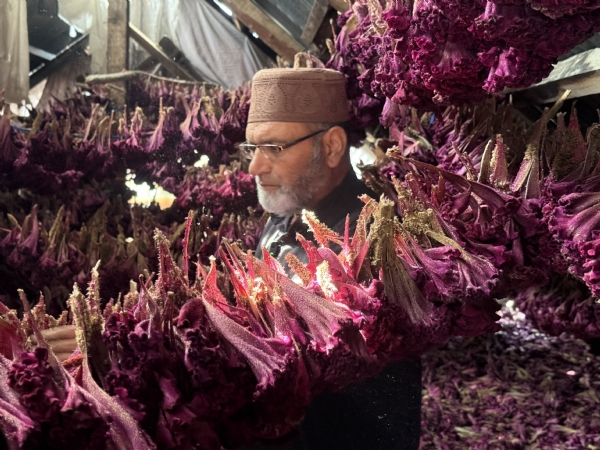
Srinagar, Nov 3 (HS): Mawal, the flower traditionally used to colour Kashmir’s dishes, is finding its way back into the Valley’s wazwan cauldrons (degs), and rising demand is drawing back farmers who had stopped growing it. This year’s mawal harvest is over, and the flowers are now being dried.
The red flower, known botanically as Celosia cristata and commonly as cockscomb, looks very much like a rooster’s comb. The plant grows 27 to 80 cm tall. The flowers are dried and stored, then soaked in water when needed to release a deep red colour. That colour is used by wazas, the traditional Kashmiri master chefs who prepare wazwan, in their dishes. For years, mawal has been behind the red of dishes such as rista, rogan josh and marchwangan korma, and it offers a natural alternative to synthetic food colours.
Bashir Ahmad Pampori, a farmer from Noor Bagh on the outskirts of Srinagar, says demand for mawal has started to climb again. “Mawal has long been used in Kashmiri dishes (wazwan),” he told Hindusthan Samachar. “In the city, people still use the colour from this flower in wazwan.”
He gives two reasons for the revival. “People are becoming more conscious of their health, and the government has also banned synthetic colours in cooked food,” he said. “That is why the colour from this flower is being used, and demand for it has begun to rise again.”
The ban Pampori refers to dates to August last year, when the Drugs and Food Control Organisation issued a public notice prohibiting synthetic colours in wazwan, biryani and other ready-to-eat food, with fines of up to Rs 3 lakh for violations. The move followed analyses by the National Food Laboratory in Ghaziabad. The push for natural colours is not new, though. In 2020, the Food Safety Department told hosts of wedding feasts to avoid synthetic colours and pointed to natural options such as mawal, saffron, Deghi Mirch and beetroot.
For now, the trend is largely an urban one. “There is hardly any trend of using this flower’s colour for wazwan in rural areas, but in the city it has grown considerably,” Pampori said. “That shows the crop has a future.”
The flower matures in autumn. Farmers pick the blooms, dry them and sell them to traders, who grind and pack them. Pampori grows the crop on a couple of kanals of land. “My father used to grow it. Then the practice stopped for a while, and for the past three or four years I have been growing it again,” he said. “We dry the flowers and sell them to traders at Rs 300 a kilo.”
Drying is the hardest part. “Drying these flowers is very difficult,” he said. “You need a lot of space, and they must not be exposed to direct sunlight because they can spoil. That is why they have to be kept in a closed room.”
Pampori believes mawal’s use should not stop at the kitchen. “These flowers can be used for more than cooking; some medicine could be made from them too,” he said, adding that a man comes to him to buy the flowers for use as medicine. But, mawal’s established role remains that of a natural colour.
He urged wazas to choose the flower’s colour over harmful synthetic dyes. “Our chefs should use this colour,” he said. “They should put it on their list of spices so that people buy and use it too.”
The biggest obstacle to expanding cultivation is a shortage of land. Pampori says land in the city is shrinking, so the crop cannot be grown there on a large scale. “There is still plenty of land in rural areas, so the trend of growing this crop should be encouraged there, so that this traditional part of our cuisine survives and people’s health is also looked after,” he said.
He also has expectations of the government. “The government did a good thing by banning synthetic colours, but a lot more still needs to be done,” he said. He wants concrete steps to make the crop more profitable for farmers.
The journey of mawal from field to degs is the story of a tradition in which colour came not from outside but from the soil. When the ban on synthetic colours and growing health concerns pushed people to look to their own fields again, the old practice came back to life.
---------------
Hindusthan Samachar / Zahoor Hussain Bhat