Ongole, 03 November (H.S.):
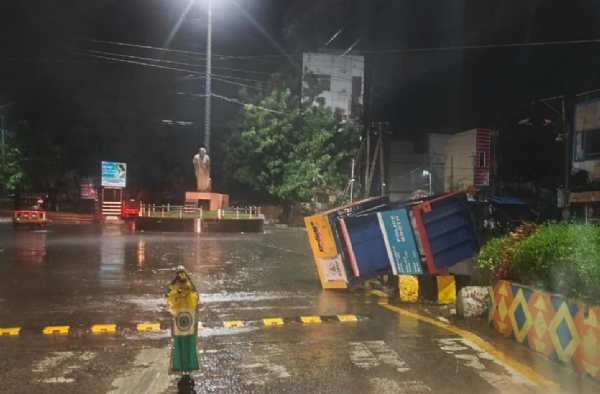
Severe Cyclonic Storm Murasu began making landfall near Ongole in Andhra Pradesh's Prakasam district in the early hours of Tuesday, bringing gale-force winds and heavy rainfall to coastal areas. Wind speeds during the process reached 110 kmph, with gusts of up to 120 kmph, according to the India Meteorological Department (IMD).
The landfall process commenced at around 1 am, with the storm's forward sector moving towards the coast. In its subsequent bulletin, the IMD reported that the northern part of the cyclone's inner spiral band had reached land by 3 am, while the dense central cloud region, known as the wall cloud, was also advancing towards the coastline.
The weather agency warned that a storm surge of approximately 1 to 1.5 metres above the astronomical tide could inundate low-lying coastal areas of South Andhra Pradesh. Bapatla, Krishna and Prakasam districts were identified as areas likely to experience the highest surge levels. Heavy rainfall was also forecast across the southern coastal belt over the following 12 hours.
The impact of the cyclone was already being felt in and around Ongole, particularly along the Kothapatnam Beach stretch, where heavy rain and extremely strong winds were reported. Coastal areas continued to experience turbulent weather as the storm moved inland.
Air traffic was also disrupted, with at least 21 domestic flights cancelled at airports in Andhra Pradesh and Chennai. The cancellations included 11 flights operating to and from Chennai and 10 IndiGo services at Vijayawada's Gannavaram Airport. Operations at Tirupati and Visakhapatnam airports were also affected by adverse weather conditions.
Authorities have provided a dedicated WhatsApp facility for residents in cyclone-affected areas of Andhra Pradesh to report emergencies and civic problems, including power outages, uprooted trees, collapsed walls, waterlogging and other damage. Residents can send a message reading Hi to 9552300009, select the Services option from the menu, and then choose Murasu Cyclone Issues. They can subsequently click on Report Issue, confirm their selection and complete the registration process by providing details such as their name, district and mandal.
Meanwhile, Chief Minister N. Chandrababu Naidu held a teleconference with district officials as the cyclone approached the coast, directing the administration to remain on high alert and ensure that no lives were lost. He sought updates on rainfall and wind conditions in Nellore, Prakasam and the Kothapatnam coastal areas.
The Chief Minister also instructed personnel at Swarna Grama and Swarna Ward offices to ensure that cyclone-related warnings and information reached residents at the grassroots level. Officials were directed to take all necessary precautions to minimise damage to property and respond promptly to disruptions in essential services.
The cyclone's influence extended beyond Andhra Pradesh, with several parts of northern Tamil Nadu experiencing persistent rainfall. Chennai, Chengalpattu and Tiruvallur districts received heavy showers from Sunday night. The IMD warned of very heavy rainfall in Chennai and Tiruvallur, while heavy rain was forecast for Chengalpattu, Kancheepuram, Ranipet, Vellore and the Nilgiris.
With the prospect of damage to electricity infrastructure, neighbouring states also extended assistance to Andhra Pradesh. Tamil Nadu dispatched three National Disaster Response Force (NDRF) teams comprising 90 personnel, along with 25 electricity department teams carrying a total of 500 personnel and essential equipment, to support rescue operations and power restoration. Karnataka also announced the deployment of 500 skilled electricity workers, along with necessary equipment, to assist in restoring damaged power infrastructure.
Odisha stepped up precautionary measures as the cyclone threatened to bring heavy rainfall to its southern districts. Ganjam, Gajapati, Rayagada, Koraput and Malkangiri were among the districts placed on alert. State Disaster Management Minister Suresh Pujari said district collectors had been instructed to remain vigilant, while evacuation efforts in vulnerable areas were accelerated. Schools and colleges in some southern districts were also ordered to remain closed until November 3.
The cyclone's impact has prompted coordinated preparedness measures across the eastern coast, with state administrations focusing on evacuation, emergency response, restoration of essential services and the protection of vulnerable communities.
Murasu developed from a deep depression over the Bay of Bengal on Sunday before intensifying into a severe cyclonic storm. The name Murasu means war drum. In its earlier forecast, the IMD had predicted that the system would cross the South Andhra Pradesh coast between Nellore and Narsapur, close to Ongole, between late Monday night and the early hours of Tuesday, accompanied by winds of 100–110 kmph and gusts reaching 120 kmph.
---------------
Hindusthan Samachar / Jun Sarkar

18 Aug 2026