



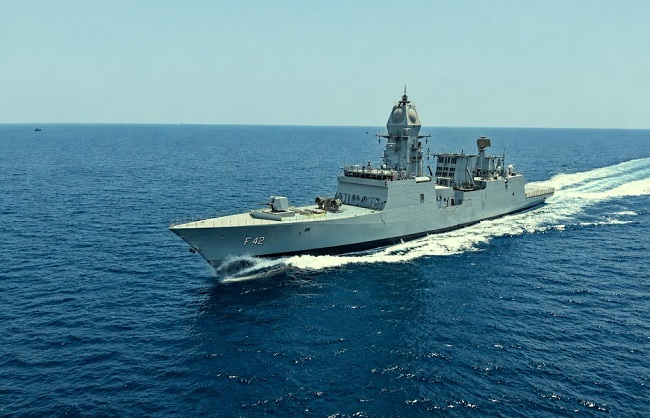
New Delhi, November 27 (HS): The Indian Navy on Friday received the indigenous advanced stealth frigate ‘Vindhyagiri’, equipped with BrahMos anti-ship and land-attack cruise missiles, as well as Barak-8 anti-aircraft missiles. Project 17A frigates are versatile, multi-mission platforms designed to address current and emerging maritime challenges. Vindhyagiri is the seventh and final ship of the Nilgiri-class frigates, built by Garden Reach Shipbuilders and Engineers Ltd (GRSE) in Kolkata.
Named after the Vindhyagiri mountain range in Karnataka, the ship is a modern reincarnation of the earlier INS Vindhyagiri, a Leander-class frigate. The new warship features enhanced stealth characteristics, advanced weapons and sensors, and an upgraded platform management system. The technologically advanced frigate also serves as a tribute to its predecessor, the Leander-class anti-submarine warfare frigate INS Vindhyagiri, which was commissioned into the Indian Navy on July 8, 1981, and served for nearly 31 years until June 11, 2012, participating in various challenging operations and multinational exercises. The newly built Vindhyagiri is poised to carry forward this rich naval legacy while strengthening India's indigenous defence capabilities.
Compared with the Shivalik-class frigates, these warships feature a more advanced suite of weapons and sensors. They are configured with a Combined Diesel or Gas (CODOG) propulsion system, comprising a diesel engine and a gas turbine. Their powerful and technologically advanced weapons and sensor systems significantly enhance their multi-dimensional combat capabilities across anti-surface, anti-air and anti-submarine warfare domains. The warship was formally accepted by Rear Admiral RS Dhaliwal, Admiral Superintendent of the Naval Dockyard, Visakhapatnam, under the Eastern Naval Command.
The delivery of Vindhyagiri comes less than eight months after the delivery of Dunagiri, the second warship in the series built by GRSE. Vindhyagiri is the 811th vessel built and delivered by GRSE and the 121st warship in the shipyard's illustrious shipbuilding history, marking another major milestone for the facility. The warship is also significant as it was launched by President Droupadi Murmu on August 17, 2023. Measuring 149 metres in length and displacing 6,670 tonnes, these frigates are among the largest and most advanced guided-missile warships built by a defence public sector undertaking with more than six decades of shipbuilding experience.
Vindhyagiri is armed with BrahMos anti-ship and land-attack cruise missiles, as well as Barak-8 anti-aircraft missiles, marking a significant enhancement in its naval strike and defensive capabilities. With a high level of indigenous content, the warship stands as a strong symbol of India's self-reliance in defence production. Powered by a combination of diesel engines and gas turbines, it is equipped with advanced AESA radar and modern combat systems. The frigate is capable of conducting anti-air, anti-surface and anti-submarine warfare operations, offering enhanced survivability and operational capabilities. Vindhyagiri can accommodate 225 personnel and is equipped with comprehensive aviation facilities for helicopter operations.
Furthermore, the institutional experience gained from the construction of the previous six P17A ships significantly reduced the construction time of Vindhyagiri to 68 months, compared with 84 months taken to build the first-of-class frigate, INS Nilgiri. The delivery of Vindhyagiri reflects India's growing design, shipbuilding and engineering capabilities, while underscoring the Indian Navy's continued focus on self-reliance in both warship design and construction. With 75 per cent indigenous content, the project involved more than 200 micro, small and medium enterprises (MSMEs) and generated employment for approximately 4,000 people directly and more than 10,000 indirectly.
Hindusthan Samachar / Jun Sarkar

18 Aug 2026