


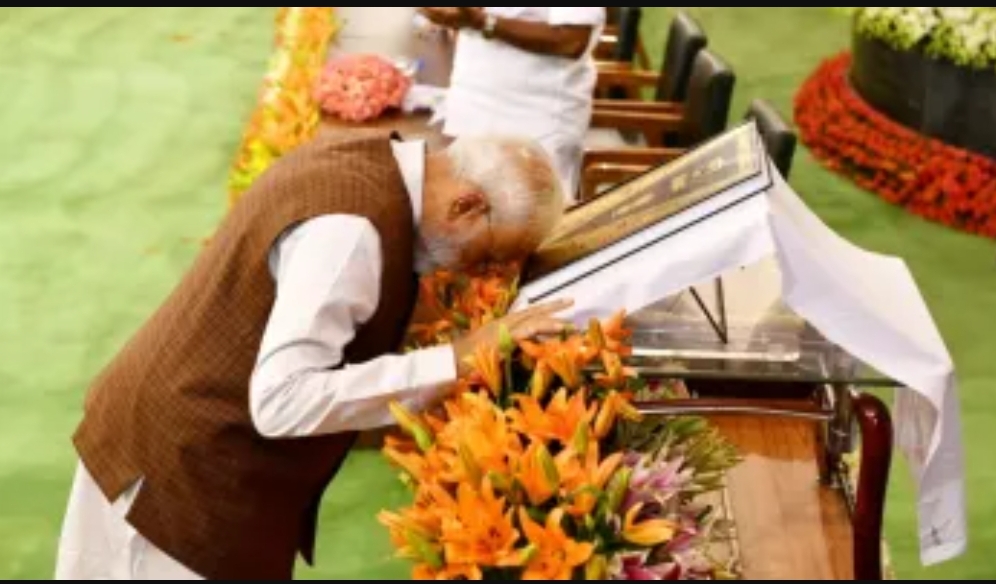
New Delhi, 26 November (H.S.): Prime Minister Narendra Modi on Thursday highlighted his government's initiatives to strengthen the Constitution and advance social and economic justice, while accusing previous governments of weakening constitutional principles through amendments, misuse of provisions and restrictions on fundamental freedoms.
In an article marking Constitution Day, the Prime Minister recalled that the Constituent Assembly adopted the Constitution on November 26, 1949, and paid tribute to Dr Rajendra Prasad, Dr Babasaheb Ambedkar and all members of the Assembly. He said the framers drew upon India's rich traditions and civilisational wisdom while preparing a modern constitutional framework.
Stressing that the Constitution should reach beyond Parliament and the courts, the Prime Minister said his government had decided over a decade ago to observe November 26 as Constitution Day to deepen its connection with citizens, particularly the youth, and strengthen national unity.
Recalling his own childhood and humble background, he said the Constitution had made it possible for a person born without privilege to shoulder the responsibility of serving the world's largest democracy. He described it as an inseparable part of the life journeys of crores of Indians and said the circumstances of one's birth should not determine the limits of one's future.
The Prime Minister said his government had sought to repay this debt by strengthening the Constitution. Referring to constitutional scholar Granville Austin's description of the document as first and foremost a social document, he said the pursuit of social and economic justice was central to its framework.
Citing a World Bank report, he said nearly 50 crore Indians had moved out of poverty, enabling families to look forward to better prospects for their children. He referred to the PM Awas Yojana, Ujjwala Yojana and Ayushman Bharat as initiatives that, according to him, give practical effect to constitutional ideals of dignity, equality and social justice.
He also cited MUDRA and PM-SVANidhi, which provide collateral-free credit to small entrepreneurs and street vendors, and digital platforms such as UPI, saying they had expanded access to opportunities and advanced economic justice and inclusivity.
Referring to constitutional amendments, the Prime Minister said the 101st Amendment introduced the Goods and Services Tax, the 102nd granted constitutional status to the National Commission for Backward Classes, and the 103rd provided reservation for Economically Weaker Sections. He said these measures addressed long-standing demands and the aspirations of disadvantaged sections.
He added that an updated version of the Constitution was now available in all 22 languages listed in the Eighth Schedule, bringing the document closer to citizens. He also cited the Bharatiya Nyaya Sanhita as an effort to move the criminal justice system away from the colonial emphasis on punishment, or Dand, towards a citizen-centric approach to justice, or Nyay.
The Prime Minister then underlined the importance of Kartavya, or citizens' duties, saying his government had emphasised responsibilities alongside rights. He cited mass initiatives such as Swachh Bharat, water conservation and environmental protection as expressions of this approach.
Turning to what he described as instances of the Constitution being weakened, the Prime Minister criticised the First Amendment of 1951, alleging that a government which had not been elected through a popular mandate used its majority in the Provisional Parliament to restrict fundamental freedoms. He said the amendment was brought months before India's first general election with the intention of influencing the electoral process and suppressing public opposition.
He also criticised the 42nd Amendment, brought during the Emergency, saying it curtailed judicial review and altered the balance of institutional powers. He urged young people to study the 38th and 39th Amendments to understand what he described as the actions of power-hungry and anti-constitutional leadership.
Referring to the use of Article 356 to dismiss elected state governments, the Prime Minister said its repeated misuse was troubling. He alleged that one political party had invoked the provision almost a hundred times and that one former Prime Minister had accounted for half of those instances.
The Prime Minister said Articles 370 and 35A had prevented the full application of the Constitution in Jammu and Kashmir for more than 70 years, affecting the rights of Scheduled Castes, Scheduled Tribes, Other Backward Classes and women. He said the historical wrong was corrected in 2019.
He also referred to Naxalism, alleging that armed groups had denied the poorest people
---------------
Hindusthan Samachar / Indrani Sarkar
18 Aug 2026