




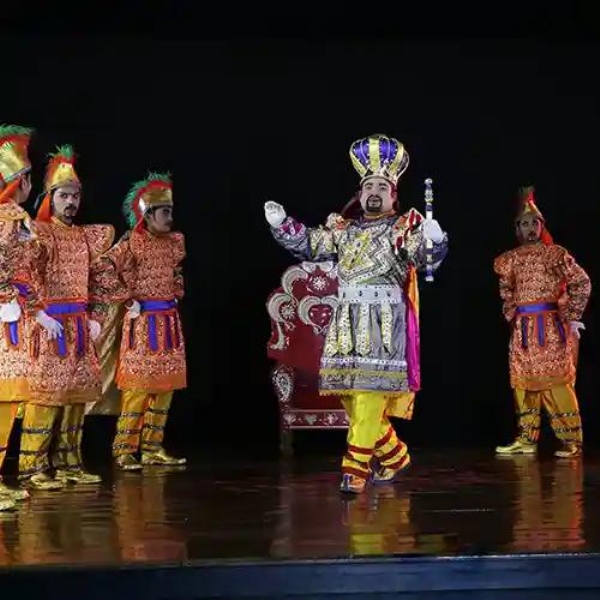
Kochi, 23 Nov (H.S.): A wooden floor has a part to play in Kerala’s Chavittu Nadakam. When soldiers march, the actors themselves supply the sound of the approaching army. They raise their feet and strike the planks in rhythm, all the while singing the lines that carry the story forward. For generations, fishing communities along the Kerala coast have used that combination of footwork and song to bring kings, warriors and saints to the stages of their church festivals.
The Malayalam words chavittu, meaning a stamp of the foot, and nadakam, meaning drama, tell the audience what to listen for. Drums and bells accompany the singing. On an open stage, spectators can follow the action through the sweep of an arm or a change of step. Costumes help them read the scene from a distance. A crown picks out the king among his courtiers, while helmets and breastplates mark the ranks of soldiers.
The text leaves some of the demanding work to the performer. A soldier in a breastplate must keep his place in the ranks and sustain a sung phrase through a sequence of steps. The audience can hear a missed beat as plainly as it can see a mistimed turn.
The tradition took shape among Kerala’s Latin Catholics during the period of Portuguese influence, with its beginnings generally traced to the seventeenth century. Some of the earliest plays were written in Tamil and performed on church grounds. Older scripts retain turns of phrase unfamiliar to many Malayalam speakers today. The music and gestures, meanwhile, would be recognisable to audiences elsewhere in southern India, even when the figures on stage were dressed for a medieval European court.
One enduring favourite follows a European emperor on a campaign to recover a lost kingdom. An audience once had time to get to know an entire court. A single story could unfold over ten to fifteen days, with people returning for successive episodes. A troupe today can fit the action into about two hours, bringing the emperor and his army home in time for the curtain to fall the same evening.
In Gothuruth, an island near North Paravur in Ernakulam district, fishermen and daily wage workers have played some of these royal roles. A photographer who visited the island for its theatre festival in 2015 later made portraits of performers standing in floodwater. They posed in the robes and crowns they wore on stage. The photographs show both the splendour an audience sees at a performance and the conditions the actors return to when it ends.
For women entering the theatre, even finding a costume once called for ingenuity. A performer who took the stage at fourteen in 1969 recalled that the men had clothes made specially for their roles. The women draped their saris to achieve the shape they wanted. Gowns came later. Another performer remembered a childhood in which her parents and elder sisters all acted. She had an entire family to watch before her turn came.
The teacher, known as an annavi, guides the troupe through rehearsals. The words are preserved in a script book called a chuvadi. Learning what to do with the hands takes longer than reading the lines. One veteran actor recalled that after years of practice, hearing a particular song would bring the accompanying gesture to his fingers. In 2012, the inclusion of Chavittu Nadakam in Kerala’s school youth festival opened that training to a wider circle of children.
Gothuruth launched its own festival dedicated to Chavittu Nadakam that same year. The repertoire has since given audiences a glimpse of what else those wooden boards can hold. A play staged at a museum in 2023 took up coastal erosion in Chellanam, a fishing village in Ernakulam district. For writers taking up subjects such as coastal erosion, the work begins with the tune. One playwright described fitting new words to the traditional ragas, choosing phrases that a performer could sing in character while keeping the familiar shape of the melody.
For a woman in the audience who remembered seeing Chavittu Nadakam at a church feast, the subject came as a surprise. The songs and steps were familiar. This time, the land in danger lay a short journey from the theatre.
---------------
Hindusthan Samachar / Arun Lakshman