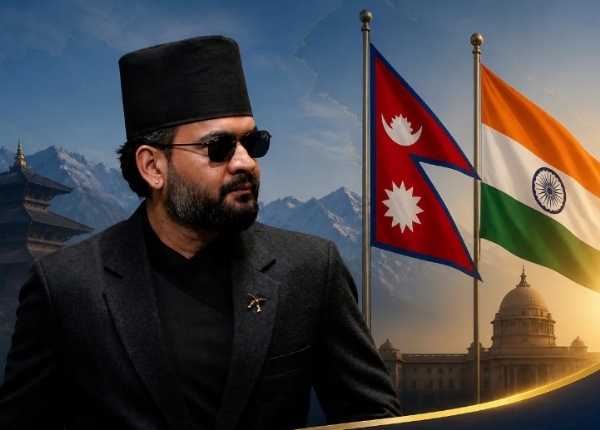
New Delhi, November 22 (HS): Nepal Prime Minister Balendra Shah will arrive in India today for a two-day state visit from November 22 to 23. Following the formation of a new government in Nepal in March this year, Prime Minister Narendra Modi had invited Shah to visit India. This will be Shah’s first bilateral foreign visit and the first in-person meeting between the two leaders following their telephone conversations and exchange of messages. According to sources, Shah’s programme may also include several other meetings and discussions.
During the visit, the two prime ministers are expected to virtually inaugurate several completed initiatives and lay the foundation stones for a number of new projects. They are also expected to reach an understanding on forward-looking bilateral documents covering various sectors and exchange them. Shah’s visit comes at a time when the national priorities of the two countries are broadly aligned, whether in terms of economic and social development, infrastructure expansion, adoption of technology, or addressing challenges such as natural disasters and climate change.
The discussions between the two leaders are expected to provide political direction and shape the framework for the bilateral partnership in the years ahead. Both sides are likely to review all aspects of their bilateral relations and explore new avenues of cooperation. The outcomes of the discussions could have a bearing on future collaboration in areas such as development partnership, energy, hydropower, railways, connectivity, climate change and disaster resilience, infrastructure and technology.
Key Aspects of the India-Nepal Partnership
- The two countries share unique and wide-ranging ties, characterised by mutual trust, open borders, shared traditions and deep people-to-people connections.
- Over the past decade or so, there have been 17 bilateral visits at the level of heads of state or government. Since 2014, Prime Minister Narendra Modi has visited Nepal five times.
- More than 40 bilateral institutional mechanisms are in place to advance cooperation across various sectors, and these mechanisms have continued to meet regularly.
- India is Nepal’s largest trade, transit and investment partner.
- Nepal enjoys duty-free access to the Indian market.
- India is Nepal’s largest export destination, accounting for nearly 80 per cent of Nepal’s total merchandise exports.
- India is also the largest source of foreign direct investment (FDI) in Nepal, accounting for approximately one-third of the country’s total FDI.
Major Pillars of Bilateral Relations
The two countries have developed a strong and comprehensive development partnership, which is one of the key pillars of their bilateral relationship. Several projects and initiatives are being undertaken under this partnership, including:
- More than 600 High Impact Community Development Projects across Nepal’s 74 districts, with a cumulative cost exceeding 16.62 billion Nepali rupees.
- Connectivity projects, including cross-border railway lines, pipelines for petroleum products and Integrated Check Posts.
- Major projects such as Nepal’s new National Police Academy.
- Projects relating to roads, hydropower and transmission lines supported through India’s Lines of Credit.
- Cooperation in post-earthquake reconstruction. Following the 2015 Gorkha earthquake, reconstruction has been completed, with India’s assistance, for 50,000 houses, 71 educational projects, 128 health facilities and 21 cultural heritage projects.
- Humanitarian assistance and disaster relief. Following the flash floods of August 26, 2026, India dispatched approximately 140 tonnes of emergency supplies and provided technical assistance for tunnel rescue operations and forensic activities.
- Supply of more than 4,400 vehicles to Nepal.
- Cooperation in the energy sector has been steadily expanding. This includes a long-term power trade agreement under which India will import up to 10,000 MW of electricity from Nepal over a period of 10 years. At present, India imports approximately 1,200 MW of electricity from Nepal annually.
- Nepal earned approximately 18 billion Nepali rupees from net electricity exports to India in the financial year 2025-26. Since November 2024, Nepal has also been exporting electricity to Bangladesh through the Indian grid.
- Both sides are currently working to enhance cross-border transmission capacity through new high-capacity transmission lines.
- Indian entities are also involved in the development of several hydropower projects, including the 900 MW Arun-3 Hydropower Project, which is currently under construction.
- A three-tier bilateral mechanism is in place to discuss cooperation in water resources, flood management, inundation control and hydropower development.
- With grant assistance from India, flood management and river-training works have been undertaken along the Kamala, Bagmati and Lalbakeya rivers.
- India and Nepal also share a strong energy partnership, with the long-term power supply agreement playing an important role in meeting Nepal’s energy requirements.
Balendra Shah’s Programme
According to a statement issued by the Ministry of External Affairs, Shah is scheduled to arrive in New Delhi at approximately 3.15 pm today. He will land at Terminal 3 of Indira Gandhi International Airport. At 6 pm, he will meet External Affairs Minister Dr S. Jaishankar at the Taj Mahal Hotel.
On Monday, Shah will receive a ceremonial welcome at Rashtrapati Bhavan at 10 am. Forty minutes later, he will visit Rajghat to pay floral tributes. At 11 am, he will hold a meeting with Prime Minister Narendra Modi at Hyderabad House. The exchange of Memoranda of Understanding (MoUs) is scheduled for 12.15 pm, followed by a joint press conference.
At 3.15 pm, Shah will meet President Droupadi Murmu at Rashtrapati Bhavan. He is scheduled to depart from New Delhi for Nepal at 4.50 pm.
Advisory for the Media
In its advisory, the Ministry has asked accredited media representatives to arrive one hour before the scheduled events. They must carry their Press Information Bureau (PIB) card or press identity card, along with an additional identity document, such as a passport, Aadhaar card or driving licence. Mobile phones will not be permitted inside the Rashtrapati Bhavan complex.
---------------
Hindusthan Samachar / Jun Sarkar
18 Aug 2026