New Delhi, 22 November (H.S.): India has streamlined the process of obtaining filming permissions from multiple government departments through the India Cine Hub (ICH), enabling filmmakers to secure approvals from municipal bodies, traffic authorities, Indian Railways, the Archaeological Survey of India and other agencies through a single digital platform. The portal currently integrates around 32 services.
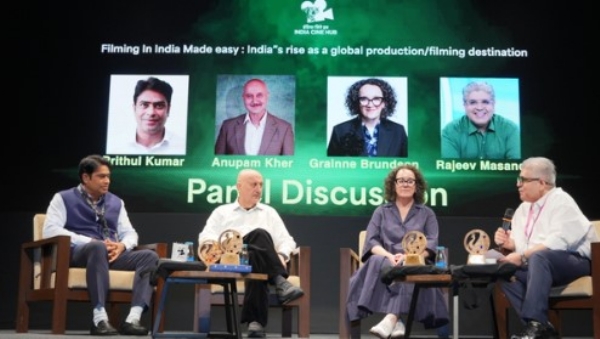
According to the Ministry of Information and Broadcasting, the initiative was highlighted during a panel discussion titled ‘Filming Made Easy: India’s Rise as a Global Filming and Production Hub’, held on Sunday at the 57th International Film Festival of India (IFFI) in Goa. The discussion featured Prithul Kumar, Joint Secretary in the Ministry of Information and Broadcasting; Grainne Brunsdon, Chief Operating Officer of Screen Australia; and actor, director and producer Anupam Kher. Film critic and journalist Rajeev Masand moderated the session.
Prithul Kumar said the integration of state governments into the India Cine Hub portal was a significant step towards simplifying the process of obtaining filming permissions. Applicants can seek approvals from multiple departments through a common application form. The portal also provides a dashboard to track application status and secure payment links wherever fees are applicable. Efforts are underway to integrate the Digital Sky platform for drone-related permissions as well.
He said the stipulated timeline for granting permissions for international film shoots was 28 days, although the average processing time since 2015 had been 18 days. Madhya Pradesh also has a mechanism under which applications are deemed approved if no decision is taken within 15 days.
Kumar said the number of companies exploring international film production and co-production opportunities in India had increased from around 25–30 annually to between 100 and 200. He urged film professionals and service providers to register on the portal so that filmmakers from across the world could access information about the resources, facilities and services available in India.
Screen Australia Chief Operating Officer Grainne Brunsdon described India’s diverse filming locations, talented film professionals and strong emotional connection with audiences as conducive to international collaborations. She said Indian cinema was gaining popularity in Australia, noting that last year, more Australians watched an Indian film than an Australian film. She added that the cultural, educational, sporting and business ties between the two countries were also creating new avenues for joint filmmaking.
Brunsdon said successful co-productions were not merely about financial collaboration and sharing risks but also offered opportunities for creative exchange. Filmmakers from India and Australia, she said, could learn from each other’s storytelling traditions and explore shared narratives, including stories connected to diaspora communities.
Actor Anupam Kher welcomed the India Cine Hub initiative, observing that the process of securing filming permissions in India had improved considerably. He said the country’s diverse landscapes, cuisines, costumes and cultural settings offered filmmakers a wide range of creative possibilities. Emphasising that cinema transcends geographical boundaries, he said filmmakers should be provided with the necessary facilities to shoot.
Kher said the single-window system would benefit not only established producers but also emerging filmmakers, writers and other professionals involved in production. He, however, cautioned filmmakers against intermediaries who might emerge in the name of facilitating permissions and advised them to remain vigilant.
---------------
Hindusthan Samachar / Jun Sarkar

18 Aug 2026