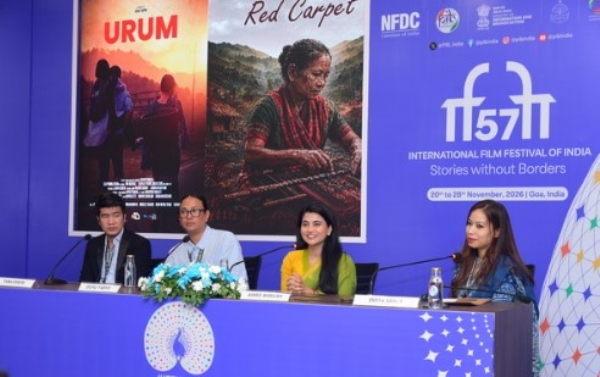
New Delhi, November 22 (HS): Two films showcasing the cultural heritage, indigenous identity and social realities of Northeast India have been featured at the 57th International Film Festival of India (IFFI), offering distinct perspectives on the region through an Assamese documentary on traditional Karbi handloom weaving and a film exploring the psychological journey of a grieving father in Arunachal Pradesh.
According to the Ministry of Information and Broadcasting, directors Aimee Baruah and Duyu Tabyo shared insights into their films and filmmaking experiences during a press conference held in Goa on Sunday. ‘Red Carpet’ has been featured in the Indian Panorama Non-Feature Film section, while ‘Urum’ has been selected for the Indian Panorama Feature Film section.
Aimee Baruah’s Assamese documentary ‘Red Carpet’ explores the centuries-old handloom weaving tradition of the Karbi community in Karbi Anglong, Assam. The film highlights efforts to preserve the traditional craft amid modernisation and changing lifestyles. Through the journey of a traditional weaver from Donkamokam village, it traces how handwoven fabric made its way to the prestigious red carpet of the Cannes Film Festival, becoming a symbol of cultural identity, pride and hope.
Baruah said the journey of traditional fabric woven in a small village in Assam to the prestigious Cannes red carpet had brought international recognition to the craftsmanship of local weavers and the cultural identity of the region. She urged the younger generation to take pride in their language, culture and traditions and carry forward their rich heritage.
Director Duyu Tabyo’s ‘Urum’ narrates the story of a father in a remote mountain community of Arunachal Pradesh grappling with the tragic loss of his young daughter. The film explores his grief, memories, guilt and psychological turmoil as he seeks to confront the truth surrounding his daughter’s death and find inner peace amid lingering questions.
Tabyo recalled witnessing an incident during his childhood in Ziro, Arunachal Pradesh, involving a father struggling with the grief of losing his daughter. The memory remained with him for years and eventually became the inspiration for the film. He said his intention was not to convey a moral message but to explore the psychological and emotional state of a father enduring profound grief.
Tabyo said making the film in the indigenous Nishi language was a deliberate effort to preserve his linguistic and cultural identity. He observed that the younger generation was increasingly becoming disconnected from its mother tongue and traditional identity. Cinema, he said, could serve as an important medium for documenting indigenous stories, languages and ways of life, helping younger generations reconnect with their roots.
---------------
Hindusthan Samachar / Jun Sarkar

18 Aug 2026