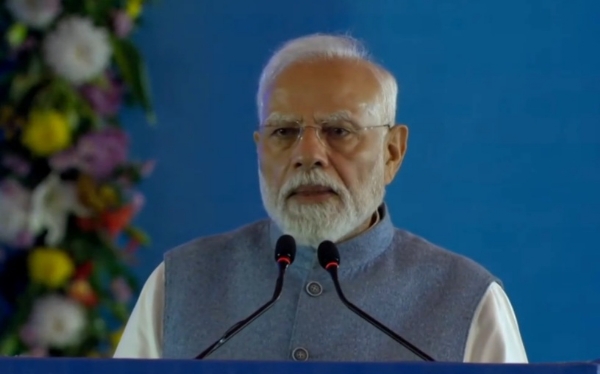
New Delhi, 21 November (H.S.): Prime Minister Narendra Modi on Saturday said India could progress in the 21st century only by recognising, respecting and strengthening skills, emphasising that the government's initiatives over the past years had been guided by the spirit of ‘Shrameva Jayate’. He said India was steadily advancing towards becoming the skill capital of the world and urged young people to dream big, hone their skills and dedicate themselves wholeheartedly to achieving their aspirations.
Addressing the 5th Kaushal Deekshant Samaroh in Lucknow, Uttar Pradesh, the Prime Minister expressed delight at the city being chosen to host the prestigious skill development event, saying the occasion was also a matter of pride for him as an MP from Uttar Pradesh.
Observing that the graduating youth had crossed an important milestone in their lives and were now poised to directly contribute to nation-building, the Prime Minister said the skills and craftsmanship acquired at Industrial Training Institutes (ITIs) were a major driving force behind the vision of Viksit Bharat. He said nations advanced through the capabilities and skills of their young people.
Highlighting India's rich tradition of craftsmanship,PM Modi referred to several renowned examples of the country's traditional skills, including Lucknow's Chikankari, fine muslin, Banaras and Kanjeevaram silk, Kashmir Pashmina, cotton textiles, Kalamkari, steel used in the world's finest swords, and bronze and Panchdhatu idols. He said hundreds of such crafts had historically served as the foundational pillars of society and India's identity across the world had long been associated with its skills and craftsmanship.
Explaining how India's earlier social system was organised around specialised skills, the Prime Minister cited Gujarat's Vasavaya tradition, under which skilled artisans and service providers who sustained village life would settle wherever a new village was established. He said these skilled people were indispensable to the functioning of village communities.
PM Modi noted that although such traditions had existed across different regions of India since ancient times, their significance gradually diminished. Recalling an exercise he had assigned to officials during his tenure as Chief Minister of Gujarat, he said they were asked to list every task and service required by an individual from waking up to going to sleep and from birth to death. The exercise identified nearly 1,000 essential skills that kept society functioning. He said the initiative led to the development of a modern skill-development ecosystem in Gujarat.
The Prime Minister attributed the decline of India's skill-based ecosystem to the colonial education system, which, he said, had transformed a society rooted in craftsmanship into one focused on producing clerical workers, while the British prioritised their own industries and manufacturing. He said clerical occupations continued to receive greater social recognition even after independence, while skilled workers and craftspeople faced an inferiority complex and increasingly distanced themselves from their traditional trades. This mindset, he asserted, had caused considerable damage to the country.
Emphasising the government's efforts to restore dignity to skilled professions,PM Modi said a series of initiatives had been undertaken in the spirit of ‘Shrameva Jayate’. He noted that the tradition of convocations, previously associated largely with college and university degree holders, had been extended to ITI graduates receiving skill certificates. He also highlighted the strong emphasis on skill development in the National Education Policy, reiterating that India's progress in the 21st century depended on giving skills the recognition and respect they deserved.
Addressing concerns over Artificial Intelligence (AI) and its potential impact on employment, the Prime Minister recalled the COVID-19 pandemic, when skilled workers played a critical role in keeping essential services and operations running amid widespread uncertainty. He said individuals possessing skills would continue to have employment opportunities, asserting that skills could not be taken away from them.
PM Modi said learning a skill was not merely about operating machines but about making people's lives easier, enhancing the nation's capabilities and strengthening its manufacturing potential. Highlighting the government's focus on ITIs since 2014, he said nearly 5,000 new ITIs had been established over the past decade. The number of students enrolled in ITIs had increased by more than five lakh, while the participation of girls had risen to more than two-and-a-half times, he added.
The Prime Minister said the government had prioritised training, quality, faculty development and infrastructure in ITIs, which had previously faced shortcomings, including outdated trades. More than 30 new-age trades had been introduced, including Aeronautical Structure, Artificial Intelligence Assistant, Cyber Security Assistant, Drone Technician, Green Hydrogen Technician, Industrial Robotics, Electric Vehicles, Animation and Special Effects, and Semiconductor Technician.
He said these emerging trades were designed to meet the requirements of both domestic and global industries, particularly as India continued to expand its trade agreements and Free Trade Agreements (FTAs). The new opportunities, he said, were aimed at preparing young people for the evolving demands of the future workforce.
Highlighting efforts to modernise ITI curricula, upgrade machinery, train instructors in emerging technologies and establish direct links between training institutions and industry, Modi said Rs. 60,000 crore was being invested under the PM-SETU scheme. He expressed confidence that the initiative would significantly benefit India's youth.
The Prime Minister said India's rapid development was generating extensive employment opportunities for skilled workers. Referring to the government's efforts over the past 12–13 years, he said nearly 50 crore people had been lifted out of poverty through various initiatives that had strengthened their confidence and improved their living conditions.
He cited large-scale programmes such as the construction of four crore houses for the poor, the expansion of water pipelines and the provision of electricity connections to areas and households that had previously lacked access. These initiatives, he said, had created substantial employment opportunities for electricians, carpenters and other skilled workers, with lakhs of new jobs generated through such development programmes.
Highlighting the growing demand for skilled manpower in emerging sectors, PM Modi referred to disruptions in gas supplies during the West Asia conflict a few months ago. He said the government had set a target of providing at least one lakh piped natural gas (PNG) connections every day, but review meetings had repeatedly highlighted a shortage of plumbers, which was slowing progress towards the target.
He also pointed to the expanding opportunities in solar energy and the rapidly growing sports economy, including sports equipment manufacturing and fitness-related industries. The Prime Minister said skilled workers would have greater employment prospects as demand continued to rise across these sectors.
Announcing that India was moving towards becoming the skill capital of the world,PM Modi shared what he described as encouraging news for the youth and Uttar Pradesh. India will host the WorldSkills Asia competition in 2027 in Greater Noida, welcoming young participants from several countries. He extended his advance best wishes to Uttar Pradesh for hosting the event.
The Prime Minister also praised Uttar Pradesh's contribution to the country's development, crediting the state government led by Chief Minister Yogi Adityanath for transforming the state into an expressway hub and expanding its development landscape. He referred to the state's multiple international airports, major universities, flourishing tourism sector, large mobile manufacturing facilities, the upcoming chip factory and the manufacturing of BrahMos missiles, which he said had demonstrated their impact during Operation Sindoor.
PM Modi said these development initiatives were creating fresh opportunities for young people across Uttar Pradesh.
Recalling a recent interaction during the inauguration of a factory in his parliamentary constituency of Banaras, the Prime Minister said a young woman had told him that she could now return home comfortably even at 11 pm. He credited the state government under Yogi Adityanath for creating an environment of security, saying safety, confidence and the prospects of prosperity would collectively contribute to building a Viksit Bharat.
Concluding his address, PM Modi extended his best wishes to the young graduates and urged them to make the most of the opportunities available to them. He said the entire sky was open before the youth and encouraged them to dream big, strengthen their skills and devote all their efforts to fulfilling their aspirations.
---------------
Hindusthan Samachar / Jun Sarkar
18 Aug 2026