




China is weaponising dependence
-Dr Mayank Chaturvedi
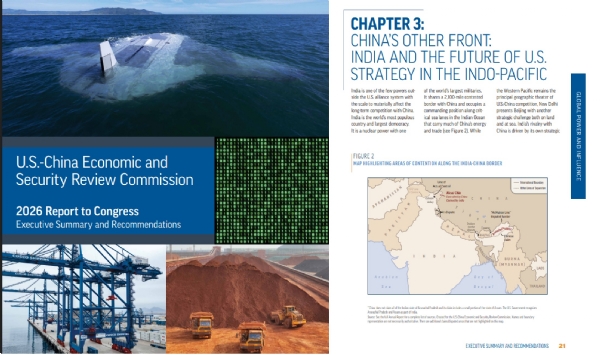
New Delhi, 21 November (H.S.): China counts India's rise on the global stage among its biggest strategic challenges. The stratagems it employs to contain that rise have been laid bare in the 2026 annual report of the U.S.-China Economic and Security Review Commission (USCC), a body constituted by the American Congress. The report states in considerable depth that China is at present working simultaneously on three fronts, the border, the sea and the market, to weaken and suppress India.
The report describes the deepening challenge of two fronts for India through Pakistan, growing Chinese inroads in the Indian Ocean, and India's deep dependence on Chinese components and machinery as instruments of pressure in Beijing's hands. It also urges the United States to sharpen its partnership with India on matters ranging from the supply of medicines to the succession of the Dalai Lama.
What is the report, and why does it matter to India, the US and other countries?
First, it should be noted that the USCC is an advisory body of the US Congress, created in 2000. Its task is to monitor the national security implications of US-China economic relations and to make recommendations to Congress every year. This time all 10 members of the Commission approved the report unanimously. It carries 30 recommendations for Congress, of which 10 have been identified as the most important.
This year the Commission held a separate hearing on India, and its delegation also visited the country. The third chapter of the report, titled China's Second Front: India and the Future of US Strategy in the Indo-Pacific, is wholly India-centric. According to it, India is among the select few countries that, by virtue of population, economy, military strength and geographical position, are capable of influencing the long-term balance of power with China.
India has the world's largest population, is the largest democracy and a nuclear power, shares a disputed border of about 2,100 miles with China, and has a decisive presence over the Indian Ocean sea routes through which a large part of China's energy and trade passes. The report argues that Beijing understands this well, and is therefore working to check India's rise on several fronts.
Two-front pressure through Pakistan
The report's most sensitive conclusion concerns security. It says that China's evolving military partnership with Pakistan has made the prospect of confrontation on two fronts a constant and serious concern for India. According to the Commission, Operation Sindoor, launched by India in response to the terror attack at Pahalgam in Jammu and Kashmir in May 2025, was an example. It showed that China strengthens Pakistan during a crisis without itself entering the fight. In other words, Beijing's strategy is not one of direct confrontation but of tilting the balance from behind the scenes. According to the report, China has followed the same method in the cases of Russia and Iran: it kept supporting their military and economic capacity but did not join the war directly.
Improving ties on the border, but a trust deficit
The report regards the unresolved boundary dispute as the central fault line in India-China relations. It calls the Galwan Valley clash of 2020 a decisive turning point, after which it became difficult for India to keep the boundary dispute separate from the rest of the relationship. New Delhi and Beijing have gradually brought relations back on track since the end of 2024, but strategic mistrust remains deep, and India regards peace on the border as a precondition for wider normalisation.
It may be noted that the USCC had pointed in the same direction in its China Bulletin of 10 November. Its headlines mentioned that, despite improving relations, Chinese troops occupy some positions on the Indian side of the disputed border. The Government of India's official response to this claim had been very sharp.
Growing Chinese footprint in the Indian Ocean
The report's second major alarm concerns the sea. According to the Commission, China's growing naval and surveillance presence has begun to erode India's decades-old strategic advantage in the Indian Ocean. Beijing is building infrastructure and a logistics network capable of sustaining long naval campaigns. Chinese naval, surveillance and research vessels are operating closer to India and to vital sea lanes.
The Commission claims that China has begun to replay its South China Sea script in the Indian Ocean as well. This includes invoking historical rights and renaming undersea features. According to the report, this could lay the ground for more aggressive activity and jurisdictional claims in future. The Indian Navy will be directly affected, since it will have to keep watch over a larger area and spread its resources more thinly.
Dependence is the weakest link
The most concrete and data-rich part of the USCC report concerns the economy. The Commission says China's sharpest move is economic. Beijing is using its hold over industrial components, technology and expertise without which India's manufacturing system cannot easily function. According to examples recorded in the report, China restricted exports of some key materials and products to India. It recalled its engineers and held back equipment in order to slow electronics manufacturing in India. Prices of pharmaceutical inputs were cut to undermine new Indian drug plants. Export controls were also imposed on battery technology to obstruct India's clean energy industry.
India's dependence on China is greatest in electronics and clean-energy goods. Some 97 per cent of India's silicon wafer imports and 93 per cent of its lithium-ion battery imports come from China. Its share is 74 per cent in solar cells and 62 per cent in electric inverters. In memory chips, too, China accounts for 46 per cent of India's imports. Alternatives in these categories are very limited. The next largest suppliers are Thailand for wafers, Japan for batteries and inverters, Indonesia for solar cells and South Korea for memory chips.
In pharmaceuticals the situation is more worrying. China supplies 87 per cent of antibiotic inputs and 74 per cent of active pharmaceutical ingredients (APIs), while it controls more than half of India's imports of key starting materials (KSMs) for drug manufacture. European manufacturers are the next largest option for antibiotics and APIs, but for KSMs, according to the report, an alternative supplier cannot even be clearly identified.
In industrial machinery, China accounts for 45 per cent of India's imports, with the United States the largest alternative. The picture shows that the faster India's industrial expansion, the deeper its dependence on Chinese machines and components may become. (USCC Report, 2026)
These figures show that the problem is not confined to imports; it is also one of the absence of alternatives. In many categories, according to the report, the next largest supplier is far behind. Thailand for silicon wafers, Japan for batteries and European manufacturers for pharmaceutical inputs are listed as options, while for the starting materials for drugs the alternative source itself is described as unknown.
China's new condition: goods must not reach America
The most worrying point for the US is that India's dependence may now extend to its supply chains. According to the report, in 2025 Beijing asked some Indian companies to certify that certain inputs from China would not be re-exported to the United States. Under the arrangement to reduce US-China trade tensions, China has for now suspended this condition, but the Commission considers it a tool that China can use again whenever it wishes. In its words, India's dependence could become a weapon against the American supply chain.
The USCC believes this matters because American companies are moving production to countries like India to reduce their dependence on China. The report warns that if India's own industry remains dependent on Chinese machinery and components, the roots of the China Plus One strategy will remain weak.
India's dilemma: caution, and compulsion
The USCC report also records India's efforts. New Delhi has modernised its military, expanded domestic manufacturing capacity, restricted Chinese participation in sensitive sectors and deepened cooperation with the US and other partners. At the same time, the Commission assesses that India's industrial dependence has deepened rather than eased.
India has recently relaxed some restrictions on Chinese investment and equipment, because the cost of maintaining them was rising. The faster India's industrial expansion, the greater the demand for Chinese machines, components and technical know-how. The report acknowledges that this is a difficult balancing act for India, with security concerns on one side and the needs of economic growth on the other. Building India's own supplier networks will require heavy capital, technology and time.
Demand on America: change the rules of partnership
The Commission believes US-India relations have deepened considerably over the past two and a half decades. The two countries have a ten-year defence framework, negotiations on a bilateral trade agreement are under way, there are technology initiatives from semiconductors to biomanufacturing, and the Quad is active afresh. But according to the report, a gap is growing between these ambitions and implementation on the ground, because export controls, procurement rules, financing arrangements and fragmented bureaucratic processes were designed for a different era and are now becoming obstacles. To bridge this gap, the Commission has made concrete suggestions to Congress. Two of them are the most important.
First, drug supply. The Commission has proposed a Comprehensive Critical Drug Diversification (C2D2) programme, resting on US-India cooperation. Under it, an early-warning mechanism for the supply of essential medicines would be created, so that dependence on a single country or a single factory can be identified. The US government would provide multi-year procurement guarantees, so that manufacturers are assured that purchases from them will continue even when Chinese goods are cheaper.
There would also be an initiative to promote public and private investment in India in the manufacture of active pharmaceutical ingredients and starting chemicals. The condition would be that producers seeking funds must demonstrate that their dependence on Chinese starting materials is minimal and steadily declining. As far as practicable, matching funds should also be sought from India, and coordination built with Indian producers to withstand the blow of Chinese pricing.
Second, the succession of the Dalai Lama. The Commission assesses that, as the 14th Dalai Lama advances in age, China is preparing to turn the succession into an international struggle over legitimacy and will use instruments of pressure to turn the outcome in its favour. India is at the centre of this dispute because it hosts the Dalai Lama and the Tibetan government-in-exile and shares a disputed border with China. The report asks Congress to declare as US policy that the Gaden Phodrang Trust holds the sole legitimate authority to identify the successor, and that any successor chosen or imposed by the Chinese government will not be recognised by the United States.
The Secretary of State has been asked to take several steps. These include an inter-agency exercise on possible succession scenarios, a senior-level dialogue with the Government of India involving intelligence sharing on Chinese influence operations, and informal dialogue with Indian counterparts on the political and security implications. It also recommends working with allies to deny international legitimacy to a China-designated successor and strengthening the cyber security of the Central Tibetan Administration.
The larger context of the report: the 2027 calendar
It is noteworthy that the report comes at a time when the leaders of the US and China have held two summits this year, in May and September, and both sides are speaking of constructive strategic stability. The Commission views this phrase with suspicion. Its argument is that, for Beijing, stability means not restraint but maintaining an advantage while managing risk.
According to the USCC, the coming year is full of events. In 2027 the Chinese army (PLA) marks its centenary, to which Xi Jinping has tied the goal of readiness for a Taiwan crisis. In the same year the 21st Congress of the Communist Party will be held, at which a fourth term for Xi is expected, and the 30th anniversary of Hong Kong's handover also falls.
In addition, the US-China trade arrangements of 2025 that curbed tensions are due to expire soon. The Commission says no one of these dates makes confrontation inevitable, but every date raises the importance of today's decisions. In this entire scenario India's role becomes crucial. The report says India will not sit in anyone else's camp, and for precisely this reason it matters so much in this competition. The Commission also cautions that closeness to the US will not mean identical positions on every issue, because India places its own interests and strategic autonomy above all.
The other side: what to keep in mind
Certain points should be borne in mind while reading this report. It is the perspective of a commission of the US Congress, whose very job is to highlight China-related risks. The report's recommendations are not binding and will take effect only if the US Congress legislates on them. The report places American interests at the centre in voicing its expectations of India.
The message for India
Although all the conclusions of the report are written from the American viewpoint, their implications for India are direct. First, the appearance of normal relations on the border does not mean strategic risks have diminished. Second, growing Chinese interference through Pakistan and the Indian Ocean route could place an additional burden on India's military planning and resources. Third, reducing dependence on China in items such as medicines, batteries, chips and solar equipment is now not only an economic matter but also a question of India's national security. Fourth, the benefit of the growing partnership with the US will accrue only when obstacles such as export controls, procurement rules and financial structures are removed.
The Commission's conclusion about Beijing, in a single line, is that even while speaking the language of reconciliation it continues its efforts to gain an edge. The challenge before India is to reduce this dependence while preserving its strategic autonomy. This task, as the report itself acknowledges, demands capital, technology and, above all, time.
The report at a glance
Report: USCC 2026 Annual Report, submitted to Congress on 18 November 2026
Unanimity: approved by all 10 Commissioners
Recommendations: 30 in all, of which 10 are the most important
India focus: Chapter 3, China's Second Front
Information cut-off date for the report: 8 October 2026
---------------
Hindusthan Samachar / Mayank Chaturvedi