




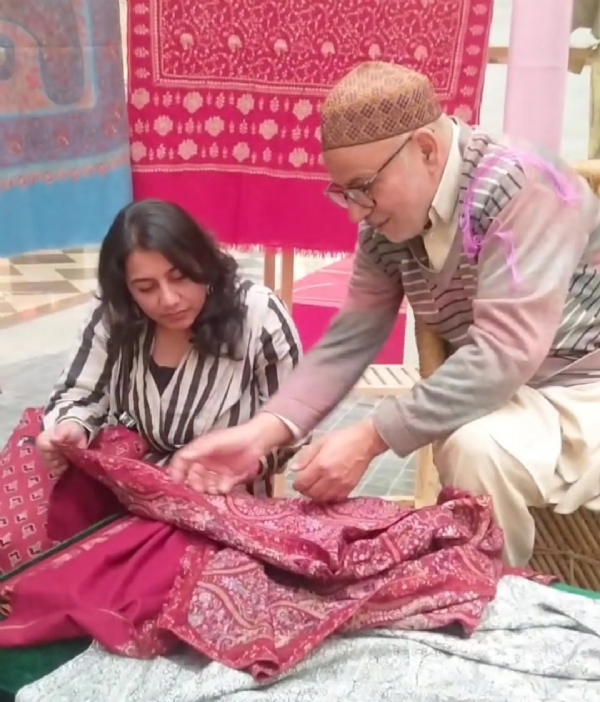
Srinagar, Nov 21 (HS): At the 45th India International Trade Fair, running since November 13 at Bharat Mandapam in Delhi’s Pragati Maidan, veteran artisans from the Kashmir Valley have filled the Jammu and Kashmir Pavilion, on the first floor of Hall No. 1, with their finest work.
Visitors, especially those with a love for Kashmiri crafts, rarely walk past without stopping to look at, and touch, pieces that took months or even years to make, whether or not they end up buying anything.
Amid the rows of handicrafts and the bustle of the crowd, one master artisan has become a major draw for local and foreign buyers alike. He sells shawls of various designs and price ranges from his stall, and also works on a jama shawl at a space set aside for live demonstrations, explaining each stage of the process to onlookers, who are often left amazed by what they hear.
A crowd, mostly young people, gathers around him. They watch him at work, pose for photographs and post reels on social media, which is carrying his name well beyond the fairgrounds.
The artisan is Bashir Ahmad Bhat, a national awardee from Sonpah village in central Kashmir’s Budgam district. The Government of India has designated Sonpah a Craft Village for the promotion and preservation of traditional Kashmiri crafts.
His standing is reflected in the fact that he met Prime Minister Narendra Modi in Delhi on National Handloom Day and spoke with him at length about the art of shawl-making.
Sonpah, in Beerwah tehsil, is a village of about 400 households, where more than 20 people have won state and national awards for their fine sozni needlework. According to Bhat, the craft was introduced there some 200 years ago by a religious preacher, Ghulam Hassan Shera, and his father, Ghulam Ahmad Bhat, was among the first to learn it from him.
Bhat has been associated with the craft for nearly four decades. In 2016, he also took part in the BRICS Handicraft Exchange Programme in Jaipur.
In a detailed conversation with Hindusthan Samachar, Bhat spoke about the fair, his craft and its past and future.
He said reversible shawls, which can be worn on both sides, are on display this year, priced between Rs 1.5 lakh and Rs 9 lakh. Among them is a special piece known as the aksi shawl.
“The work on an aksi shawl is much finer. It can take up to three years to make and costs Rs 9 lakh, while a nim jama shawl is priced at Rs 1.5 lakh. Ordinary shawls cost between Rs 10,000 and Rs 20,000,” he said.
Bhat is optimistic about the craft’s future. “When I started, I had no income and nothing to my name. Today, thanks to this craft, I have almost everything. Even prominent people from across the country are proud to sit with me and be photographed with me,” he said.
He said times have changed. “There was a time when an artisan had to go to a trader asking for work. Today, traders plead with artisans to make shawls for them,” he said.
At the same time, he stressed that exporters can do the most to keep the industry alive. “If they pay a good price, the industry will grow and artisans will have more secure livelihoods,” he added.
For Bhat, the craft is a sacred legacy. “This is a trust handed down to us by Hazrat Shah-e-Hamdan (RA). We must respect it, protect it and pass it on to future generations in an organised way,” he said.
The craft also sustains his entire family. “I earn a respectable living from this work. My daughters, my son and other relatives also make their livelihood from it, and some of them have received awards for their masterpieces,” he said.
He urged educated youth not to waste time waiting for government jobs, and to learn the craft and build their own livelihoods instead.
Bhat also has a complaint. He said bookings for artisans like him are made late, so they do not get suitable spaces at the trade fair, which hurts business.
“Our bookings are made late, so we don’t get the special halls, because they are already taken. We are given space on the first floor of Hall No. 1, which is isolated and far from the entrance gate, so customers find it hard to reach us,” he said.
Even so, buyers find their way to him and show keen interest in the secrets of the craft. Bhat has been coming to the fair without a break for nearly 25 years, and many of his regular customers wait for the fair dates each year so they can meet him.
“Some customers show me photographs and videos they took in 2000,” he said.
“They ask me how a shawl is made, and I explain the painstaking work involved right there on the spot, and they are astonished,” he added.
Bhat said his sales are not limited to fairs, as he also receives online orders from many countries.
“I get orders from the US, Europe and Canada, and recently from Saudi Arabia too. Last year, a buyer from Pune booked a shawl, which I sold to him for Rs 7.5 lakh. A call came from Saudi Arabia asking for a full video of the shawl I was making,” he said.
He said the Central government is introducing various schemes to keep the craft alive.
“Under schemes of the Centre and the state, training centres are set up where we are engaged as instructors and teach young people the craft,” he said.
“About 12 experienced artisans work with me under my guidance, and all of them are award winners,” he added.
It was through this craft that Bhat, a national awardee, got to meet Prime Minister Modi.
“August 7 was National Handloom Day. I was invited to Delhi, where I met Modi ji and spoke to him at length about this craft. He listened with great attention,” he said.
---------------
Hindusthan Samachar / Zahoor Hussain Bhat