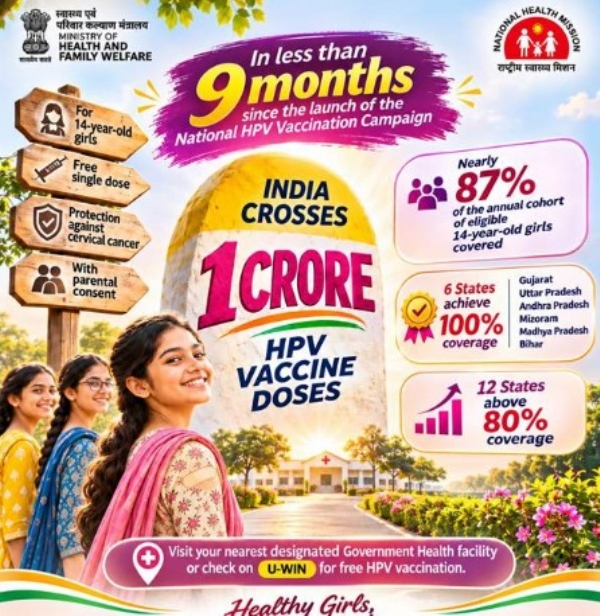
New Delhi, 21 November (H.S.): India has administered more than one crore doses of the Human Papillomavirus (HPV) vaccine in less than nine months under its nationwide vaccination campaign aimed at preventing cervical cancer. The programme, which offers free and voluntary single-dose vaccination to 14-year-old girls, has achieved nearly 87 per cent of its annual target.
According to the Union Ministry of Health and Family Welfare, Prime Minister Narendra Modi launched the nationwide campaign in February 2026. Under the initiative, eligible 14-year-old girls are being vaccinated at designated government health facilities, subject to parental consent. The annual target is approximately 1.2 crore girls, based on the 2021 population estimates of the Registrar General of India.
Six states — Gujarat, Uttar Pradesh, Andhra Pradesh, Mizoram, Madhya Pradesh and Bihar — have achieved 100 per cent coverage of their identified target populations.
Among the other states, Assam has recorded 95.63 per cent coverage, followed by Telangana at 95.28 per cent, Karnataka at 93.16 per cent and Uttarakhand at 90.17 per cent. Chhattisgarh has achieved 86.21 per cent coverage, while Rajasthan has recorded 85.23 per cent. Kerala stands at 77.02 per cent, Tamil Nadu at 76.12 per cent, Odisha at 74.90 per cent, and the Union Territory of Dadra and Nagar Haveli and Daman and Diu at 72.99 per cent.
In terms of the total number of beneficiaries vaccinated, Uttar Pradesh leads the country, with more than 29.33 lakh girls having received the vaccine. Bihar follows with over 13.70 lakh, while Gujarat has vaccinated more than 7.75 lakh girls.
The Ministry said the progress of the campaign had been supported by coordination between the Central and state governments, district administrations, healthcare institutions and frontline health workers. States have adopted locally tailored approaches to expand vaccination coverage in rural, urban and remote areas. State-level initiatives undertaken in Bihar, Tamil Nadu and Sikkim have also been integrated with the national campaign.
The U-WIN digital platform has emerged as an important component of the programme, facilitating real-time monitoring of vaccination progress, beneficiary records and the issuance of digital certificates. Parents can also use the platform to book vaccination appointments for their daughters. The system helps authorities identify districts with coverage gaps and track eligible girls who are yet to receive the vaccine.
According to the Ministry, persistent infection with certain high-risk types of Human Papillomavirus is responsible for the vast majority of cervical cancer cases. HPV vaccination is among the most effective preventive measures for reducing the risk of these infections and associated cancers. More than 800 million doses of HPV vaccines have been administered worldwide.
Vaccination sessions are being conducted at designated government health facilities under the supervision of trained medical officers. To ensure beneficiary safety, vaccination centres have been linked to healthcare facilities providing round-the-clock services to manage any rare adverse events following immunisation.
The Ministry said it would continue working with state governments and local health authorities to reach all eligible girls and strengthen access to preventive healthcare across the country.
---------------
Hindusthan Samachar / Jun Sarkar
18 Aug 2026