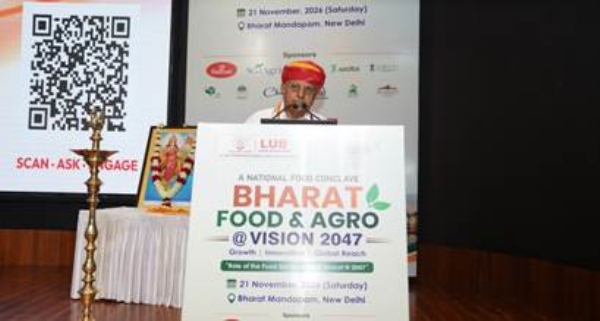
New Delhi, November 21 (HS): Union Minister of State for Agriculture and Farmers Welfare Bhagirath Chaudhary on Saturday said the vision of ‘Viksit Bharat 2047’ could not be realised unless farmers, who feed the country’s 1.4 billion people, were economically empowered. Agriculture is the backbone of the economy, while farmers are its soul, he said.
Bhagirath Chaudhary was addressing the ‘Bharat Food and Agro 2047’ conference organised by Laghu Udyog Bharati at Bharat Mandapam. He said agriculture would define the future and emerge as the country’s largest industry. Calling upon entrepreneurs to work as partners in the progress of farmers, he said agriculture and small-scale industries were two sides of the same coin and together constituted the country’s largest employment-generating sectors.
The minister said farmers were central to India’s economic progress and strengthening the agricultural sector, making it self-reliant and climate-resilient was essential to achieving the Viksit Bharat 2047 goal. Agricultural development, he said, should not be confined to increasing production but must also prioritise the quality of produce, food security, sustainable farming practices and enhancement of farmers’ incomes.
He emphasised the need to ensure the purity and quality of food products, invoking the popular saying, “Jaisa ann, vaisa man” (as the food, so the mind). He said a healthy society was essential for building a developed nation. Bhagirath Chaudhary also underscored the need to establish testing laboratories in India capable of meeting international standards to facilitate exports, ensuring that Indian agricultural and food products were not rejected in foreign markets and traders did not incur losses.
Expressing concern over the indiscriminate use of chemical fertilisers and pesticides, the minister said such practices were seriously affecting both soil fertility and human health. Citing the example of the ‘Cancer Train’ running from Punjab to Bikaner, he urged farmers to initially adopt cow-based natural farming, including practices such as Jeevamrit, on at least 10 per cent of their land. He said the Centre had launched the ‘Viksit Krishi Sankalp Abhiyan’ in 2025 and was currently implementing the ‘Khet Bachao Abhiyan’ to connect farmers with scientists.
Highlighting the nutritional benefits of millets, or Shri Anna, Chaudhary said small industries had immense potential to develop and export ready-to-eat and ready-to-cook products made from millets. He urged entrepreneurs to promote local products globally under the ‘Vocal for Local’ initiative, transforming local products into global brands.
The minister said reducing the distance between farms and factories would help prevent crop wastage and generate employment opportunities at the grassroots level. Listing key initiatives of the Central Government, he said the Rs. 1 lakh crore Agriculture Infrastructure Fund was facilitating the development of cold storage facilities, warehouses and processing units across villages and towns. He also highlighted initiatives such as the establishment of 10,000 Farmer Producer Organisations (FPOs), the PM Kisan Sampada Yojana, the PMFME scheme and the ‘One District One Product’ (ODOP) initiative to promote the food processing industry.
Bhagirath Chaudhary urged entrepreneurs associated with Laghu Udyog Bharati to strengthen the ‘farm-to-fork’ supply chain by embracing artificial intelligence (AI), modern technologies and smart packaging, and by establishing direct partnerships with FPOs to promote contract farming. He expressed confidence that the conference would lay out a new roadmap for India’s agricultural and food processing industries.
Addressing the conference, Laghu Udyog Bharati's All-India President Madhusudan Dadu said the organisation was working towards expanding and strengthening small industries through its guiding principle of upgrading, upliftment and acquiring new and advanced skills. He said the organisation had emerged as a strong voice of the MSME sector, representing nearly 70,000 units across 28 states.
He said the organisation was working towards enabling micro enterprises to grow into small businesses, small enterprises into medium-sized businesses, and medium-sized businesses into large corporate entities through the principles of upgradation, upliftment and upskilling.
Dadu said members of the organisation were actively participating in the governing boards of various government departments and banks to contribute to policymaking and its effective implementation. He added that 11–12 members had been inducted into boards of directors over the past two months alone.
Emphasising the need to bridge the gap between academia and industry, he said the organisation had signed Memoranda of Understanding (MoUs) with the Council of Scientific and Industrial Research (CSIR), the Central Food Technological Research Institute (CFTRI) and various universities to address technological challenges faced by small industries.
He added that skill development programmes were also being conducted in collaboration with Industrial Training Institutes (ITIs) and the National Skill Development Corporation (NSDC). The organisation had established 28 product clusters to address sector-specific challenges, he said, adding that following its initiative in the pharmaceutical sector, the food and agriculture conference was providing entrepreneurs with a platform to explore collaboration rather than competition and gain a comprehensive understanding of the entire value chain.
Former national president of Laghu Udyog Bharati and product cluster coordinator Ghanshyam Ojha described the conference as a new beginning for the organisation's food and agriculture sector initiative. He called upon stakeholders to increase the MSME sector's contribution to GDP by 2047, reduce dependence on imports for machinery and raw materials, and explore export opportunities in new markets.
Ojha said six more conclaves covering sectors such as foundry, mining, plastics, packaging and electronics, among others, would be organised next year, while a major national-level event was proposed for 2028.
Laghu Udyog Bharati's All-India Joint General Secretary and National Co-coordinator of the Food and Agriculture Product Cluster, Ashish Devda, emphasised value addition to farmers' produce, organic farming and innovation as key strengths of small enterprises. He said the adoption of AI, modern trade practices and scientific storage systems was essential to minimise post-harvest losses.
Calling for making enterprises ‘export-ready’, Devda described international standards and certification as the passport to global markets. He urged entrepreneurs to pursue the vision of taking products ‘from farms to factories and from factories to the world’.
The conference aims to advance the vision of Viksit Bharat 2047 and give India's food and agriculture sector a stronger global identity.
---------------
Hindusthan Samachar / Jun Sarkar
18 Aug 2026