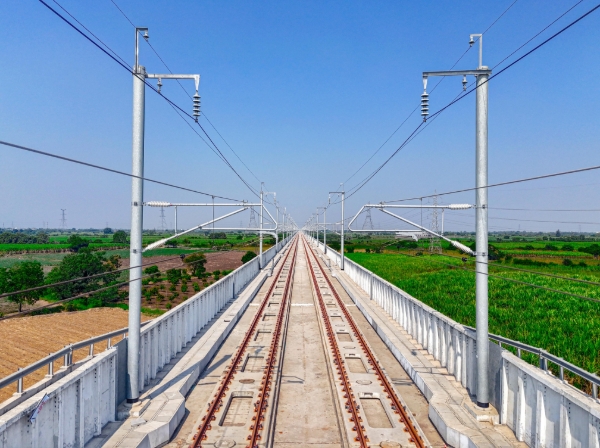
The energisation covers both the up and down lines along the elevated section and will be undertaken progressively in smaller stretches under the supervision of technical teams. The process is being carried out in accordance with prescribed safety procedures and is expected to facilitate further testing activities on the corridor.
The Mumbai-Ahmedabad project uses a 2 × 25 kV overhead traction system, an advanced electrification technology deployed in high-speed rail networks. The 508-km corridor will have 14 traction substations (TSS), which will draw electricity from the national grid and supply power to the overhead equipment serving the trains.
At Bilimora in Gujarat's Navsari district, installation work has been completed in the control panel, changeover switch, transformer and circuit breaker buildings of the first traction substation. The traction substations in Gujarat will receive power from the 220 kV Ambetha Grid Substation of the Gujarat Energy Transmission Corporation Limited (GETCO).
The corridor's electrical network will be monitored through a centralised control centre to support safe and reliable operations.
The Surat-Bilimora section covers approximately 50 km of elevated alignment. It includes bridges across four rivers and a steel bridge over National Highway 53. Around 94,000 noise barriers have also been installed along the viaduct to reduce the impact of train noise on surrounding areas.
Safety advisory issued
Following the energisation of the overhead electrical system, residents, commuters, construction workers and members of the public have been advised to stay away from the electrical installations. They have also been cautioned against touching the equipment or carrying out any unauthorised work in the vicinity of the alignment.
---------------
Hindusthan Samachar / Indrani Sarkar

18 Aug 2026
ED raids KPSC office, 20 other locations over Karnatak veterinary recruitment scam
ED raids KPSC office, 20 other locations over Karnatak veterinary recruitment scam..