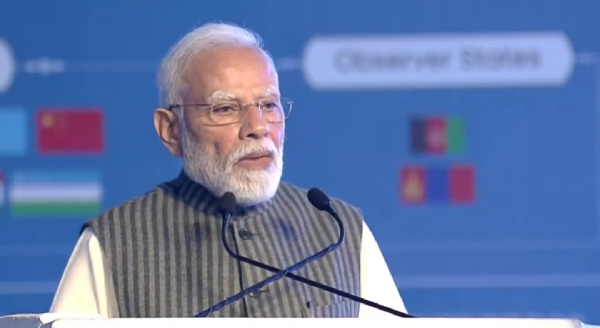
New Delhi, 20 November (H.S.): Emphasising the role of shared heritage and cultural exchanges in building bridges between nations, Prime Minister Narendra Modi on Friday inaugurated the first Shanghai Cooperation Organisation (SCO) Civilisational Dialogue Forum at the historic Purana Qila in New Delhi. Addressing the gathering, he underlined that civilisational connectivity could serve as a powerful foundation for global peace, particularly at a time when the international community is grappling with conflicts and geopolitical uncertainties.
PM Modi said that dialogue rooted in shared cultural experiences had become increasingly important in a world marked by tensions and unrest. He emphasised that cultural connections could foster mutual understanding, strengthen trust and create lasting bonds between societies, describing them as among the strongest guarantees of peace.
Highlighting the historical links connecting the Eurasian region, the Prime Minister referred to the trade and cultural exchanges between the Indus Valley Civilisation and Mesopotamia nearly 5,000 years ago. He noted that merchants, scholars, travellers and Buddhist monks had historically carried ideas, knowledge, languages and traditions across geographical boundaries, contributing to the evolution of interconnected civilisations.
He also highlighted the potential of the SCO to expand its role beyond its established areas of cooperation in security, economic engagement and regional connectivity. Civilisational dialogue, he indicated, could provide the organisation with another avenue to promote international understanding and closer people-to-people relations.
The Prime Minister also drew attention to the opportunities offered by modern technology in strengthening cultural connections. Digital platforms and technological advancements, he said, could help preserve and share knowledge, while museums, libraries, archives and historical institutions remained vital repositories of humanity's collective heritage.
Calling for the forum to develop into a meaningful and enduring institution, PM Modi urged participants to make the inaugural gathering the beginning of a sustained tradition of civilisational engagement. He expressed the hope that the platform would evolve beyond a ceremonial event and contribute to shaping broader global thinking through dialogue, shared knowledge and mutual respect.
The three-day forum, being held from November 20 to 22, brings together scholars, academics, subject experts, cultural representatives and other participants to explore the shared and interconnected civilisational heritage of SCO countries. The initiative builds upon a proposal made by Modi at the SCO Summit in Tianjin, China, in 2025, to establish a dedicated platform for civilisational dialogue under the organisation's framework. The proposal was subsequently welcomed in the Bishkek Declaration.
The choice of Purana Qila as the venue lends historical significance to the gathering. The monument, situated in the heart of the national capital, provides a setting for showcasing the layers of Delhi's history and its connections with the wider civilisational landscape of the region.
The inaugural programme featured a cultural presentation titled “Civilisations in Conversation”, combining music, dance, visual storytelling and narration. Based on the theme “Vasudhaiva Kutumbakam – The World Is One Family”, the presentation highlighted cultural connections between India and the wider Eurasian region.
India's archaeological, artistic and literary heritage is also being showcased through exhibitions organised under the title “ASTITVA – The Essence of Our Existence”. One of the principal displays offers an account of Delhi's historical evolution through archaeological evidence dating from 1200 BCE to 1200 CE. Excavated remains, artefacts, architectural fragments and other discoveries provide insights into the region's cultural and civilisational development.
The exhibition also features the “Mahabharat Scroll Pavilion – Anant: A Rare 18th Century Mahabharata Scroll”, presenting an illustrated manuscript that reflects India's rich epic and artistic traditions.
The academic deliberations scheduled for November 21 and 22 will focus on four broad themes. These include shared cultural expressions such as music, performing arts, textiles, cuisine and traditional games; common influences in art and architecture; linguistic and literary connections, including scripts and manuscripts; and monastic trails and philosophical traditions.
Through these discussions, the forum seeks to strengthen cultural cooperation and encourage sustained intellectual engagement among countries associated with the SCO. It is also expected to provide opportunities for scholars and cultural institutions to explore common historical influences and identify areas for future collaboration.
The inaugural edition marks an effort to broaden the SCO's engagement by placing civilisational heritage and cultural understanding alongside its existing areas of regional cooperation. By bringing together countries with diverse traditions and shared historical connections, the forum aims to create a lasting platform for dialogue, mutual learning and stronger people-to-people ties.
---------------
Hindusthan Samachar / Jun Sarkar
18 Aug 2026