Bhubaneswar, 02 November (H.S.): BJP national spokesperson Dr Sudhanshu Trivedi on Monday accused the Congress and Rahul Gandhi of attempting to undermine public confidence in constitutional institutions, conceal their political failures and create an atmosphere of instability in the country. He alleged that while Naxalism was declining in the forests, its ideology was being given a new platform in Delhi through political activities.
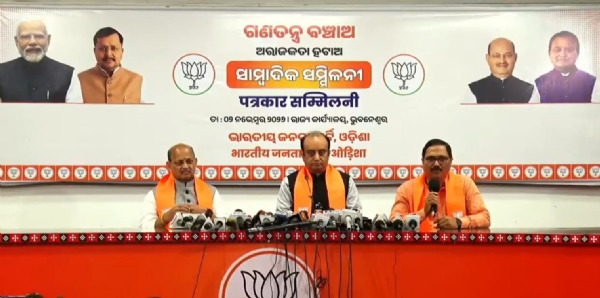
Addressing a press conference at the Odisha BJP headquarters in Bhubaneswar, Trivedi criticised the Congress's reported 'Mock Parliament' programme and questioned its approach towards democratic institutions and parliamentary conventions. Odisha BJP president Manmohan Samal and state general secretary Biranchi Narayan Tripathy were also present.
Trivedi said the format of the Congress's Mock Parliament reminded him of the parallel structures once established by Maoist groups in areas under their influence. He claimed that Naxalites used to organise their own assemblies, set up parallel courts and operate what they called 'Janata Sarkar'. Alleging that the Congress was following a similar approach, he questioned the absence of an opposing viewpoint in its Mock Parliament. He said the exercise reflected an inclination to hear only one side, drawing a comparison with the Emergency, when opposition leaders were jailed.
Targeting Rahul Gandhi, the BJP spokesperson alleged that Congress leaders were reluctant to undertake sustained political work among the people. Referring to the West Bengal Assembly elections, he cited Union Home Minister Amit Shah's announcement that he would spend 25 days in the state and challenged Rahul Gandhi to demonstrate a similar level of commitment during an election campaign. He accused the Congress leadership of relying on slogans and allegations rather than political engagement on the ground.
Trivedi also criticised Rahul Gandhi's remarks and references to Hindu religious symbols. Referring to statements made at a rally at Ramlila Maidan, he questioned the Congress leaders' references to Lord Shiva's wedding procession s. He also recalled Rahul Gandhi's earlier statement about fighting the 'Shakti' in Hinduism. Trivedi said Shiva and Shakti were inseparable in Hindu philosophy and alleged that such remarks reflected a lack of understanding of India's cultural and religious traditions.
The BJP leader accused the Congress of repeatedly creating doubts about the credibility of major Indian institutions and public-sector organisations. Referring to the Life Insurance Corporation of India (LIC), State Bank of India (SBI) and Hindustan Aeronautics Limited (HAL), he said the Congress had questioned their financial health and performance. He claimed that LIC and SBI had continued to perform strongly, while HAL had an order book of nearly Rs 1 lakh crore. He also accused the opposition of spreading confusion over COVID-19 vaccine supplies and raising questions about the Indian armed forces, the Air Force and defence operations.
Questioning the conduct of the Leader of the Opposition, Trivedi referred to protests and demonstrations involving All India Radio premises, the Prime Minister's residence and march towords the Supreme Court. He said democratic opposition was legitimate, but political leaders were also expected to respect constitutional institutions and maintain public order. He further referred to Rahul Gandhi's interaction with Prime Minister Narendra Modi in Parliament and subsequent gestures in the House, questioning the seriousness of his political conduct.
Trivedi also questioned the Congress's association with certain leaders linked to left-wing organisations. Referring to statements concerning Bangladesh and the involvement of some leaders associated with the student wing of the Communist Party of India (Marxist-Leninist), he alleged that the Congress was providing political space to groups whose ideological history included armed struggle. He asked the party to clarify its position on such associations.
In his address, Trivedi referred to the 1999 confidence vote that led to the fall of the Atal Bihari Vajpayee government by one vote. He recalled that then Odisha Chief Minister Giridhar Gamang, who was also a Lok Sabha member, had participated in the voting. Trivedi alleged that the subsequent election schedule was influenced by political considerations and the Congress's expectation of gaining from public sympathy.
He also cited the 1991 Lok Sabha elections following the assassination of former Prime Minister Rajiv Gandhi. He questioned the decision to defer elections across the country, arguing that the rules generally required postponement only in the constituency of a deceased candidate. He alleged that the delay and subsequent campaign activities helped the Congress politically. Trivedi further referred to the controversy involving former Chief Election Commissioner N. Gopalaswami and then Election Commissioner Naveen Chawla, claiming that questions had been raised about Chawla's impartiality and that more than 200 MPs had written to the President on the issue.
On the Congress's criticism of election processes, Trivedi said governments returning to power through successive elections was not unusual in a democracy. Citing examples from Delhi, Maharashtra, Jharkhand, Kerala and Punjab, he argued that political parties across the country had secured consecutive electoral mandates. He said the people's verdict, rather than allegations of irregularities without evidence, should remain the basis for assessing electoral outcomes.
Referring to Prime Minister Narendra Modi's vision of a developed India by 2047, Trivedi accused several opposition parties of prioritising family-based political succession over the country's long-term development. He said political parties should focus on national interests, economic progress and strengthening democratic institutions instead of creating instability to cover up electoral setbacks.
Trivedi referred to protests in European countries, including the United Kingdom, Spain, France, Italy and Belgium, over housing, healthcare and education. He questioned the reliability of international rankings such as the Happiness Index and Freedom Index, arguing that countries placed favourably in such assessments were also witnessing public dissatisfaction over basic services. He suggested that either these indices did not accurately reflect ground realities or the protests were part of a wider international conspiracy, and alleged that attempts were being made to draw India into a similar situation.
Trivedi urged people to examine political developments carefully and remain alert to what he described as attempts to spread misinformation and weaken confidence in constitutional institutions.
---------------
Hindusthan Samachar / Monalisa Panda
18 Aug 2026
ED raids KPSC office, 20 other locations over Karnatak veterinary recruitment scam
ED raids KPSC office, 20 other locations over Karnatak veterinary recruitment scam..