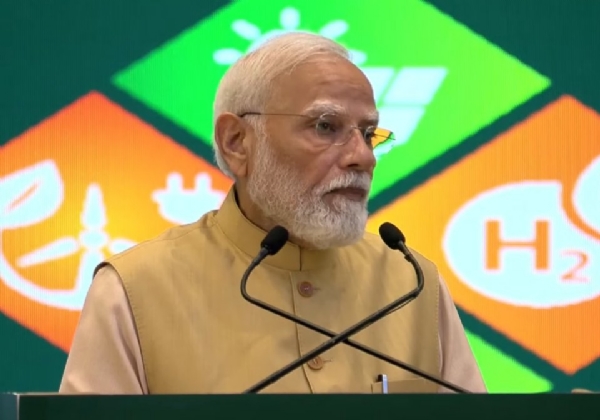
New Delhi, 02 November (H.S.): Prime Minister Narendra Modi on Monday said India would endeavour to add an additional 500 gigawatts (GW) of non-fossil energy capacity over the next 10 to 11 years, creating investment opportunities worth more than Rs. 20 lakh crore in the country's renewable energy sector by the end of this decade.
Addressing the inauguration of the Bharat Renewable Energy Summit & Expo 2026 at Bharat Mandapam, PM Modi said India's political and policy stability, coupled with its large-scale demand and growth potential, offered attractive opportunities for global investors.
He noted that non-fossil sources already account for more than 50 per cent of India's total installed electricity generation capacity, with the country having achieved nearly 300 GW of non-fossil energy capacity. India, he added, ranks among the world's top three countries in solar and renewable energy.
The Prime Minister recalled that at the 2021 climate conference, India had pledged to achieve 500 GW of non-fossil energy capacity by 2030. He also highlighted that the country had achieved its Paris Agreement commitment of sourcing 50 per cent of its total installed electricity capacity from non-fossil sources in 2025, five years ahead of the 2030 deadline.
PM Modi said the world had faced several major economic disruptions in recent years, including the COVID-19 pandemic and the West Asia crisis. Although the crisis in West Asia continues, he said, India's 1.4 billion people had responded effectively to these challenges, while the country's growth rate had remained robust.
He observed that the impact of these global disruptions on the Indian economy could have been far more severe had the country not invested in clean energy and developed new systems to support the sector over the past decade. The crises, he said, had demonstrated that energy security was directly linked to economic security, with clean energy forming the foundation of future energy security.
The Prime Minister said India had made significant progress in translating its renewable energy commitments into action over the past 12 years. Recalling the 2021 pledge to achieve 500 GW of non-fossil capacity by 2030, he said the country was advancing steadily towards the target and would endeavour to add another 500 GW of capacity over the coming 10 to 11 years.
PM Modi said the government's objective was to bring every government building, school, college, hospital and street-lighting system under solar power. More than 44,000 government buildings have already been connected to solar energy, resulting in annual savings of approximately Rs. 700 crore.
Referring to the PM Surya Ghar: Muft Bijli Yojana, launched in February 2024, he said the scheme aims to install rooftop solar panels in one crore households. More than 65 lakh households have joined the initiative over the past 24 to 25 months, he added.
The Prime Minister also called for farmers to become not only food providers but energy producers as well. Under the PM-KUSUM scheme, more than 30 lakh farmers have been provided with solar-powered irrigation facilities. He said each farmer using solar pumps could potentially save around Rs. 1 lakh annually.
PM Modi encouraged farmers to install solar panels on vacant land and along the boundaries of their fields so that the model could be adopted in an increasing number of villages.
Emphasising the need for innovation in solar energy, he urged startups, Indian Institutes of Technology (IITs), researchers and entrepreneurs to develop models capable of meeting households' energy requirements throughout the year and around the clock through solar power. He said efforts should be made to create systems that would also enable families to cook using electricity generated by rooftop solar installations.
He also stressed the need to advance clean cooking initiatives to reduce the country's dependence on imported gas.
Highlighting India's ambitions in green hydrogen, PM Modi said the National Green Hydrogen Mission had set a target of producing 5 million tonnes of green hydrogen annually by the end of this decade. He added that efforts were also underway to integrate green hydrogen into the transport sector and that the country's first green hydrogen-powered train had been launched a few months ago.
The Prime Minister pointed out that generating electricity alone was not sufficient; it was equally important to ensure that power reached areas where it was needed. While some parts of the country have substantial solar and wind energy generation potential, others have comparatively limited availability. To address this imbalance, the government is developing Green Energy Corridors through dedicated transmission lines and substations.
PM Modi also underlined the importance of developing indigenous technologies for energy storage. He said India needed to create its own energy storage solutions and expand battery storage capacity, describing this as a significant opportunity for researchers, investors and young people. He added that solutions developed in India could also benefit other countries.
Referring to the growth of domestic manufacturing, the Prime Minister said India's solar module manufacturing capacity had increased from approximately 2 GW a decade ago to more than 200 GW. Solar cell manufacturing capacity had also reached nearly 40 GW.
He noted that India had earlier depended on imports even for relatively small components and equipment used in solar energy systems, but was now expanding domestic manufacturing across a wider range of products. He described this progress as an example of the success of the government's Aatmanirbhar Bharat and Make in India initiatives.
PM Modi said India wanted its innovations and experience to benefit humanity as a whole. He emphasised that the country's achievements in clean energy could prove useful to several nations.
The Bharat Renewable Energy Summit & Expo 2026 is being held alongside the ninth Assembly of the International Solar Alliance and the fourth International Conference on Green Hydrogen, bringing together global stakeholders to advance cooperation in the clean energy sector.
---------------
Hindusthan Samachar / Jun Sarkar
18 Aug 2026