Shillong , 02 November (H.S.): Meghalaya Chief Minister Conrad K Sangma on Monday welcomed
the visit of the Joint Parliamentary Committee (JPC) examining the proposed
amendments to the Foreign Contribution (Regulation) Act (FCRA), thanking its
members for consulting stakeholders in Shillong and hearing their concerns.
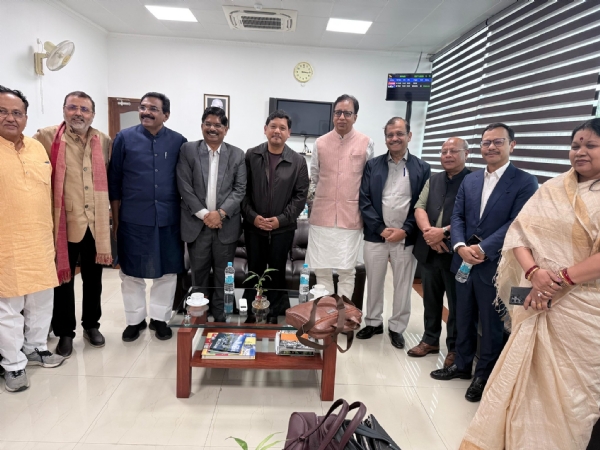
Taking to social media after meeting members of the
parliamentary panel at Umroi Airport, Sangma said he appreciated their efforts
to ensure that the views and perspectives of various stakeholders were heard
and considered during the deliberations on the proposed legislation.
The committee also includes Meghalaya's National People's
Party (NPP) leader and Rajya Sabha MP James Pangsang Kongkal Sangma as a
special invitee. James Sangma had earlier urged the panel to hold consultations
in Shillong so that organisations from Meghalaya and the wider Northeast could
directly present their concerns.
The JPC, headed by BJP MP Sanjay Jaiswal, held consultations
in Shillong on Monday, interacting with representatives of nearly 40
organisations from Meghalaya and other northeastern states, including religious
institutions, non-governmental organisations and groups working for persons
with disabilities.
The Foreign Contribution (Regulation) Act, 2010, regulates
the receipt and utilisation of foreign donations by individuals, associations
and organisations in India. Organisations receiving foreign contributions must
obtain FCRA registration or prior permission from the Union Home Ministry and
comply with prescribed reporting and financial regulations.
The proposed FCRA Amendment Bill, 2026, has attracted
considerable attention because it seeks to introduce a mechanism for the
supervision, management and disposal of assets belonging to organisations whose
FCRA registration is cancelled, surrendered or expires without renewal. The
proposed legislation provides for a government-appointed Designated Authority
to take charge of such assets.
The issue has particular significance for Meghalaya, one of
India's most Christian-majority states, where Christians account for nearly 75
per cent of the population, according to the 2011 Census. Churches, missionary
institutions, charitable organisations and faith-based groups have historically
played an important role in running educational institutions, healthcare
facilities, orphanages, community welfare programmes and other social
initiatives.
Many such institutions depend, at least partly, on foreign
donations to support their activities. Consequently, changes in FCRA
regulations could have implications for their ability to receive, manage and
utilise overseas contributions.
Church organisations and other civil society groups have
expressed concerns about the proposed provisions, particularly those relating
to the control of assets if an organisation loses its FCRA registration. They
have sought safeguards to ensure that legitimate charitable and religious
activities are not disrupted.
The government, meanwhile, has maintained that the proposed
amendments are intended to strengthen transparency, accountability and
oversight in the utilisation of foreign funds while preventing their misuse.
The Shillong consultation was therefore an important
opportunity for organisations from Meghalaya and the wider Northeast to place
their concerns directly before the parliamentary committee. The panel has
sought additional written submissions from participating organisations within
15 days before proceeding with its further deliberations.
Hindusthan Samachar / Abhijit Deb
18 Aug 2026
ED raids KPSC office, 20 other locations over Karnatak veterinary recruitment scam
ED raids KPSC office, 20 other locations over Karnatak veterinary recruitment scam..