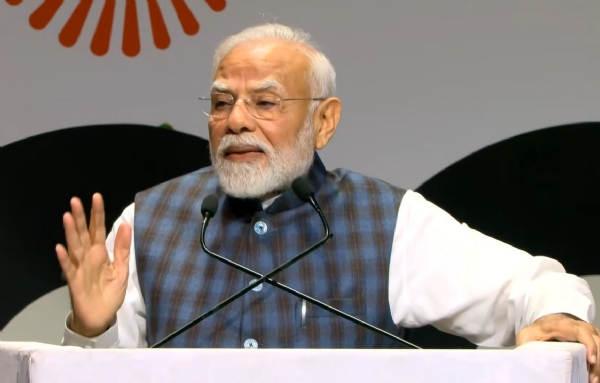
New Delhi, 19 November (H.S.): Prime Minister Narendra Modi on Thursday called upon India's industry leaders to align themselves with the vision of a developed and self-reliant India, emphasising that the time had come for Indian industry to determine what it aspired to achieve over the next 20 years. He said the principle of ‘India First’ must guide their long-term investment decisions, adding that India's journey towards self-reliance would unlock new business opportunities.
Prime Minister Modi inaugurated the annual general meeting and annual convention of the Federation of Indian Chambers of Commerce and Industry (FICCI) at Bharat Mandapam in New Delhi. Presenting his government as an industry-friendly administration, he urged business leaders to express their views on further reforms without hesitation.
He observed that past experiences with previous governments had made the industry hesitant to openly communicate its concerns and suggestions. “The industry's experience with previous governments has been so bitter that I am still bearing the consequences of it. This is not an old government; this is a friendly government. It knows how to honour friendships, and you are my true friends. Therefore, without any hesitation or reservation, write to me openly and tell me what further reforms are still needed,” he said.
The Prime Minister said the industry should identify components and manufacturing inputs that could be produced domestically rather than relying on imports. Citing the pharmaceutical sector as an example, he noted that although India is recognised globally as the ‘Pharmacy of the World’, it continues to import active pharmaceutical ingredients (APIs), bulk drugs and drug intermediates worth billions of dollars every year.
“There are hundreds of such categories in which we remain dependent on imports. Our pharmaceutical industry must identify the ingredients that can be manufactured in India. It must also assess the sectors in which investments in new technologies and large-scale production facilities can make us competitive with other countries,” he said.
He further urged industry leaders to undertake honest introspection, recognise their strengths, learn from their shortcomings and continuously strive for improvement. He called on businesses to invest in understanding the requirements of international customers, adapting to global standards and establishing robust distribution networks. The Prime Minister cautioned industry against treating India's 1.4-billion-strong population merely as a market where anything could be sold. He pointed out that even today, sellers often reassure customers by claiming that a product is of “export quality”, reflecting the need to raise quality standards in the domestic market.
The Prime Minister also urged industry leaders to ensure that the benefits of government tax concessions and incentives were passed on to employees. He noted that his government had reduced the basic corporate tax rate from 30 per cent in 2014 to 22 per cent, while income up to Rs. 12 lakh was now exempt from income tax.
In this context, he asked whether companies had increased employees' salaries or recruited additional staff following these tax benefits. He also highlighted the simplification of income tax return filing and refund procedures, observing that refunds, which earlier took up to eight months, were now being processed within a week.
Recalling India's economic journey, Modi referred to the era of the Licence-Quota Raj, the unsuccessful experiment of nationalisation and the subsequent phase when the Indian economy was counted among the world's ‘Fragile Five’ economies. However, he said that over the past 12 years, the people of the country had worked tirelessly to transform this situation. India's youth, farmers, workers and members of the industrial sector had all contributed significantly to this transformation.
The Prime Minister also called upon industry leaders to increase investments in India's agricultural sector. He urged businesses to establish reliable procurement systems with specific overseas markets in mind and develop products that meet demand in those markets, so that Indian products could become recognised globally and serve as a source of national identity.
Extending his greetings on the completion of 100 years of FICCI, Modi said that it was a remarkable achievement for an institution to remain active and vigilant for a century, evolve with changing times and continue contributing to the country's economic journey.
Reflecting on India's economic progress, he said the country had achieved significant milestones through collective efforts over the past 12 years. The pace of development in India was now rapid, while the rate at which people were emerging from poverty had also accelerated.
Referring to the latest World Bank report, the Prime Minister said it was a matter of pride for the country, as it indicated that nearly 500 million Indians had overcome poverty in just 12 to 13 years.
He said FICCI had also been a witness to this transformation, adding that the country's current development trajectory demonstrated that India was moving in the right direction and that its chosen path held the promise of sustained national success.
Hindusthan Samachar / Jun Sarkar
18 Aug 2026