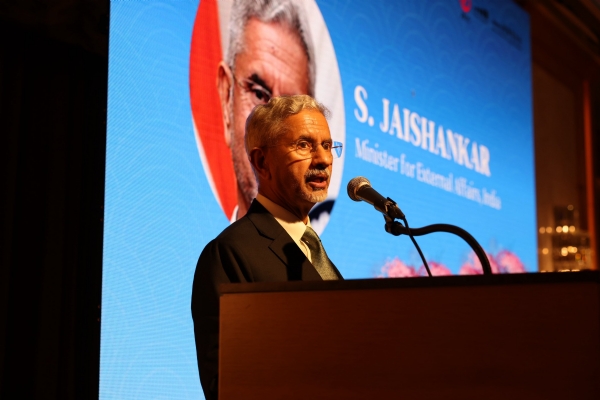
Tokyo, 18 November (H.S.): External Affairs Minister Dr. S. Jaishankar on Wednesday said strengthening cooperation between India and Japan was imperative amid a rapidly evolving global landscape and growing economic uncertainties. He emphasised that economic security was among the highest priorities for both countries, requiring them to strengthen their domestic capabilities while expanding reliable and trusted partnerships.
Addressing the inaugural session of Raisina Tokyo 2026, Jaishankar said the global order was currently undergoing five major transformations. These included persistent shocks to the international system, the strategic use of resources and technology, intensifying competition and a growing appetite for risk-taking, the need to diversify supply chains, and the increasing importance of trusted partnerships.
He observed that the COVID-19 pandemic, two major conflicts, trade disruptions and economic instability had significantly affected the international order that had evolved over decades of globalisation. Energy, resources, market access, technology and finance were increasingly being used as strategic instruments. Critical nodes of physical and digital connectivity were also becoming part of the strategic agenda, weakening the rules- and norms-based international order.
The External Affairs Minister said that, in response to these developments, major economies were working to reduce risks and diversify their sources of supply. Economic decisions were increasingly being driven by reliability and the availability of alternatives rather than cost and efficiency alone. In this changing environment, dependable partners and shorter supply chains had become increasingly important for countries and businesses alike.
Jaishankar said these challenges were particularly evident in the Indo-Pacific region. As two major countries committed to a free and open Indo-Pacific, India and Japan needed to safeguard their respective national interests while working to strengthen the capabilities of partner countries and deepen reliable cooperation.
He described India and Japan as complementary partners, observing that their interests had never clashed and that their historical relationship had remained cordial. Under the leadership of Prime Minister Narendra Modi and Japanese Prime Minister Sanae Takaichi, there were significant opportunities to impart fresh momentum to bilateral ties. He said the prevailing global circumstances provided a strong basis for expanding cooperation between the two countries.
The External Affairs Minister urged Japanese industry leaders and investors to reassess their understanding of the transformation India had undergone over the past decade. He said that since 2014, India had made substantial progress in infrastructure development. Improvements in highways, ports, airports, railways and the power sector had made the country a more conducive and efficient destination for business.
He noted that improved infrastructure was making India an attractive hub for manufacturing and overseas production operations serving global markets. At the same time, the country's vast domestic market offered significant opportunities for Japanese companies.
Jaishankar said India had also made considerable progress in education, skill development and human resource capacity over the past decade. The number of educational institutions had doubled, skill-development initiatives had expanded, and a robust culture of innovation and start-ups had taken shape. The impact of these developments was increasingly visible in sectors such as digital technology, space, drones, healthcare and defence.
He highlighted extensive opportunities for India and Japan to collaborate in emerging and future-oriented sectors, including advanced manufacturing, semiconductors, critical minerals, information and communication technology, clean energy and pharmaceuticals. India's scale, diversity and creative capabilities in artificial intelligence (AI), he said, could be particularly valuable for Japanese companies.
Emphasising the importance of self-reliance in security and defence, alongside dependable international partnerships, Jaishankar said the two countries needed to develop appropriate policies and frameworks to expand bilateral cooperation in these areas. He also called for greater exchanges in education, culture and language, as well as stronger people-to-people ties.
The minister noted that India-Japan relations had undergone a significant transformation over the past three decades, with expanding economic engagement and a deepening political understanding. The two countries are members of the Quad and partners in the G4 initiative for United Nations reforms. They also work together through platforms such as the East Asia Summit.
Jaishankar said the expansion of India-Japan relations would not only contribute to greater stability and security in the Indo-Pacific but also provide an important pillar for an increasingly multipolar Asian and global order.
---------------
Hindusthan Samachar / Jun Sarkar
18 Aug 2026