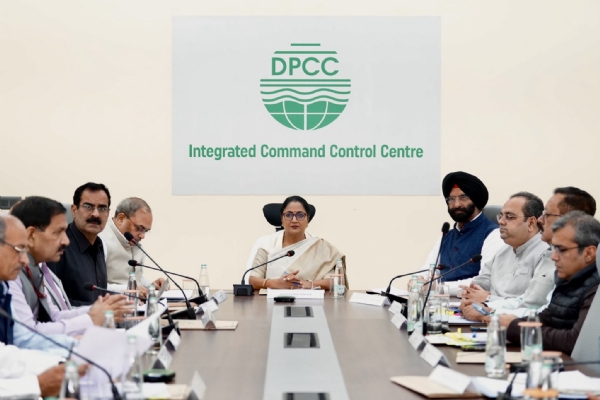
New Delhi, 18 November (H.S.): Chief Minister Rekha Gupta on Wednesday chaired a high-level meeting at the Integrated Command and Control Centre (ICCC) of the Delhi Pollution Control Committee (DPCC) to review measures being undertaken to curb air pollution in the national capital. The meeting assessed pollution hotspots, monitoring and inspections, enforcement action, dust from roads and construction sites, vehicular and public transport emissions, industrial pollution, construction and demolition waste, and solid waste management.
The Chief Minister directed all departments to work in close coordination and with a strong sense of accountability, warning that negligence at any level would not be tolerated. She also instructed officials to ensure regular monitoring in areas with both high and low Air Quality Index (AQI) levels.
During the meeting, pending complaints concerning roads, unpaved stretches and potholes within a three-kilometre radius of pollution hotspots were reviewed zone-wise and department-wise. Of the 68,137 complaints related to various agencies, 61,507 have been resolved. Gupta directed the concerned departments to prioritise the clearance of pending complaints relating to potholes and unpaved roads.
The Chief Minister also cautioned against treating the installation of green nets at construction sites as a mere formality. She directed that green nets must be properly secured to scaffolding in accordance with prescribed standards. The departments concerned and construction agencies were instructed to ensure strict compliance with pollution-control norms and take stringent action against violators.
Taking a firm stand on roads being left damaged for prolonged periods after excavation, Gupta directed that the department or agency responsible for digging up a road must restore it to its original condition once the work is completed. She also called for the regular removal of dust, soil and silt from roads, with mechanised sweeping machines, water sprinkling and road washing deployed to control dust pollution.
The meeting also reviewed road redevelopment works being undertaken under the Commission for Air Quality Management (CAQM). A total of 3,744 kilometres of roads have been identified as requiring redevelopment in 2026.
The Chief Minister directed that essential road and public utility works should not be unnecessarily disrupted during the construction and demolition restrictions scheduled to come into force from December 10. The concerned agencies were asked to continue work in accordance with applicable regulations and permitted exemptions so that development activities could proceed alongside pollution-control measures.
The Delhi Metro was also instructed to operate the anti-smog guns and mist-spray systems available within its premises regularly between 7 pm and 11 pm.
Environment Minister Manjinder Singh Sirsa said that not a single day of severe pollution had been recorded in Delhi so far this year, with the AQI not crossing the 400 mark. He noted that during November over the past decade, the city had frequently witnessed four to six days of such severe pollution.
Sirsa further said that the average AQI during the first fortnight of November stood at approximately 170, while October had emerged as the cleanest month in the past decade. The number of days with clean air had also reached a record 220. He added that around 60 per cent progress had been achieved in cleaning the Yamuna and clearing the city's landfill sites.
Delhi Health and Transport Minister Dr Pankaj Kumar Singh said the meeting reviewed departmental action plans and monitoring mechanisms, with directions issued to curb road dust, construction-related pollution and vehicular emissions. In view of the possibility of a rise in pollution levels during winter, the government is pursuing both immediate interventions and a long-term strategy.
He said the number of electric buses was being increased to reduce vehicular pollution, while owners of two-wheelers, three-wheelers and four-wheelers would also be encouraged to shift towards electric mobility. The fitness and emission levels of vehicles entering Delhi from outside would be closely monitored. An allocation of Rs 5 crore has been approved for the modernisation of Pollution Under Control (PUC) centres.
---------------
Hindusthan Samachar / Jun Sarkar
18 Aug 2026
ED raids KPSC office, 20 other locations over Karnatak veterinary recruitment scam
ED raids KPSC office, 20 other locations over Karnatak veterinary recruitment scam..