Manila/New Delhi, 17 November (H.S.): India, the United States, Japan and Australia have reaffirmed their commitment to strengthening cooperation in maritime security, cyber security, critical supply chains and emerging technologies across the Indo-Pacific region. The four countries strongly condemned terrorism and violent extremism in all their forms, including cross-border terrorism, and pledged to step up cooperation to counter these threats.
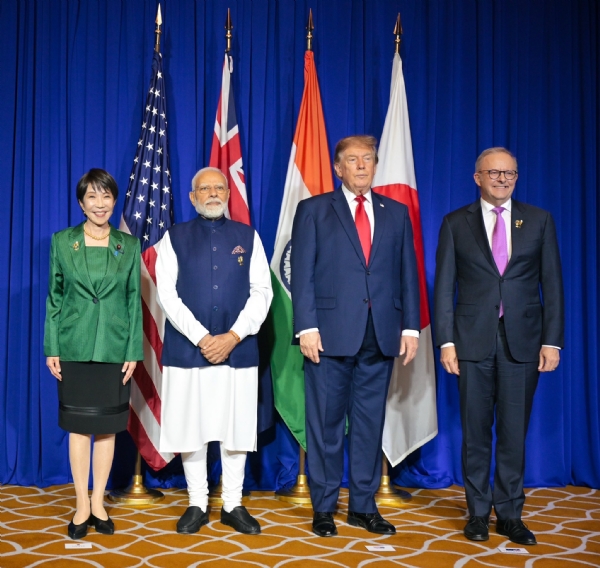
US President Donald Trump, Prime Minister Narendra Modi, Japanese Prime Minister Sanae Takaichi and Australian Prime Minister Anthony Albanese participated in the Quad Leaders’ Summit in Manila, the capital of the Philippines, on Tuesday. In a joint statement issued after the meeting, the four leaders described the Quad as an active partnership committed to peace, stability and prosperity, which has played a positive role in the region.
The joint statement said the four countries strongly opposed destabilising and unilateral actions aimed at changing the status quo through force or coercion, noting that such measures escalate tensions and undermine regional peace and stability. The leaders also expressed serious concern over economic coercion, including the imposition of arbitrary export restrictions.
The four countries agreed to secure critical supply chains, safeguard freedom of navigation and overflight, and promote investment in the development and deployment of emerging technologies, including artificial intelligence (AI). They also pledged to work together to ensure open, secure and resilient maritime transit corridors across the Indo-Pacific.
Quad Business Leaders’ Forum to Be Held in 2027
The joint statement outlined plans to convene the inaugural Quad Business Leaders’ Forum in early 2027, bringing together business leaders, government officials and policy experts from the four countries. The initiative aims to strengthen commercial ties between the private sectors and promote business agreements and partnerships to advance prosperity across the Indo-Pacific.
The leaders also underscored the importance of the AI Accelerator announced at the Quad Foreign Ministers’ Meeting in Atlanta. The initiative will help coordinate and finance efforts to expand access to trusted AI, promote its adoption and provide technical assistance across the Indo-Pacific region.
Maritime Surveillance and Joint Exercises
On maritime security, the four leaders welcomed the Indo-Pacific Maritime Surveillance Collaboration initiative, which seeks to strengthen information-sharing mechanisms and enhance maritime domain awareness and surveillance capabilities.
According to the joint statement, P-8 and P-3C maritime patrol aircraft from all four countries are expected to participate in the first-ever Quad maritime exercise in 2027.
The leaders also highlighted progress under the Quad Partnership for Cable Connectivity and Resilience, which aims to expand access to secure and reliable communications infrastructure. They welcomed Australia's expanded contribution to the partnership, including a greater focus on power cables, which is expected to strengthen regional energy security and connectivity. The proposed undersea cable projects in the Indian Ocean were also welcomed.
Quad to Strengthen Cyber Security Cooperation
Expressing concern over the growing frequency and expanding scope of cyberattacks in the region, the four leaders announced plans to strengthen Quad cyber security cooperation. The initiative aims to promote a free, open and secure cyberspace through closer coordination among the member countries.
The joint statement unequivocally condemned terrorism and violent extremism in all their forms and manifestations, particularly cross-border terrorism. The four countries reaffirmed their commitment to strengthening existing Quad cooperation to combat terrorism.
The leaders also reiterated their unwavering support for ASEAN centrality and unity, pledging to work together to uphold a free and open Indo-Pacific.
Notably, former Japanese Prime Minister Shinzo Abe first articulated the vision of a free and open Indo-Pacific in 2016. The joint statement observed that nearly a decade after the articulation of this vision, and almost ten years after the revival of the Quad, the vision remains stronger and more relevant than ever.
---------------
Hindusthan Samachar / Jun Sarkar
18 Aug 2026