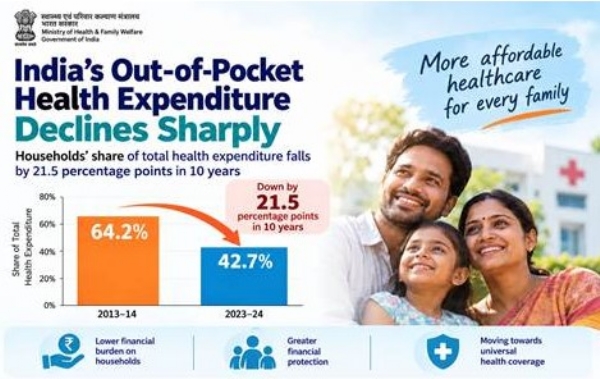
New Delhi, 15 November (H.S.): Government expenditure on healthcare in India has more than tripled over the past decade, rising to Rs. 4.14 lakh crore in 2023-24 from Rs. 1.30 lakh crore in 2013-14. During the same period, the share of healthcare expenses paid directly by households declined significantly, from 64.2 per cent to 42.7 per cent of total health expenditure.
According to the National Health Accounts (NHA) Estimates for India 2023-24, the proportion of healthcare costs borne directly by families fell by 21.5 percentage points over the decade, indicating a reduced dependence on out-of-pocket payments.
The Union Ministry of Health and Family Welfare released the National Health Accounts Estimates for 2023-24 on Sunday, outlining changes in public investment in healthcare and the financial burden on households. The report states that government health expenditure increased from Rs. 1.30 lakh crore in 2013-14 to Rs. 4.14 lakh crore in 2023-24.
The government's share in total health expenditure also increased by 14.9 percentage points over the same period. Per capita government spending on healthcare rose from Rs. 1,042 in 2013-14 to Rs. 2,959 in 2023-24, marking an increase of approximately 2.8 times.
Out-of-pocket expenditure accounted for 64.2 per cent of total health spending in 2013-14. This share declined to 43.4 per cent in 2022-23 and further to 42.7 per cent in 2023-24. According to the Ministry, the expansion of public healthcare services, along with access to free or affordable medicines, diagnostic tests and hospital treatment, has helped reduce the direct financial burden on families.
Government spending on primary healthcare has also increased, reaching Rs. 1.53 lakh crore. A key focus has been on delivering healthcare services closer to communities through Ayushman Arogya Mandirs. These centres provide screening for non-communicable diseases, essential medicines, diagnostic services and preventive healthcare facilities.
The share of social security expenditure in total health spending has also risen, increasing from 6 per cent in 2013-14 to 11 per cent in 2023-24. This includes expenditure under Ayushman Bharat-Pradhan Mantri Jan Arogya Yojana, state health insurance schemes, social health insurance programmes and medical benefits for government employees.
Over the same period, the share of private health insurance expenditure in total health spending increased from 3.4 per cent to 10.2 per cent. The Ministry said this reflected the expanding reach of health insurance in the country.
The Ministry further noted that initiatives such as the Free Drugs and Diagnostics Initiative, the Pradhan Mantri National Dialysis Programme, the Pradhan Mantri Bhartiya Janaushadhi Pariyojana and AMRIT pharmacies were helping people access affordable healthcare services and medicines.
In addition, eligible beneficiaries under the Ayushman Bharat scheme are entitled to cashless hospital treatment. The National Pharmaceutical Pricing Authority (NPPA) also plays a role in regulating medicine prices to improve affordability.
The National Health Accounts Estimates for 2023-24 constitute the 11th edition of the series. The estimates have been prepared by the National Health Accounts Technical Secretariat, housed within the National Health Systems Resource Centre (NHSRC) under the Union Ministry of Health and Family Welfare. The exercise follows the internationally recognised framework of the System of Health Accounts 2011.
---------------
Hindusthan Samachar / Jun Sarkar
18 Aug 2026