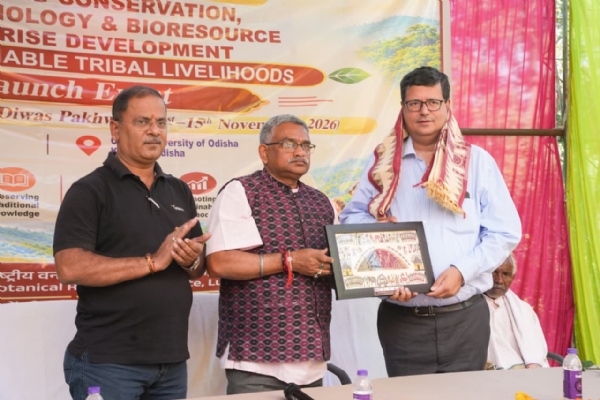
Bhubaneswar, 13 November (H.S.): A joint team of the Union Ministry of Tribal Affairs, CSIR–National Botanical Research Institute (CSIR-NBRI), Lucknow, and the Central University of Odisha (CUO) visited Pakjhola village in Semiliguda block on Friday to interact with traditional healers and villagers and explore ways to conserve indigenous medicinal plant knowledge.
The visit was part of a two-day programme aimed at promoting medicinal plant conservation, documenting traditional knowledge and strengthening sustainable livelihoods among tribal communities.
The team included Manish Thakur, Additional Secretary, Ministry of Tribal Affairs; Prof. Ajit Kumar Shasany, Vice-Chancellor, CUO; Dr. Sharad Srivastava, Scientist-G and Principal Investigator, CSIR-NBRI; senior officials of the Ministry and CSIR-NBRI, representatives of Himalaya Wellness Company, ITDA Koraput and faculty members of CUO.
During the field visit, the delegation interacted with traditional healers and local knowledge holders to understand indigenous healing practices, the use of medicinal plants and the rich biodiversity of the region. The discussions highlighted the need to document traditional knowledge systematically and scientifically validate it for future conservation and sustainable utilisation.
Thakur said tribal communities possess immense knowledge of medicinal plants and their uses, which needs to be documented and scientifically validated. He expressed confidence that the project would benefit tribal communities across the country, particularly in Odisha.
Prof. Shasany said CUO would serve as a bridge between the Ministry, CSIR-NBRI and local tribal communities. He assured the university's full support for documenting generational knowledge and conserving rare medicinal plants.
Under the initiative, CSIR-NBRI will document 200–300 medicinal plant species, develop propagation protocols for 30–40 priority rare, endangered and threatened (RET) and other high-value medicinal plants, and establish a dedicated live conservatory. The project also envisages setting up at least 16 community nurseries and 16 seed banks, besides providing scientific training and technical support to promote bioresource-based livelihood opportunities.
The project, titled 'Integrated Conservation, Agro-Technology and Bioresource Enterprise Development for Sustainable Tribal Livelihoods in Tribal Hotspots of India', was formally launched at the CUO campus on November 12 by the Ministry of Tribal Affairs in collaboration with CSIR-NBRI. It will cover 16 identified tribal hotspots across 13 states.
The initiative seeks to integrate scientific expertise, institutional collaboration and community participation to conserve biodiversity, preserve indigenous knowledge and promote sustainable livelihoods among tribal communities.
---------------
Hindusthan Samachar / Monalisa Panda

18 Aug 2026
ED raids KPSC office, 20 other locations over Karnatak veterinary recruitment scam
ED raids KPSC office, 20 other locations over Karnatak veterinary recruitment scam..