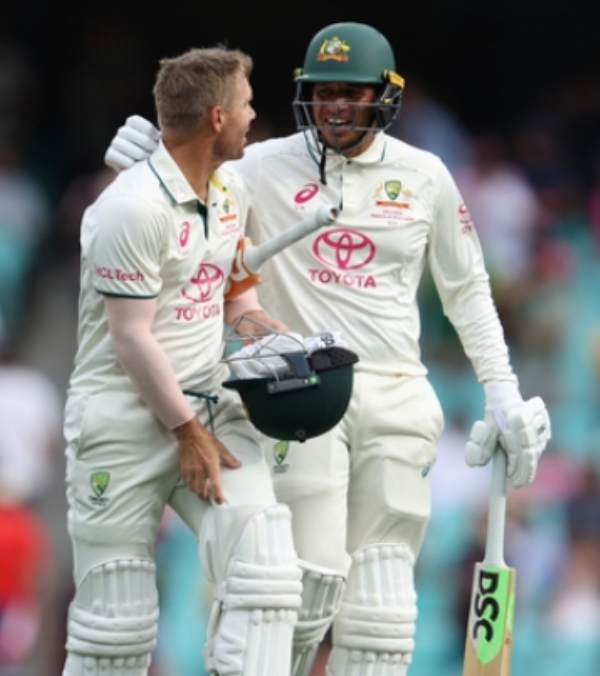
Sydney, November 13 (H.S.): Australia captain Pat Cummins on Friday strongly rejected claims made by former teammate Usman Khawaja regarding the infamous 2018 sandpaper scandal, insisting that the allegation that the entire team knew about the ball-tampering plan was “100 per cent wrong”. Cummins described the accusations against him as “complete and utter nonsense”.
Khawaja, who has retired from international cricket, released his autobiography this week, devoting a chapter to the ball-tampering controversy that erupted during Australia’s 2018 Test tour of South Africa and sent shockwaves through world cricket. In the book, he alleges that the entire Australian team, including Cummins, knew about a plan to roughen the ball’s surface with sandpaper to generate reverse swing.
The controversy centred on the third Test in Cape Town, although Khawaja has also claimed that the same method was used during the second Test in Port Elizabeth.
Cricket Australia’s investigation at the time concluded that only David Warner, Steve Smith and Cameron Bancroft were aware of the plan. All three were sent home in disgrace and subsequently handed suspensions. Smith was also stripped of the captaincy. Tim Paine took over the leadership before Cummins eventually became Australia’s captain.
Addressing the media at a press conference on Friday, Cummins categorically denied knowing that sandpaper was being taken onto the field.
“When he says that we all knew, if he means that we knew sandpaper was being taken onto the field, he is 100 per cent wrong. I have consistently said this for the last eight years. I did not know that it was happening,” Cummins said.
He went on to reject the suggestion that he and other players had helped devise the ball-tampering plan.
“But I think Usman actually makes much more serious allegations than that. He says that I and some others were the architects of a scheme to tamper with the ball using sandpaper. That is complete and utter nonsense,” he added.
Cummins and fellow Australian bowlers Mitchell Starc, Josh Hazlewood and Nathan Lyon had issued a joint public statement in 2021 maintaining that they had no knowledge of the plan. Warner, however, has strongly supported the latest claims made by his close friend Khawaja.
Former Australia head coach Darren Lehmann has also denied having any knowledge of the incident, while former batting coach Graham Hick has dismissed Khawaja’s allegations as “completely false”. Starc reiterated his earlier position this week, saying he had not known that sandpaper was being taken onto the field. Lyon and Hazlewood have not commented on the latest developments, while Smith and Bancroft have also maintained their silence.
Cummins questioned Khawaja’s decision to make such serious allegations eight years after the incident, expressing concern over the potential damage to the reputations of those involved.
“Usman is my friend, but friends are not careless with each other’s lives and reputations. In his book, he has been careless with my life, the lives of several others and Australian cricket as well. I think the way he has presented his account has been quite irresponsible, and it affects a lot of people,” Cummins said.
Earlier this week, Khawaja told the media that, following the Cape Town Test, he had urged the entire team in the dressing room to accept collective responsibility rather than allowing Warner, Smith and Bancroft to bear the blame alone.
Cummins, however, said he had no recollection of any such discussion or team meeting.
“I do not remember any conversation about taking collective responsibility. I also do not recall any team meeting in which he stood up and said that we should take responsibility for this as a team,” he said.
Cricket Australia has ruled out reopening its investigation into the scandal. On Thursday, the organisation’s chairman, David Boon, assured Cummins that the controversy would not affect his position as captain and that his job was secure.
Cummins acknowledged that, around 2018, the Australian team had a culture driven by an intense desire to win at any cost, which ultimately manifested itself in the Cape Town scandal. However, he maintained that the team’s culture had improved significantly since then.
“I did not like the way we spoke to umpires or opposition players. I think there was a certain arrogance at the time, and sometimes our behaviour had an unpleasant edge to it. As a young player, that was something I did not appreciate,” he said.
Cummins added that, since taking over as captain, he had made a conscious effort to ensure that such an attitude did not become part of the current Australian team.
“Now that I am captain, I have spent a great deal of time making sure that this kind of attitude is not present in the Australian team,” he said.
---------------
Hindusthan Samachar / Jun Sarkar

18 Aug 2026
Cincinnati Open: Williams Sisters Fall in First Round, Kostyuk-Stearns Duo Edges Them Out in Super Tiebreak

18 Aug 2026