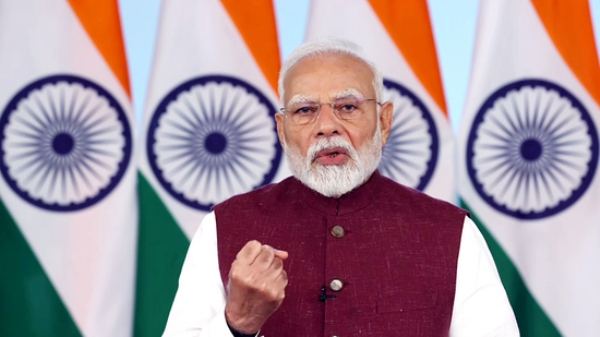
New Delhi, 13 November (H.S.): Prime Minister Narendra Modi's participation in the 23rd ASEAN-India Summit and the 21st East Asia Summit in Manila on November 17 is expected to provide fresh momentum to India's engagement with Southeast Asia, with maritime security, defence cooperation, regional connectivity and economic partnerships among the key areas of focus.
The summits, hosted by the Philippines as ASEAN Chair for 2026, will provide an opportunity to review the progress of the India-ASEAN Comprehensive Strategic Partnership, exchange views on regional and international developments and identify new areas of cooperation. This will be Modi's 13th participation in the ASEAN-India Summit since 2014.
ASEAN remains a cornerstone of India's Act East Policy and an important pillar of its Indo-Pacific vision. India and the regional grouping established dialogue relations in 1992, which were elevated to a Strategic Partnership in 2012 and a Comprehensive Strategic Partnership in 2022. The ASEAN-India Plan of Action for 2026-2030 provides the framework for taking forward cooperation across political-security, economic and socio-cultural sectors.
Maritime engagement has gained particular importance in the partnership. The year 2026 has been designated as the ASEAN-India Year of Maritime Cooperation, with both sides seeking to strengthen collaboration in maritime security, safety, connectivity and the blue economy.
The second ASEAN-India Maritime Exercise was held from September 28 to October 2 this year. In another regional engagement, India hosted the seventh East Asia Summit Conference on Maritime Security Cooperation in Kochi on October 5 and 6. These initiatives form part of India's broader engagement on maritime law enforcement, coast guard cooperation, search and rescue and respect for international maritime law, including the United Nations Convention on the Law of the Sea.
Defence cooperation is another important component of the relationship. India regularly participates in the ASEAN Defence Ministers' Meeting-Plus, which brings together ASEAN members and its dialogue partners, including the United States, Russia, China, Japan, South Korea, Australia and New Zealand. Joint exercises, naval port calls, defence equipment exports and training programmes have contributed to closer engagement. India also conducted training for women peacekeepers from ASEAN countries.
The inaugural ASEAN-India Defence Think Tank Forum, held in New Delhi on October 14 and 15, provided a platform for strategic dialogue and exchanges on regional defence and security issues.
Economic cooperation remains central to the partnership, with both sides working to strengthen trade and investment, improve connectivity and promote resilient and diversified supply chains. Cooperation is also being pursued in digital transformation, disaster preparedness, development partnerships and people-to-people exchanges.
India's development engagement with ASEAN includes projects in education, science and technology, digital infrastructure and capacity building. More than 100 projects and activities have been undertaken through the ASEAN-India Fund, the ASEAN-India Fund for Digital Future and the ASEAN-India Green Fund since 2014, with a combined budget of USD 35 million.
These initiatives include scholarships at Nalanda University, faculty exchanges, IT centres in Cambodia, Laos, Myanmar and Vietnam, and capacity-building programmes in electricity grids, telecommunications and cybersecurity. Under the ASEAN-India Science and Technology Development Fund, 120 collaborative research projects have been supported, while 220 researchers have benefited from the ASEAN-India Research Training Fellowship Programme.
India has also approved 237 Quick Impact Projects in Cambodia, Laos, Myanmar and Vietnam under the Mekong-Ganga Cooperation mechanism. These projects are aimed at supporting development and narrowing regional gaps through practical cooperation.
The 21st East Asia Summit will provide a wider platform for Modi to engage with leaders of participating countries on strategic and international issues. India has consistently supported ASEAN unity and centrality and the role of ASEAN-led mechanisms in maintaining an open, inclusive and forward-looking regional architecture.
The Philippines is chairing ASEAN this year under the theme 'Navigating Our Future, Together'. The year also marks the 50th anniversary of the Treaty of Amity and Cooperation in Southeast Asia, which sets out principles of peace, mutual respect, dialogue and cooperation. India was among the first Dialogue Partners of ASEAN to sign the treaty.
The next milestone in the relationship will come in 2027, when India and ASEAN mark 35 years of dialogue relations and five years of their Comprehensive Strategic Partnership. The upcoming summits are expected to provide an opportunity to assess ongoing initiatives and identify further areas of cooperation as both sides seek to strengthen their regional partnership.
---------------
Hindusthan Samachar / Indrani Sarkar
18 Aug 2026