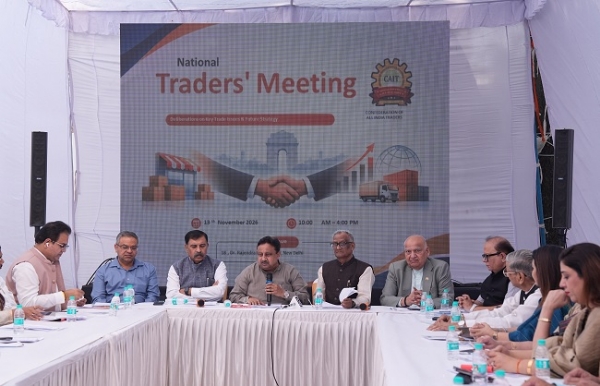
New Delhi, 13 November (H.S.): The Confederation of All India Traders (CAIT) has urged the Central and state governments to formulate a uniform national policy to regulate sit-ins and demonstrations that disrupt commercial activities in markets and restrict the movement of the general public.
At its national meeting held in New Delhi on Friday, trader representatives from 25 states unanimously adopted a resolution calling for the development of permanent and designated protest sites on the outskirts of major cities and district headquarters. The representatives strongly urged the Central and all state governments to establish such designated venues for sit-ins, demonstrations and other forms of protest so that commercial markets, residential neighbourhoods, essential public facilities and key transport routes are not adversely affected.
CAIT National Secretary General Praveen Khandelwal, while outlining the discussions and the resolution adopted at the meeting, said India was a vibrant democracy in which every citizen enjoyed the constitutional right to peaceful protest and freedom of expression. However, he stressed that these rights should not be exercised in a manner that brings business activities to a standstill, blocks public roads, disrupts normal life or affects the livelihoods of millions of people.
The resolution unanimously adopted at the meeting called for the establishment of permanent protest venues equipped with essential facilities on the outskirts of every major city and district headquarters. It also called for special protection for major wholesale and retail markets, commercial centres and industrial zones to ensure that demonstrations do not disrupt their functioning.
The resolution further proposed that prior permission from the competent administrative authority, along with a clearly designated venue and a fixed time limit, should be mandatory for every demonstration. It also called for restrictions on indefinite occupations of roads, highways, market entrances and other essential public spaces, as well as on blockades that obstruct traffic.
CAIT National President B.C. Bhartia said the organisation would take up the issue with the Prime Minister, Union Home Minister, chief ministers of all states, state governments, police commissioners and other competent authorities. He added that, if necessary, appropriate judicial and constitutional remedies would also be pursued to safeguard the constitutional rights of traders and citizens.
Bhartia emphasised that while the right to protest was an integral part of democracy, the rights to conduct business, earn a livelihood and move freely were equally important.
---------------
Hindusthan Samachar / Jun Sarkar