Hisar, 12 November (H.S.): The Indian Council of Agricultural Research (ICAR) has introduced a new system of appointing regional coordinators covering all states to strengthen coordination among its research institutes, agricultural universities and Krishi Vigyan Kendras (KVKs), Dr Yashpal Singh Malik, Deputy Director General (Agricultural Education), ICAR, said on Thursday.
Emphasising the need for a collaborative approach, Dr Malik urged institutions to pool their resources, expertise and experience and work together in the spirit of ‘One Nation, One Team’.
He said that achieving the goal of Viksit Bharat by 2047 would require research institutions to move beyond routine activities and focus on identifying the actual challenges faced by farmers and developing practical, effective solutions. The challenges confronting agriculture and animal husbandry, he noted, could be addressed only through collective efforts and stronger institutional cooperation.
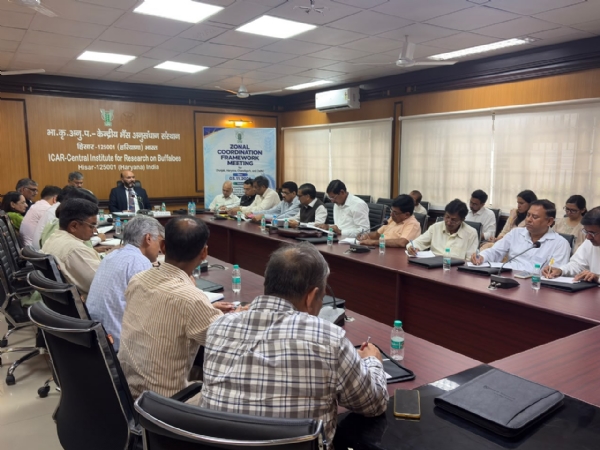
Chairing a regional coordination meeting, Dr Malik said ICAR had taken an important step towards improving coordination among agricultural research, academic activities and extension services across the country. As part of this initiative, the first regional coordination meeting for Haryana, Punjab, Chandigarh and Delhi was organised at the ICAR-Central Institute for Research on Buffaloes (CIRB), Hisar.
### Regional Coordination Meetings to Be Held Every Three Months
The meeting decided that regional coordination sessions would be held every three months to review the progress of ongoing activities and initiatives. Participating institutions will compile details of their memoranda of understanding (MoUs), sources of revenue and major achievements over the past two to three years.
The institutions will also undertake joint initiatives in key areas such as buffalo and dairy development, natural farming, One Health, soil and human health, and climate-resilient agriculture.
It was further agreed that laboratories, hospitals, libraries and other institutional facilities would be made accessible to partner institutions through mutual cooperation. A database of subject experts will also be prepared so that their services can be utilised for farmer training programmes, awareness campaigns and regional activities whenever required.
The meeting also decided that ICAR-CIRB would coordinate with the Haryana Livestock Development Board and the state Animal Husbandry Department to ensure a regular supply of certified Murrah buffalo semen and liquid nitrogen to livestock owners. The initiative is expected to improve access to quality breeding facilities and support breed improvement programmes for buffaloes.
Administrative and financial matters, including delays in the release of grants and fellowships, pending audit objections and the underutilisation or parking of available funds, were also discussed. The concerned institutions were directed to address these issues on priority and take corrective measures without delay.
### Training to Be Tailored to FPO Requirements; Expert Teams to Visit Villages
A special session was held with representatives of Farmer Producer Organisations (FPOs), during which farmers pointed out that training programmes were generally conducted according to predetermined annual schedules, whereas the problems faced by farmers and livestock owners could arise at any time.
Responding to their concerns, Dr Malik directed the concerned institutions, KVKs and agricultural universities to provide timely training and technical guidance in accordance with the specific requirements of FPOs.
It was also decided that teams of four to five experts would visit farmer groups associated with FPOs and their operational areas. Besides organising animal health camps, the teams would conduct practical demonstrations of modern technologies for farmers.
An online portal will also be developed to enable FPOs to directly submit their concerns and suggestions to the relevant institutions.
To make scientific and technical information more accessible to livestock owners, ICAR will bear the entire cost of producing short videos of two to five minutes on subjects such as animal care, balanced feeding, proper nutritional management and heat detection in animals. These videos will be shared free of cost with farmers and livestock owners through WhatsApp, enabling them to access and apply useful information in their daily practices.
With a view to ensuring the local availability of quality animal feed for dairy farmers, ICAR-CIRB will prepare a project report for setting up low-cost community-based feed mills, also known as cluster feed mills. The proposed unit is estimated to cost around Rs. 10 lakh and will have a production capacity of 500 kg of animal feed per day. The initiative is expected to make quality feed more accessible to dairy farmers and facilitate better nutritional management of livestock.
The participating institutions were also instructed to display the direct mobile and WhatsApp contact numbers of their extension officers and subject experts on their respective websites. This will enable farmers and FPO representatives to approach specialists directly for technical advice, guidance and assistance in resolving their concerns.
The decisions taken at the meeting are aimed at making better use of institutional resources and expertise, bridging the gap between research and agricultural extension, and ensuring that scientific technologies and innovations reach farmers and livestock owners directly. The regional coordination initiative is expected to strengthen institutional partnerships in agriculture and animal husbandry while facilitating timely and practical solutions to farmers' concerns.
At the outset, ICAR-CIRB Director Dr T. K. Bhattacharya welcomed the guests and participants.
Scientists, officials and representatives from ICAR-CIRB, ICAR-National Research Centre on Equines (NRCE), Chaudhary Charan Singh Haryana Agricultural University (CCSHAU), Hisar, Lala Lajpat Rai University of Veterinary and Animal Sciences (LUVAS), Hisar, Krishi Vigyan Kendras in Bhiwani, Fatehabad, Hisar, Jind and Rohtak, and various Farmer Producer Organisations attended the meeting.
---------------
Hindusthan Samachar / Jun Sarkar
18 Aug 2026