Bhubaneswar, 10 November (H.S.): Odisha is positioning itself as a national model for millet-led agricultural transformation, with a renewed focus on conserving indigenous seed varieties, expanding millet cultivation, strengthening farmer institutions and developing sustainable market linkages.
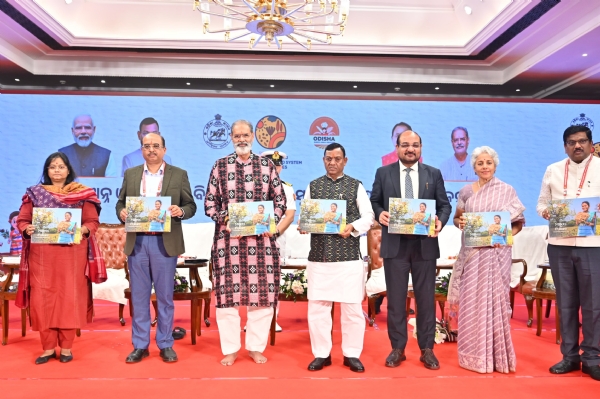
These issues were discussed at a two-day national symposium on ‘Shree Anna and Strengthening Seed Systems for Landraces-2026’, which commenced at the Mayfair Convention in Bhubaneswar on Monday.
Odisha Governor Braj Mohan Ram inaugurated the symposium in the presence of Deputy Chief Minister and Agriculture and Farmers' Empowerment Minister Kanak Vardhan Singh Deo, Department of Agricultural Research and Education (DARE) Secretary and ICAR Director General Dr Mangi Lal Jat, M.S. Swaminathan Research Foundation Chairperson Dr Soumya Swaminathan, and Agriculture and Farmers' Empowerment Department Commissioner-cum-Secretary Sachin Ramachandra Jadhav.
Eminent agricultural scientists, policymakers, senior government officials and other stakeholders attended the event.
The inaugural session was followed by visits to exhibition stalls showcasing agricultural innovations, indigenous crop diversity and millet-based products. Participants also interacted with farmers to understand their experiences and initiatives in promoting traditional crop varieties.
Addressing the gathering, Dr Mangi Lal Jat emphasised the need to harness Odisha's rich agro-biodiversity, particularly opportunity crops such as millets, to address major challenges relating to climate change, soil health and nutrition. He also highlighted the importance of strengthening local food systems as part of the One Health approach.
Appreciating the achievements of the Odisha Shree Anna Abhiyan, he said the state's experience had the potential to serve as a national model for millet-based agricultural transformation.
Ambitious targets for millet cultivation
Dr Jat called for expanding the area under millet cultivation in Odisha from the existing 1.79 lakh hectares to five lakh hectares by 2047, with an annual production target of eight lakh metric tonnes.
He also appreciated the state's progress in ragi procurement. Odisha procured 7.5 lakh quintals of ragi during the Kharif Marketing Season (KMS) 2024-25 and has set a target of eight lakh quintals for 2025-26.
Highlighting the importance of conserving indigenous millet diversity, he drew attention to the state's 163 documented finger millet landraces and stressed the need to preserve and promote traditional varieties such as Kalia, Bati, Mami and Bharathi.
Focus on research, processing and market linkages
Dr Jat emphasised scaling up scientific cultivation practices and promoting minor millets such as suan and kangu. He also called for developing affordable processing machinery to address technological gaps and make millet cultivation and value addition more economically viable.
Strengthening Farmer Producer Organisations (FPOs) and women's Self-Help Groups (SHGs), promoting millet-based enterprises and expanding market linkages were identified as key priorities.
He highlighted the role of ICAR-Indian Institute of Millets Research (ICAR-IIMR), Hyderabad, in supporting these initiatives and proposed stronger research collaboration between ICAR-IIMR and Odisha, including the establishment of a Centre of Excellence on Millets at Odisha University of Agriculture and Technology (OUAT).
Deputy Chief Minister Kanak Vardhan Singh Deo, in a social media post, said the symposium focused on conserving indigenous seed varieties, enhancing millet production, strengthening FPOs and creating wider market opportunities for farmers.
He stressed that promoting millet-based food traditions among both rural and urban communities was equally important for building a sustainable agricultural ecosystem. Such collective efforts, he said, would help safeguard Odisha's agricultural heritage, improve farmers' prosperity and strengthen the state's agricultural future.
The two-day national event aims to strengthen institutional partnerships, facilitate knowledge exchange and accelerate the adoption of climate-resilient agricultural practices, paving the way for sustainable and economically viable millet-based development in Odisha.
---------------
Hindusthan Samachar / Monalisa Panda

18 Aug 2026
ED raids KPSC office, 20 other locations over Karnatak veterinary recruitment scam
ED raids KPSC office, 20 other locations over Karnatak veterinary recruitment scam..