




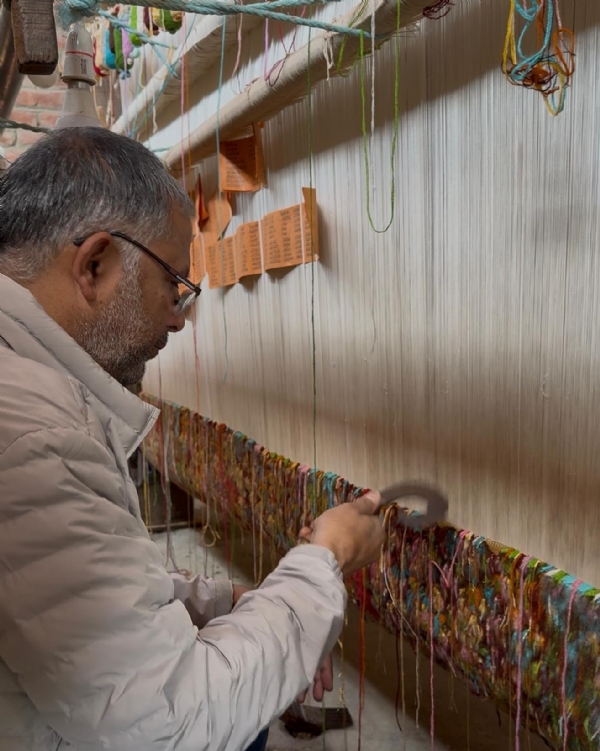
Srinagar, Nov 10 (HS): Carpet weaving, one of Kashmir’s best-known traditional crafts, has survived years of difficulty and is finding its place in the Valley’s economy again, thanks to efforts by the government and master artisans.
The craft was once a major industry, with weavers working in homes and workshops across the Valley. It later declined so sharply that about 90 per cent of those in the trade are said to have left it for other work.
Now, with government support and the efforts of some master artisans, it is drawing fresh attention. More people, in both towns and villages, are taking it up as a way to earn a living.
Mohammad Rafiq Sofi, an award-winning master weaver from Noor Bagh in Srinagar, told Hindusthan Samachar that the craft offers a steady livelihood and can even take a person abroad. He believes children can earn enough to cover their own expenses and help support their families while they study.
Sofi has been weaving carpets for more than four decades, through good times and bad. “My father was in the craft from 1955, and I took it over in 1979,” he said. “It has been my whole life since then. Through all the ups and downs I never left it. It has given me respect, and it has given me a name in the world.”
“More than 500 artisans work under my supervision and earn a good living,” he said. “Weavers in different parts of the Valley, including Budgam, Charar-e-Sharief, Bandipora, Palhalan and Sumbal, also make carpets for me.”
Sofi says he works out new designs with his brother, and that the carpets are in demand internationally as well. “We create the designs ourselves and have the carpets woven,” he said. “We use local flowers and other motifs, and these carpets are in demand abroad. We make them not only for the floor but also as wall hangings for homes.”
He worries, however, that machine-made carpets are hurting sales of genuine ones. “Machine-made carpets are cheaper and hard to tell apart, so people prefer to buy them,” he said. “Ours cost more, and buyers complain about the price.”
“The good news is that well-off buyers still prefer hand-knotted carpets, which are not only more beautiful but also last longer,” he added.
Sofi received a national award last month for a finely made carpet with a traditional design. He called the Geographical Indication (GI) tag for hand-made Kashmiri carpets a very important step.
“The GI tag was a big move by the government,” he said. “It protected the craft and let the Kashmiri carpet keep its standing and identity. It is a certificate of authenticity that no one can challenge.”
He says he never compromises on the materials he uses, which is why his business keeps growing. “I do this work with complete honesty,” he said. “I earn my own livelihood, and I give other artisans a good income too. They easily earn Rs 700 to Rs 800 a day.”
Sofi urged young people to take up the craft. “Education is important, but after that it is not right to keep running after a government job,” he said. “Young men can weave carpets alongside their studies and earn for themselves and for their families.”
He says the craft offers wide opportunities and could provide a living for thousands of people. “You can earn not just money but respect,” he said. “It is through this craft that I got the chance to see countries like Germany and France.”
He received the National Award 2025 in the hand-knotted carpet category from the Union Ministry of Textiles.
Carpet weaving in Kashmir is widely regarded as a centuries-old tradition. It is said to trace back to the 15th century, in the time of Sultan Zain-ul-Abidin, popularly known as Budshah, who is believed to have brought in outside craftsmen to train local weavers. In the Mughal era, Kashmiri carpets reached royal courts.
A hand-knotted carpet is woven from wool, silk or a mix of both. Weavers follow a written pattern called ‘talim’, which records the colour and position of every knot. Depending on its size and the fineness of the design, one carpet can take months to complete.
Chinar leaves, the tree of life and garden patterns are among the popular designs. Government schemes such as One District One Product also support artisan cooperatives.
---------------
Hindusthan Samachar / Zahoor Hussain Bhat