New Delhi, 10 November (H.S.): In a major initiative to take India’s marine fisheries sector to new heights, the Central Government has taken special steps to harness the vast fisheries potential of Lakshadweep and the Andaman and Nicobar Islands. By promoting tuna production, seaweed cultivation and ornamental fish farming in these island territories, the government aims to strengthen local economies while creating new avenues for employment and exports.
Under the Pradhan Mantri Matsya Sampada Yojana (PMMSY), an investment of Rs. 218 crore has been earmarked for the Andaman and Nicobar Islands and Rs. 175 crore for Lakshadweep. The government’s objective is to ensure the scientific and sustainable utilisation of the islands’ marine resources and take fisheries beyond primary production by integrating the sector with modern technology, processing, value addition and exports.
India has a coastline stretching approximately 11,099 kilometres and an Exclusive Economic Zone (EEZ) covering nearly 2.4 million square kilometres. The estimated potential of marine fisheries resources within the country’s EEZ stands at 5.86 million metric tonnes. The fisheries sector supports the livelihoods of around five million fishers and makes a significant contribution to food security, nutrition, employment and foreign exchange earnings. In the financial year 2025-26, India’s marine food exports were valued at approximately Rs. 73,890 crore.
Lakshadweep and the Andaman and Nicobar Islands hold particular strategic importance from a marine perspective. Together, the two island groups account for nearly 40 per cent of India’s Exclusive Economic Zone. Located in the Arabian Sea and the Bay of Bengal, respectively, they provide access to rich marine fishing grounds and migratory routes of tuna species.
The lagoons, coral reefs and deep-sea areas of Lakshadweep are conducive to tuna fishing and seaweed cultivation. Meanwhile, the extensive coastline, rich marine biodiversity and proximity to the maritime routes of Southeast Asia give the Andaman and Nicobar Islands considerable potential for expanding marine aquaculture and seafood processing.
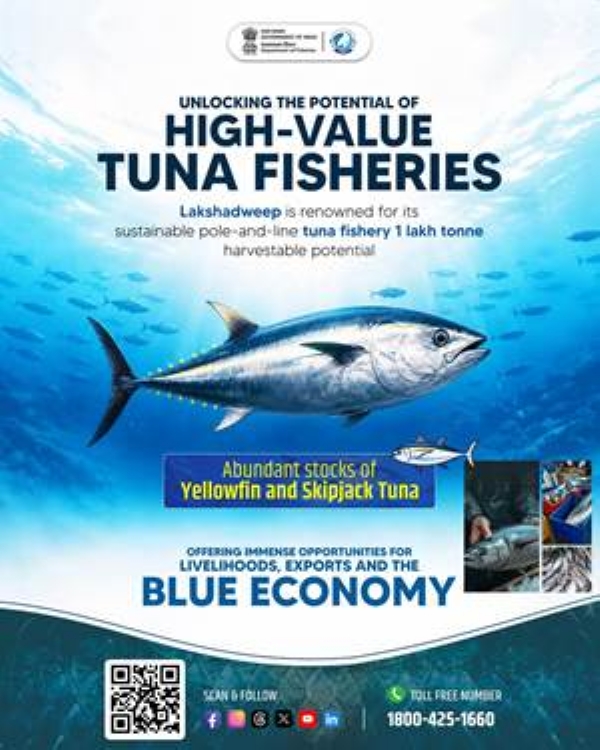
The government’s strategy accords special priority to tuna fisheries. High-value tuna species, including yellowfin, skipjack and bigeye, are found in abundance in the waters surrounding Lakshadweep and the Andaman and Nicobar Islands. The plan is to harness these resources scientifically and increase India’s share in both domestic and international markets.
Under a five-year plan, Lakshadweep has set a target of doubling its tuna production to 50,000 tonnes. To achieve this, the government will promote modern deep-sea fishing vessels, mother vessels and the traditional, environmentally friendly pole-and-line fishing technique.
In the Andaman and Nicobar Islands, a dedicated tuna cluster is being developed under the PMMSY. The initiative will cover the modernisation of fishing vessels, provision of new boats, upgrading of the fishing fleet and expansion of cold-storage facilities. In addition, efforts will be made to strengthen market linkages with the assistance of the Marine Products Export Development Authority (MPEDA) and promote direct seafood exports from the islands.
**Seaweed Cultivation to Open Up New Employment Opportunities**
Alongside tuna fisheries, seaweed cultivation is also being developed as a key pillar of the island economies. The pristine lagoons of Lakshadweep and the marine ecosystems of the Andaman and Nicobar Islands offer favourable conditions for seaweed farming.
Seaweed is used in the manufacture of food products, nutritional supplements, cosmetics, medicines and bio-industrial products. Lakshadweep is proposed to be developed as a dedicated seaweed cluster. The plan includes establishing large-scale cultivation facilities, seed banks, hatcheries, and training and capacity-building infrastructure. These initiatives could create new income-generating and self-employment opportunities for local residents, particularly coastal communities.
Ornamental fish farming will also be developed as a high-value commercial activity in the island territories. More than 300 species of ornamental fish associated with the coral reefs of Lakshadweep, in particular, offer considerable potential for the sector.
Under the government’s plan, emphasis will be placed on establishing medium-scale rearing units, promoting conservation-oriented and regulated collection practices, and developing markets for sustainably sourced aquarium fish. This could open up new business opportunities for local youth and entrepreneurs while ensuring the protection of marine biodiversity.
**Modern Infrastructure to Strengthen the Entire Fisheries Value Chain**
To strengthen the entire value chain of the fisheries sector, modern infrastructure will also be expanded across the islands. The proposed facilities include fish landing centres, ice-making plants, cold-storage and transportation networks, onboard fish preservation systems, fish aggregation devices, boat-building centres and value-addition units.
These facilities will help maintain the quality of fish, reduce post-harvest losses and promote processing at the local level. They will also make it easier to transport island-produced seafood to major domestic markets and international export hubs.
The broader objective of the government’s initiative is to develop Lakshadweep and the Andaman and Nicobar Islands into major centres of a diversified, ocean-based economy. By bringing together tuna fisheries, seaweed cultivation, ornamental fish farming, modern infrastructure, research and exports, the initiative seeks to create greater opportunities for value generation within the islands.
However, the success of these plans will depend on how effectively environmental protection and the conservation of coral reefs are ensured alongside the utilisation of marine resources. The active participation of local fishers, entrepreneurs and island communities will also be essential.
Overall, these new dimensions of fisheries development in Lakshadweep and the Andaman and Nicobar Islands are expected to strengthen the marine economy, expand local employment opportunities and give fresh momentum to India’s seafood exports.
---------------
Hindusthan Samachar / Jun Sarkar

18 Aug 2026