New Delhi, 01 November (H.S.): Newly appointed Chief of the Air Staff, Air Chief Marshal Ashutosh Dixit, has said that as the Indian Air Force transforms to meet the country's requirements over the next decade, it must remain prepared at all times to fight and win. He made the remarks on Sunday while outlining his priorities during his first address to Air Force personnel after taking over as the 29th Chief of the Air Staff.
Dixit assumed charge on October 31, succeeding Air Chief Marshal Amar Preet Singh, who retired after 42 years of distinguished service. Before taking over, he paid floral tributes to fallen soldiers at the National War Memorial. He also sought the blessings of his mother and mother-in-law by touching their feet before saluting them.
Air Chief Marshal Dixit arrived at the Racecourse Air Force Station in an electric vehicle to assume command. Embracing sustainable mobility, he has adopted an electric vehicle as a step towards promoting green transportation.
During his interaction with officers, he said, I feel deeply honoured to assume command of the Indian Air Force as its 29th Chief of the Air Staff.
He also expressed gratitude to the President, the Supreme Commander of the Armed Forces, the Prime Minister and the Defence Minister for the confidence they had reposed in him.
Earlier in the morning, he paid homage at the National War Memorial to the brave personnel who had made the supreme sacrifice in the service of the nation. He said their courage would remain the benchmark against which the Air Force would measure itself.
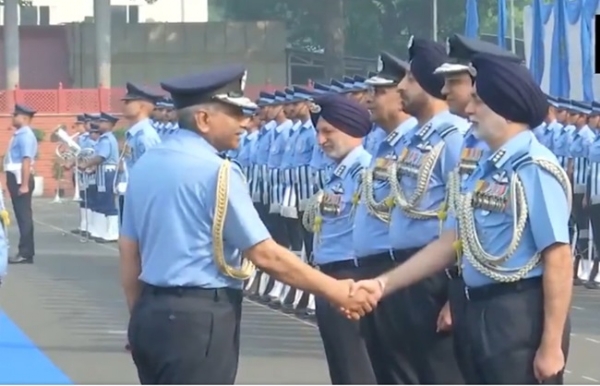
After receiving the Guard of Honour at the parade ground of Racecourse Air Force Station, Dixit acknowledged the contribution of his predecessor, Air Chief Marshal A.P. Singh, under whose leadership the Indian Air Force demonstrated the effectiveness of precise and decisive air power during Operation Sindoor.
I am taking over from Air Chief Marshal A.P. Singh, under whose leadership the Air Force demonstrated what precise and decisive air power can achieve during Operation Sindoor. I thank him for handing over a force that is fully prepared, he said.
He observed that India's security environment continued to remain challenging, while emerging technologies and systems were transforming the nature of warfare. These included drones, long-range precision weapons, space-based capabilities, cyber technologies, artificial intelligence and the electromagnetic spectrum.
The Air Force, while transforming into the force that India will need in the next decade, must always be ready to fight and win, he said.
The Air Chief Marshal outlined his priorities through the acronym VAYU, which represents Vigilance and Readiness, Atmanirbharta, Yukti and Unity of Effort.
Explaining the first pillar, he said V stood for Vigilance and Readiness. Every squadron, radar, air defence unit and air warrior must remain prepared to respond at a moment's notice. He added that restoring the Indian Air Force's combat strength to its sanctioned level would be one of his foremost priorities.
The second pillar, A, stands for Atmanirbharta or self-reliance. He identified the Tejas Mk-1A and Mk-II programmes, the Advanced Medium Combat Aircraft (AMCA), indigenous sensors and domestically developed weapons as key priorities.
We will fight with Indian solutions, and we will hold them in numbers that sustain operational requirements, he said, adding that while the Air Force's responsibility was to fight and win, its foremost objective should be to deter conflict through credible air power.
The third pillar, Y, represents Yukti, or innovation and ingenuity. Dixit said the Air Force would focus on innovation in doctrine, procedures and technology. Key areas would include networked, artificial intelligence-enabled command and control systems, layered counter-drone defences, responsive maintenance, force protection, resilience and the use of near-space as an operational domain for the Air Force.
He said these areas would remain under constant review, with sustained efforts directed towards their development and advancement.
The fourth pillar, U, stands for Unity of Effort. Linking this priority to the broader vision of JAI — Jointness, Atmanirbharta and Innovation — Dixit said the Air Force would work closely with the Indian Army, the Indian Navy and national agencies to plan and operate together.
Air power delivers the greatest effect when it is integrated from the very first plan, he said.
---------------
Hindusthan Samachar / Jun Sarkar

18 Aug 2026