




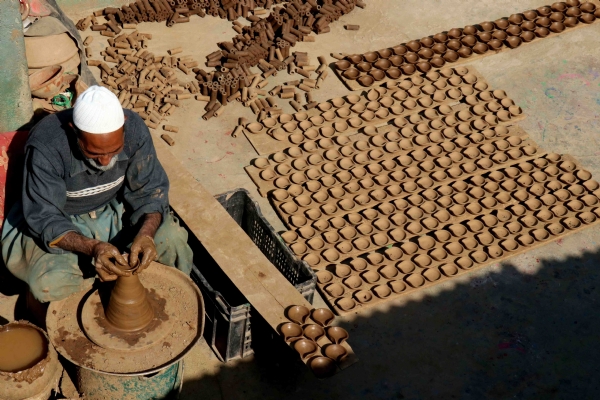
Srinagar, Nov 1 (HS): With Diwali, the festival of lights, about a week away, clay is taking the shape of lamps in a workshop at Ishber, Nishat, some 12 kilometres from the historic Lal Chowk. The family of Mohammad Umar Kumar is working day and night to make thousands of diyas that will light up homes across several states of north India on Diwali night. The hands shaping them belong to a Muslim family.
The practice is not new, but it grows bigger every year. Umar told Hindusthan Samachar that the family began making diyas in 2000. “First we got a small order, and every year after that we saw an extraordinary increase in it,” he said. According to him, it began with a few dozen diyas, and the number has now reached thousands, even tens of thousands.
For Umar, the Diwali season is not only a source of livelihood but also a source of a different kind of joy. “We are happy that a great festival like Diwali gives us a living too,” he said. “Making clay pots is our trade, but when these things are used in a festival, it gives us more happiness.”
The family starts making diyas about 20 days before Diwali, and the pace picks up as the festival draws near. Six people now work at the workshop, in two shifts to fulfil the orders. Where they once worked eight hours a day, they now work 16. About 10,000 diyas have been sold so far, according to Umar, and work on another 10,000 is under way.
Umar is a commerce graduate. Instead of taking up another job after graduating, he chose to carry on the family business. His family has been making clay pots for generations.
His customers come from several quarters. Orders come in online, Umar said, and traders also come in person to say how many diyas they need. “Every trader buys thousands of diyas,” he said. The diyas are used in Jammu and different parts of north India. Locally, Kashmiri Pandits and other Hindu families also come to the workshop to buy them, and soldiers are among the customers too.
Diyas are also available in Jammu and elsewhere, so why do people come to him? Umar gives two reasons: his diyas are made by hand, and they use natural materials. “Handmade diyas are people’s first choice,” he said.
He is not alone in the trade. Other potters also make diyas, which Umar considers a good thing, because demand is so high that no single unit could meet it. A trader with an order for thousands of diyas divides it among several potters.
It is worth mentioning that Ishber, where this Muslim family shapes diyas for Diwali, is also steeped in Hindu tradition. The village is home to Gupt Ganga, an ancient Shiva temple complex, according to the Ishwar Ashram Trust. It was here that scholar of Kashmir Shaivism Swami Lakshman Joo, known as “Lal Sahib,” settled in 1934 and later established Ishwar Ashram.
---------------
Hindusthan Samachar / Zahoor Hussain Bhat