Jamiat Ulama-i-Hind adopts resolutions against Uniform Civil Code and alleged attempts to target Muslims
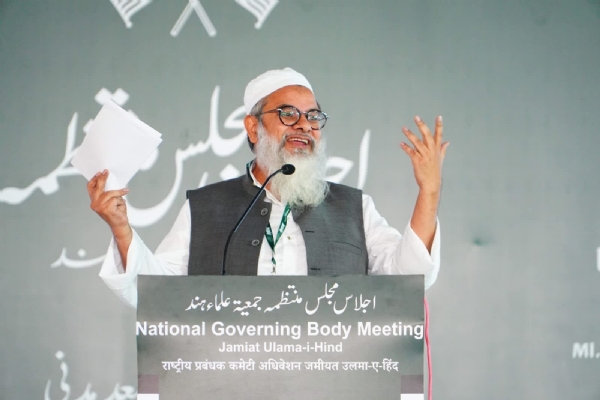
New Delhi, 01November (HS): The two-day meeting of the national executive of Jamiat Ulama-i-Hind discussed several important issues, including illegal infiltration, the constitutional rights of Muslims, religious freedom and the Uniform Civil Code (UCC). Jamiat president Maulana Mahmood Asad Madani questioned the accountability of Union Home Minister Amit Shah and the Central Government over the issue of illegal infiltration. He said the organisation did not support the unlawful presence of any foreign national in India, but maintained that preventing illegal infiltration was the responsibility of the Ministry of Home Affairs.
The meeting was held in Nuh (Mewat), Haryana, on October 30 and 31, and was attended by more than 3,000 Islamic scholars from across the country.
Addressing the gathering, Maulana Madani said that if the Home Minister allowed illegal infiltration or deliberately failed to prevent it, he would be the biggest traitor. He questioned why Muslims were being politically targeted instead of holding accountable the ministry entrusted with the responsibility of preventing illegal infiltration.
### Demand for an Independent Commission to Examine Demographic Changes
The national executive adopted a resolution rejecting what it described as misleading narratives surrounding the Muslim population and demographic changes, particularly allegations of ‘demographic jihad’.
Citing figures from the Census and the National Family Health Survey, the resolution stated that the growth rate of the Muslim population had declined from 32.9 per cent during 1981–1991 to 24.7 per cent during 2001–2011. According to Jamiat, demographic changes should be understood in the context of education, employment and socio-economic conditions rather than through a communal lens.
The organisation called upon the government to constitute an independent and impartial commission comprising internationally recognised experts to conduct a scientific study of migration, education, employment and socio-economic conditions.
The meeting also adopted a resolution opposing efforts to implement the Uniform Civil Code in Gujarat, Uttarakhand, Assam and other states. The organisation described the UCC as a challenge to religious freedom, autonomy in family matters and the fundamental rights guaranteed by the Constitution.
According to Jamiat, Islamic provisions governing marriage, divorce and inheritance are rooted in the Quran and Hadith. Any intervention in these matters, it maintained, raises serious concerns relating to the religious freedom of Muslims.
Jamiat also objected to the exemption granted to Scheduled Tribes from the UCC in Uttarakhand and Gujarat while Muslims were brought within its ambit. The organisation said this raised questions concerning the constitutional principle of equality and cited Articles 14, 25 and 26 of the Constitution.
The national executive decided to intensify the legal battle against the Uniform Civil Code and challenge the relevant laws in Uttarakhand, Gujarat and Assam before the respective High Courts and the Supreme Court. It also called for a broader democratic campaign in coordination with the All India Muslim Personal Law Board, Sikh, Christian, Dalit, Adivasi and other organisations.
The organisation further decided to submit memoranda to the President, the Prime Minister, the Union Law Minister, and the Governors and Chief Ministers of the concerned states.
Maulana Madani also questioned the political narrative that the majority community was under threat. He said the country’s real challenge was not the security of the majority community but the pursuit of power and political positions.
He urged Muslims to remain committed to Shariah while ensuring that women received their rightful entitlements and justice within their families. He particularly emphasised the need to handle matters relating to divorce, maintenance and mehr with honesty and fairness.
---------------
Hindusthan Samachar / Jun Sarkar
18 Aug 2026