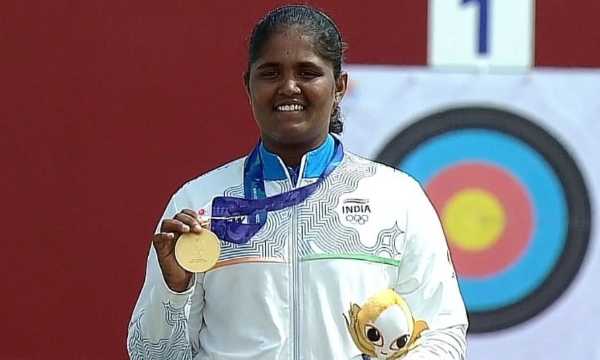
New Delhi, 09 October (H.S.): Indian archer Kumkum Mohod, who made history at the age of just 17 at the Asian Games, has now set her sights on the 2028 Los Angeles Olympics. The gold medallist in the women’s individual recurve event said her ultimate dream is to win gold medals in both the individual and team events at the Olympics. She also acknowledged that achieving this ambition would require sustained improvements in her technique, physical strength and mental resilience.
Hailing from Amravati in Maharashtra, Kumkum won three medals at the Asian Games, comprising two golds and one silver. She clinched the women’s individual recurve gold after defeating South Korea’s Oh Ye-jin in a shoot-off in the final. With this victory, she became the first Indian woman to win the gold medal in the individual recurve event at the Asian Games. She also secured gold in the women’s team event and silver in the mixed team competition.
Speaking at a virtual press conference organised by the Sports Authority of India (SAI) on Friday, Kumkum said her success at the Asian Games would boost the confidence of Indian archers. She emphasised the significance of defeating South Korea, a formidable force in international archery.
“Beating South Korea was also important. India had not won a medal of this kind in the individual event before. I believe this achievement will help India perform even better in upcoming competitions because the athletes’ confidence has increased,” she said.
Discussing her ambitions of qualifying for and winning a medal at the Los Angeles Olympics, Kumkum said she did not want to put herself under unnecessary pressure over selection. Instead, she intends to concentrate on performing to the best of her ability.
“If I work hard, I will make it to the Olympics. I just have to give my best. If I keep thinking that I must get selected at all costs, things will become difficult. If I remain relaxed and compete without stress, I will get selected and win a medal for the country as well,” she said.
Kumkum explained that, following the Asian Games, her priorities include refining her technique, improving her physical strength and developing greater mental toughness. She stressed that consistency in training is essential in archery, as even a short break can affect performance.
“If I do not practise for two or three days, I start feeling a tremor in my hand, and my control can be affected,” she explained, underlining her determination to work on her strength and technique every day.
Kumkum identified fellow Indian archer Dhiraj Bommadevara as her role model, praising his discipline and consistency as qualities she hopes to emulate. She also described winning silver alongside him in the mixed team event as a particularly memorable experience.
According to Kumkum, Dhiraj advised her to focus on her own performance rather than worrying about the outcome during a match. His message was to trust herself, avoid being distracted by the identity of her opponents and carry herself like a champion.
Reflecting on the mixed team event, in which India narrowly missed out on gold, Kumkum acknowledged that there were shortcomings in her execution. However, she said the experience had also provided valuable lessons. Competing alongside Dhiraj helped ease the pressure, and his encouragement to enjoy the match while giving her best made a difference.
Kumkum credited her family, particularly her parents, for playing a crucial role in her journey. She recalled that even when her performances were disappointing in the early days, her parents never suggested that she abandon archery. Instead, they continued to encourage her and reinforce her belief in herself.
“My parents have always motivated me. Even when I was not performing well, they never told me to give up the sport. My father still tells me, ‘Kumkum, you are the one who will make history at the Olympics.’ Their encouragement means a great deal to me,” she said.
Kumkum revealed that her mother inspired her to take up archery after watching another archer from Amravati, Unnati. She began training in the sport at around eight or nine years of age and developed a strong interest in it within six months.
She also acknowledged the importance of the training facilities available in Amravati and a scheme that provides equipment to athletes who win medals at the national level, describing such support as beneficial to aspiring archers.
Recalling the reception she received in Amravati following her Asian Games triumph, Kumkum said the experience was entirely new for her. A rally was organised in her honour, posters featuring her were put up across the city, and local residents and officials came forward to welcome her.
Smiling as she recalled the change in public attention, she said, “Earlier, we used to ask other people for photographs, but now people want to take photographs with us. It feels wonderful and makes me proud.”
Speaking about her interests outside archery, Kumkum said she enjoys listening to music and reading books, and occasionally watches films as well.
She also praised Indian para archers Sheetal Devi and Payal Nag, describing their performances on the international stage and their mental strength in the face of physical challenges as deeply inspiring.
Kumkum said fans could expect her to aim for gold medals in both the individual and team events at the Los Angeles Olympics. However, she reiterated that her immediate priority would remain hard work, consistent preparation and delivering her best performance whenever she competes.
For the young Indian archer, her historic success at the Asian Games is not the culmination of her journey but the beginning of a larger pursuit: Olympic glory on the world’s biggest sporting stage.
---------------
Hindusthan Samachar / Jun Sarkar

18 Aug 2026
Cincinnati Open: Williams Sisters Fall in First Round, Kostyuk-Stearns Duo Edges Them Out in Super Tiebreak

18 Aug 2026