New Delhi, 09 October (H.S.):
Union Health Secretary Punya Salila Srivastava has said that digital health resources play a crucial role in nurturing a culture of research in India and strengthening medical education. She emphasised the need to promote a scientific outlook towards research and encourage original research to build the country's indigenous research capabilities. She also noted that the National Medical Library (NML) network has expanded to 93 medical colleges and called for efforts to extend its reach to every medical college in the country, particularly institutions in resource-constrained regions.
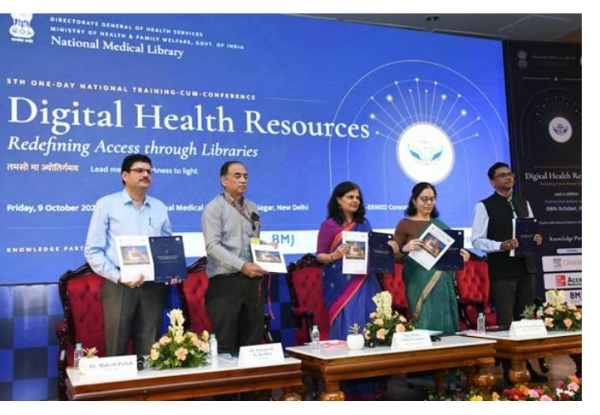
Srivastava was addressing the fifth one-day National Training-cum-Conference of the ERMED Consortium at the National Medical Library in New Delhi on Friday. Organised under the Directorate General of Health Services (DGHS), Ministry of Health and Family Welfare, the conference was themed “Digital Health Resources: Redefining Access Through Libraries”. The event aimed to strengthen the role of digital knowledge resources in medical education, healthcare delivery and evidence-based medical practice.
The Health Secretary said continuous learning and professional development were essential in the medical field. Healthcare is evolving rapidly, with new diseases being identified, innovative treatments being developed and medical practices undergoing constant change. In this context, well-equipped libraries and easily accessible digital resources can help doctors and healthcare professionals stay abreast of the latest developments, ultimately enabling them to provide better treatment to patients.
She observed that digital health resources are not merely tools for accessing information but also serve as an important foundation for building a robust research ecosystem in the country. Referring to Prime Minister Narendra Modi's vision, she stressed the importance of strengthening indigenous research capabilities and fostering scientific thinking.
While acknowledging that India could benefit from research conducted in other countries, Srivastava said the nation could not fulfil its aspirations by relying exclusively on external research. It was therefore essential to cultivate a strong research culture at home and enhance the country's capacity for original scientific inquiry.
Srivastava said the One Nation, One Subscription initiative and the ERMED Consortium complemented each other by expanding access to research papers and academic publications. These initiatives, she noted, would promote evidence-based learning in medical education and help create a conducive environment for research and innovation.
Describing the National Medical Library as an important institution, she said it should evolve into a major hub for access to knowledge and contribute meaningfully to the vision of Viksit Bharat, or a developed India.
She urged the library to develop a comprehensive roadmap for strengthening access to digital health resources. She also suggested exploring the potential of artificial intelligence (AI) in medical education, research and professional development.
The Health Secretary further underscored the need for medical institutions across states and Union Territories to share best practices, experiences and effective approaches to library management. Such collaboration, she said, could improve the availability and utilisation of digital knowledge resources across the country.
Addressing the conference, Additional Secretary Dr Vinod Kothwal observed that while physical assets may diminish when used, knowledge grows when it is shared. He said libraries were founded on this principle of knowledge-sharing.
He identified three key pillars of a medical college: faculty, infrastructure and knowledge resources. Access to books, research journals and other academic materials, he emphasised, was essential for strengthening medical education and advancing research.
The conference also featured discussions on expanding access to digital medical knowledge and ensuring its effective utilisation. In addition, hands-on training was conducted on four digital platforms to familiarise participants with their practical applications.
The training aimed to equip healthcare professionals with the skills needed to make better use of digital resources, enabling them to translate available information into evidence-based research and improved healthcare delivery.
---------------
Hindusthan Samachar / Jun Sarkar
18 Aug 2026