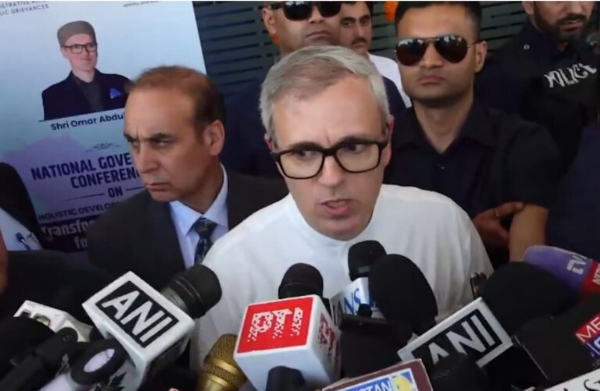
Srinagar, 06 October (H.S.): Jammu and Kashmir Chief Minister Omar Abdullah on Tuesday welcomed the Supreme Court's remarks questioning voter deletions under the Special Intensive Revision, but said it remains to be seen how far the court will go in rectifying it after taking responses from the Election Commission and the Centre.
Abdullah also said the Uniform Civil Code (UCC) will not be implemented in Jammu and Kashmir as such a pan-India law ought to be debated and passed in Parliament.
It is good that the Supreme Court is also raising questions now, especially regarding the deletions that took place from the voter lists. The Supreme Court has also sought responses from the Election Commission and the Government of India. To what extent this will be rectified through the court, we will have to wait and see, Abdullah told reporters here.
Talking about the INDIA bloc MPs' march to the EC office, he said, This process will continue. We had been raising this issue repeatedly, but very few people paid attention. Now the media has also started speaking about it, he said.
On the UCC implementation, Abdullah reiterated that a Uniform Civil Code is not truly uniform until it is implemented everywhere.
We will not implement the Uniform Civil Code here. In Bihar as well, Nitish Kumar's party has said they will not implement it. Similarly, other governments have said the Uniform Civil Code will not be applied in their states. So, this is only being implemented by the BJP, he said.
These matters are not handled from state to state. If you have the courage, bring legislation in Parliament. Debate it in Parliament, and then let's see whether it passes in Parliament or not. They will not introduce this law in Parliament because they do not have the numbers in Parliament to get it passed. That is why, bit by bit, the BJP is implementing this bit by bit across their own states, which is wrong, he added.
On the deportation of Bangladeshis from Jammu and Kashmir, the chief minister said foreigners entering India without authorisation cannot stay here.
Looking at it practically, their presence here has not really caused us any particular trouble. However, it is also true that they cannot stay illegally, he said.
Abdullah, however, sought to draw a distinction between illegal Bangladeshis and Rohingya refugees staying in India.
Those who have entered from Bangladesh without authorization are a different matter altogether. But the Rohingyas are being needlessly targeted. When they were expelled from their country, we gave them refuge here, gave them a little space, and allowed them to stay here for the time being until conditions in their country improved. Now, suddenly taking action against them seems a bit strange to me, he said.
---------------
Hindusthan Samachar / Krishan Kumar
18 Aug 2026
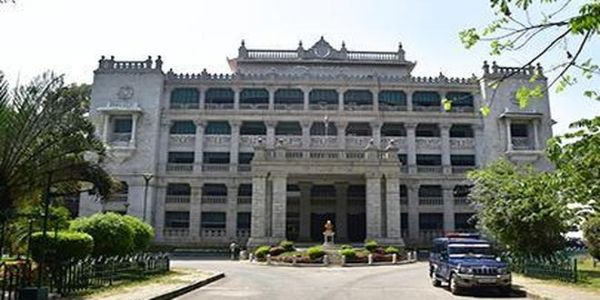
ED raids KPSC office, 20 other locations over Karnatak veterinary recruitment scam
ED raids KPSC office, 20 other locations over Karnatak veterinary recruitment scam..