Defence Minister says self-reliance in aerospace must extend to indigenous aero-engine capability
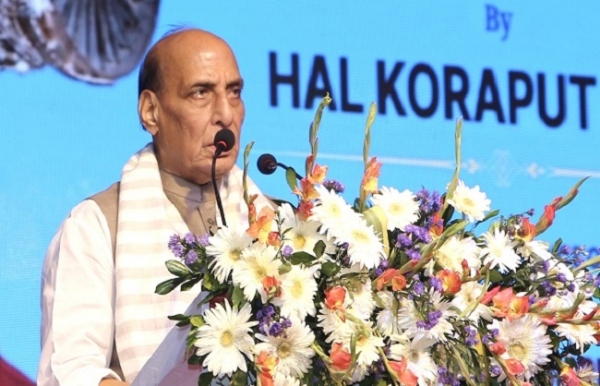
New Delhi,06 October (HS). Hindustan Aeronautics Limited’s (HAL) Koraput Division on Tuesday delivered its 2,000th aero engine. On the occasion, Defence Minister Rajnath Singh announced the launch of a second production line for the Shakti engine. Describing the milestone as a major achievement in India’s aerospace journey, he called for strengthening indigenous capabilities in the design, development, testing, manufacturing and maintenance of advanced aero engines. He stressed that mastering propulsion technology is essential for achieving self-reliance in the aerospace and defence sectors.
Congratulating the engineers, technicians, scientists and skilled workforce of HAL Koraput, Rajnath Singh said the delivery of 2,000 engines represented 2,000 significant contributions to the operational capabilities of the defence forces. Highlighting HAL Koraput’s contribution to military aviation, he said its engines have powered frontline aircraft such as the MiG-21, MiG-27, MiG-29 and Sukhoi-30MKI. He also praised HAL Koraput’s indigenous repair and overhaul capabilities, under which more than 9,000 engines have been overhauled so far. He said the indigenisation of components and reduction in turnaround time were contributing to greater operational readiness and extending the service life of critical defence assets.
The Defence Minister emphasised that self-reliance in aerospace must be extended to indigenous aero-engine capabilities, particularly for the Advanced Medium Combat Aircraft (AMCA) programme. He highlighted a proposed investment of around Rs 5,000 crore, the indigenisation of raw materials in partnership with Mishra Dhatu Nigam Limited (MIDHANI), and the establishment of India’s first indigenous high-thrust engine testing facility. He said a sovereign aerospace ecosystem requires indigenous capabilities across materials, design, manufacturing, testing, and maintenance, repair and overhaul (MRO).
He also announced an investment of Rs 218 crore for the second Shakti engine production line. The new line will have the capacity to manufacture up to 100 engines annually and is scheduled to become fully operational by 2028-29. The engines will be used for indigenous helicopters such as the Dhruv Advanced Light Helicopter and Prachand Light Combat Helicopter.
Emphasising the need for reliable indigenous propulsion for India’s helicopter ecosystem, Rajnath Singh said the defence forces require engines that are available when needed. Aero-engine development is a long-term endeavour that requires sustained investment, specialised testing, skilled manpower and a robust industrial ecosystem.
---------------
Hindusthan Samachar / Jun Sarkar

18 Aug 2026