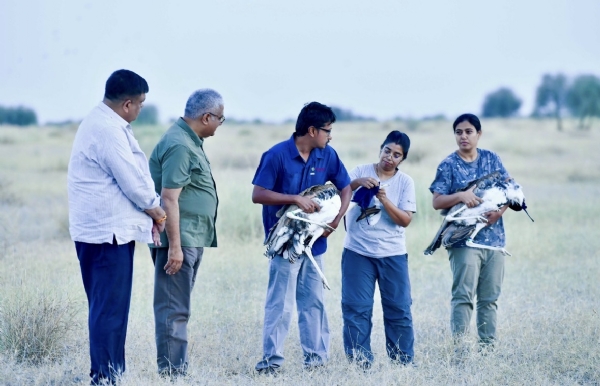
New Delhi, 04 October (H.S.): Union Minister for Environment, Forest and Climate Change Bhupender Yadav on Sunday released two male Great Indian Bustards, locally known as Godawan, into the wild in the Sam area of the Desert National Park in Jaisalmer, Rajasthan. Rajasthan Minister of State for Forest and Environment Sanjay Sharma, along with senior officials from the Central and state governments, was present on the occasion.
The Great Indian Bustard is the state bird of Rajasthan. It is an extremely rare, large terrestrial bird found in the Indian subcontinent and is also one of the world’s heaviest flying birds.
According to the Union Ministry of Environment, Forest and Climate Change, Yadav said the achievement was the result of nearly a decade of sustained efforts by scientists, researchers and field-level personnel. He expressed his gratitude to Prime Minister Narendra Modi for his guidance and support in the conservation of the Great Indian Bustard and other species.
The release marks an important step in India’s Great Indian Bustard conservation programme, moving beyond the development of a viable population through conservation breeding towards the reintroduction of captive-bred birds into their natural habitat. The experience gained from releasing the birds into the wild will be used to further refine protocols for future reintroduction efforts.
The Great Indian Bustard Conservation Programme is a joint initiative of the Ministry of Environment, Forest and Climate Change, the Rajasthan Forest Department and the Wildlife Institute of India (WII). It receives technical support from the International Fund for Houbara Conservation and financial assistance from the National Compensatory Afforestation Fund Management and Planning Authority (National CAMPA).
The programme focuses on conservation breeding, habitat management, threat mitigation, habitat restoration and the involvement of local communities in conservation efforts.
The Great Indian Bustard conservation-breeding centres at Sam and Ramdevra currently house 97 birds. Of these, 40 were obtained from eggs collected from wild nests, while 57 were born in captivity. As many as 86 birds are being retained for breeding, while 11 have been identified for release into the wild. Two of these birds were released into the Desert National Park on Sunday.
Under the conservation-breeding programme, 24 chicks survived in 2025 and another 29 survived in 2026.
The scientific efforts also include the “Jumpstart” technique, under which captive-laid eggs were placed in wild nests and subsequently accepted by female Great Indian Bustards. The technique resulted in the successful hatching of six chicks in Rajasthan and two in Gujarat.
Notably, the Rajasthan Forest Department has developed grassland enclosures covering approximately 200 square kilometres within the Desert National Park. Long-term telemetry studies conducted by the Wildlife Institute of India have identified these areas as important breeding habitats for the Great Indian Bustard.
Conservation measures for the species are being implemented in accordance with the Supreme Court’s directions and based on recommendations made by the expert committee constituted in this regard.
---------------
Hindusthan Samachar / Jun Sarkar

18 Aug 2026