408 senior Sangh office-bearers, including Dr Mohan Bhagwat and Dattatreya Hosabale, taking part
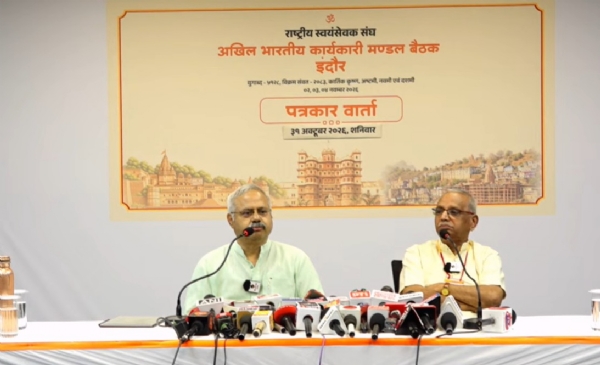
Indore, 31 October (HS): Sunil Ambekar, Akhil Bharatiya Prachar Pramukh of the Rashtriya Swayamsevak Sangh (RSS), said on Saturday that a new action plan will be drawn up, running from the organisational expansion carried out across the country in the centenary year to future expansion.
Sunil Ambekar said that, in its centenary year, the Sangh is preparing to mould the experiences of organisational expansion, social outreach and service activities across the country into a plan for the future. To this end, the annual meeting of the Sangh’s Akhil Bharatiya Karyakari Mandal will be held at the Daly College grounds in Indore from 2 to 4 November. He gave detailed information about this to journalists today.
He said that this three-day deliberation, to be held in the presence of the top leadership, including Sarsanghchalak Dr Mohan Bhagwat and Sarkaryavah Dattatreya Hosabale, and 408 senior workers from across the country, would be important for the organisation’s future direction.
He said the meeting would review the centenary-year programmes and assess organisational expansion, Hindu sammelans, the Griha Sampark Abhiyan (house-to-house outreach campaign), society’s participation in service work, and the increased contact among youth and women. Possible changes in organisational structure, public awareness (janjagaran), Panch Parivartan, the challenge of narcotics, content circulated on digital platforms, interference by external forces and global circumstances will also be considered. The experiences from the Sarsanghchalak’s visits abroad, and a strategy for taking forward his dialogue with prominent people around the world, will also be on the agenda.
13,000 new shakhas give a new picture of organisational expansion
The meeting will centre on figures relating to organisational expansion and the experiences that emerged during the centenary year. According to the Akhil Bharatiya Prachar Pramukh, the number of the Sangh’s daily shakhas across the country has risen to 1,01,151 (101,151). In addition, weekly, monthly and other types of milan programmes have reached 1,10,849 places. Since October 2025, 13,000 new shakhas have begun across the country. These figures present a picture of the geographical spread of the Sangh’s organisational activities.
Ambekar said the Sangh had drawn up a work-expansion plan for the three years before the centenary year. During this period, the emphasis was on extending the organisation’s reach, establishing contact with various sections of society and broadening the participation of swayamsevaks. Now that the series of centenary-year programmes has been completed, the Akhil Bharatiya Karyakari Mandal will assess the whole process. It will discuss where the organisation’s activities grew, in which areas society’s participation was greater, and, on the basis of the experience gained, which subjects should be given priority going forward.
65,660 Hindu sammelans, social contact the main foundation
He said the Hindu sammelans held during the centenary year were a major part of the Sangh’s social outreach activities. According to available information, 65,660 Hindu sammelans have so far been held at the level of mandals (clusters of villages) and urban neighbourhoods. Through these events, efforts were made to increase dialogue and participation among different sections of society.
Alongside a review of the experiences of these sammelans, the meeting will also consider how the suggestions and social feedback received from them can be incorporated into future activities. The review is important for the Sangh also because it can help lay the groundwork for linking the centenary-year programmes to continuing social contact and participation. The Griha Sampark Abhiyan will also be among the main topics of the meeting.
He said society gave good support to the campaign. The expansion of service work and the growing enthusiasm of various organisations working for social good will also be discussed. Several organisations have expressed a wish to work together with the Sangh. As required, ways of taking such efforts forward with the help of swayamsevaks will be considered.
Participation of women and youth will also be assessed
Women’s participation in the centenary-year programmes was also notable. This aspect emerged in the experiences of the Griha Sampark Abhiyan, the Hindu sammelans and other activities. In addition, large numbers of young men and women took part in programmes organised for youth in cities, villages and educational institutions.
The Akhil Bharatiya Karyakari Mandal is preparing to review these programmes in a positive light. Consideration will be given to setting the direction of future activities on the basis of the suggestions and expectations received from the sections of society where contact has grown. Experiences relating to dialogue among youth, awareness on social issues and participation in service work will be an important part of this process.
A significant item on the Indore meeting’s agenda is also the possible change in the Sangh’s organisational structure. According to Ambekar, there has already been deliberation on the structure. The subject will now be discussed further at the Akhil Bharatiya Karyakari Mandal meeting, and the shape of the future arrangement will be considered. Preparations are under way to begin work from March next year in line with the proposed organisational structure. The deliberations at the meeting will therefore be important for the organisation’s future functioning. Discussion is also proposed on the role of public awareness in organisational work.
According to the Sangh, there are many subjects in social life on which it is necessary to take correct information and perspective to society. Ways of presenting such subjects effectively through public awareness will be considered. The meeting will also deliberate on how experiences from social contact can be linked to the organisation’s forthcoming programmes.
From narcotics to digital content: deliberation on challenges
Alongside organisational expansion, the meeting will hold wide-ranging discussion on contemporary social challenges and subjects of national importance. The growing problem of narcotics, content circulated on new digital platforms, interference by external forces and the changing global scenario are among the main topics.
There will also be discussion of the future course of action on the important issues raised in Sarsanghchalak Dr Mohan Bhagwat’s Vijayadashami address. The role of public awareness and organisational activities will be considered in the context of challenges emerging in social conditions. On the basis of these discussions, an effort will be made to give direction to forthcoming priorities and programmes.
Ambekar also said that subjects related to the Sangh’s Panch Parivartan are included on the meeting’s agenda. Plans for taking these forward will be considered. Linking the experiences of the centenary-year programmes to forthcoming activities will be an important aspect of this process.
Experiences of visits to the US, Canada and the UK also on the agenda
The Sarsanghchalak Dr Mohan Bhagwat’s visits to the United States, Canada and the United Kingdom this year will also be discussed at the Akhil Bharatiya Karyakari Mandal. During these visits he shared his views on subjects such as the concept of Hindutva, India’s progress and India’s role in the context of world peace. The experiences of dialogue with prominent people from various fields will also be reviewed. Ways of carrying forward efforts at global contact and dialogue in the coming period will also be considered. Experiences relating to presenting India’s ideas and outlook at the global level amid changing international circumstances will form part of this discussion. The plan for the Sarsanghchalak’s travel programmes for the coming year will also be considered at the meeting.
Answering questions at the press conference about the Sangh’s future action plan, Ambekar made clear that the centenary year has been an opportunity for broad social outreach and dialogue for the Sangh. During this time, efforts were made to reach different sections of society through Griha Sampark, Hindu sammelans and various social programmes. Attention will now be given to taking these initiatives forward and widening their impact.
Nationwide events on the 650th birth anniversary of Sant Ravidas
Ambekar said that this year is the 650th birth anniversary of Sant Ravidas. The Sangh had issued a statement on the subject at its previous meeting. Since then, Sangh workers have been organising various programmes across the country. These events are being held to take Sant Ravidas’s ideas, his message of social harmony and his vision of bringing society together to a wide audience. The subject is also regarded as important in the context of the Sangh’s Panch Parivartan initiative.
He said that during the centenary year the Sangh had placed the five themes of Panch Parivartan before society. Through Griha Sampark, Hindu sammelans and other programmes, efforts were made to take these themes to all sections of society. The Sangh’s endeavour is that these themes become part of conduct and collective participation in social life.
Possibility of forming new organisations, but no immediate plan
Asked about increasing the number of Sangh-inspired organisations, Ambekar said this is a continuous process. With time, new subjects and fields of work come before society. When the need to work on such subjects is felt, an initiative is taken, and in due course separate organisations may also develop for them. He did not rule out expansion in future, though he made clear that no immediate plan is under consideration at present.
Not opposed to new technology; emphasis on its judicious use
On digital media, new means of communication and content circulated on various platforms, Ambekar said the Sangh regularly discusses and reviews contemporary issues. In the centenary year, the Sangh has tried to put forward its views on its ideas, the concept of Hindutva, India’s identity, the country’s future direction and elements that create confusion in society. He made clear that the Sangh is not opposed to any medium or new technology.
Responding to a question about public discourse on the Sangh’s ideas and the concept of Hindutva, he said that the Sangh’s national thinking and ideology have been discussed for the past hundred years. The Sangh has always been ready for such discussions. From the Sarsanghchalak to other office-bearers of the organisation, all remain available for dialogue.
No separate strategy needed to engage youth
Dismissing the need for any special strategy to increase youth participation in the Sangh, Ambekar said that the Sangh’s organisational structure is itself built on reaching young people and involving them in its activities. There is regular dialogue with young people, and they are continuously taking part in the Sangh’s programmes.
He said thousands of new people have taken part in the Sangh’s introductory training programmes. Around two lakh people took part in training programmes last year. Special youth conferences were also held during the centenary year. At these programmes, young people’s questions and doubts were discussed and the Sangh’s perspective was placed before them. The Sarsanghchalak also interacted with young people at various places.
Social participation described as important for economic stability
Replying to a question on global instability, India’s economic condition and the Sangh’s role in strengthening the country, Ambekar said that, despite instability in many parts of the world, India has maintained stability and is moving forward on the path of development. He said the Sangh has always believed that positive participation by society is extremely important for the nation’s progress. It is with this aim that the Sangh works to increase social participation. Various organisations associated with the Sangh have also, from time to time, placed their views on subjects of economic and national importance before society and the government. The necessary efforts to make India capable and strong in every field will continue.
The Sangh’s view on agitations: the nation’s interest above all
On the Sangh’s stance towards agitations and protests in the country, Ambekar raised an important question. He asked why the Sangh should be expected to stand for or against every issue that arises in the country. Citizens have the right to raise questions on national issues and to put forward their views. At the same time, he stressed the need for caution about the objectives and direction of agitations. In his view, it must be ensured that agitations are in the national interest and driven by a spirit of taking the country forward. No force should be allowed to misuse them and give elements working against national interests an opportunity to enter them. The Sangh keeps a constant watch on this aspect.
Meaning of “Param Vaibhav”: a prosperous, secure India free from social evils
Explaining the meaning of Param Vaibhav (supreme glory) in the Sangh’s conception, Ambekar said India should become a prosperous nation in which no person faces want. The country should be happy and secure, and a society free from social evils should be built. Feelings of mutual love, affinity and harmony among people should be strengthened. He said that when India develops national capability at this level, it will be able to make an effective contribution to the welfare of the world along with its own progress. India should also have the strength to support positive forces in the world and to prevent terrorist and destructive forces from becoming a threat to humanity. Building and sustaining such national strength is the core concept of Param Vaibhav.
UGC circular described as unbalanced; appeal to maintain social unity
On the UGC circular and the concerns of some sections of society, Ambekar said the Sangh has already clarified its position on the matter and has described the circular as unbalanced. The matter has been brought to the notice of the concerned authorities. The government and the UGC have also taken note of it. After a court stayed it, the matter is sub judice. He said that any further action on this subject should be based on a balanced approach. Asked about the Sangh’s organisational form and its registration, Ambekar clarified that there is at present no proposal or thought of registering the Rashtriya Swayamsevak Sangh as an organisation.
Senior office-bearers of 46 prants and 11 kshetras to attend
All six Sah Sarkaryavahs of the Sangh, the heads of the Akhil Bharatiya work departments and members of the executive will attend the three-day meeting. In addition, the Prant Sanghchalaks, Prant Karyavahs, Prant Pracharaks, Sah Pracharaks and their associate office-bearers from the country’s 46 prants (provinces) will be present. Senior office-bearers of all 11 kshetras (regions) of the Sangh are also expected at the meeting. Participation will thus range from the organisation’s national leadership to key workers from the various prants and kshetras.
It is worth noting that this event in Indore, coming after the completion of the centenary-year programmes, will give the Sangh an opportunity to review the experiences of the past year and to consider priorities for the coming years. The deliberations on subjects such as the expansion of shakhas, social contact, service work, organisational structure and global dialogue will play an important role in deciding how the momentum built during the centenary year is to be sustained.
At the press conference, the Sangh’s Akhil Bharatiya Prachar Pramukh was joined on the stage by Dr Prakash Shastri, Sanghchalak of the Malwa prant. Akhil Bharatiya Sah Prachar Pramukh Narendra Thakur, Pradeep Joshi and Kailashchandra, Prachar Pramukh of the Madhya Kshetra, were also present.
---------------
Hindusthan Samachar / Mayank Chaturvedi
18 Aug 2026