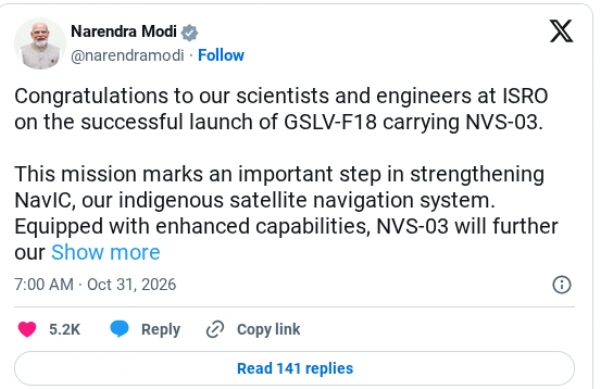
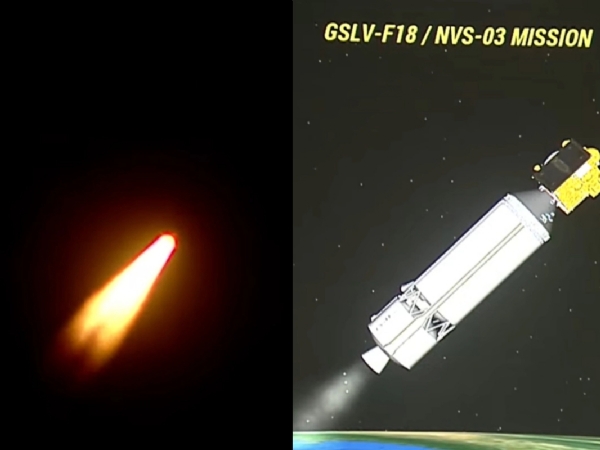
New Delhi, 31 October (H.S.): Prime Minister Narendra Modi on Saturday congratulated the Indian Space Research Organisation (ISRO) scientists and engineers on the successful launch of navigation satellite NVS-03, describing the mission as an important step towards strengthening India's indigenous satellite navigation system, NavIC.
The GSLV-F18 rocket carrying NVS-03 lifted off at 11.51 pm on Friday, October 30, from the second launch pad at the Satish Dhawan Space Centre in Sriharikota. Following a flight of approximately 18 minutes, the satellite was successfully injected into its designated Geosynchronous Transfer Orbit (GTO).
In a post on X at around 7 am on Saturday, the Prime Minister congratulated the ISRO team on the mission. He said the launch marked an important step in strengthening NavIC, India's indigenous satellite navigation system, and that NVS-03, equipped with enhanced capabilities, would further the country's pursuit of self-reliance in critical technologies and support navigation services benefiting people.
Modi also praised the dedication and ingenuity of India's space scientists, saying their work continued to make the nation proud.
ISRO Chairman V. Narayanan announced the successful completion of the mission shortly after the launch, stating that all systems of the launch vehicle had performed as expected and that the satellite had been precisely placed in its intended orbit.
Describing NavIC as a strategic national asset, Narayanan said the system provides independent Positioning, Navigation and Timing (PNT) services. Its applications include real-time tracking of trains, vehicles and shipping vessels, besides supporting strategic and other civilian requirements.
Narayanan also highlighted the importance of the NavIC constellation to the government's 'One Nation, One Time' initiative, which aims to strengthen India's independent timekeeping infrastructure. He said the satellite would complement the three navigation satellites already in operation and restore the constellation to its minimum operational configuration of four satellites.
Union Minister of State (Independent Charge) for Science and Technology Jitendra Singh also congratulated Team ISRO on the successful GSLV-F18/NVS-03 mission. He said the achievement reflected India's growing capabilities in space technology and its commitment to strengthening sovereign, indigenous navigation capabilities.
Singh also credited the space-sector reforms introduced in recent years for supporting India's progress and referred to the vision of the pioneers of the country's space programme, Vikram Sarabhai and Satish Dhawan.
NVS-03 is the third satellite in ISRO's second-generation Navigation Satellite series. Weighing 2,232 kg, it carries indigenous and procured atomic clocks, including an Indian-developed Rubidium atomic clock. The satellite will transmit navigation signals in the L1, L5 and S bands, adding capabilities to the existing NavIC network.
Atomic clocks are essential to satellite navigation because they provide the precise timing signals required to determine the position of users on the ground. The inclusion of an indigenous clock is an important step in strengthening India's domestic capabilities in a critical component of navigation technology.
NavIC, or Navigation with Indian Constellation, is India's independent regional satellite navigation system, designed to provide positioning, navigation and timing services across the country and up to approximately 1,500 km beyond its borders. Its services include a Standard Positioning Service for civilian users and a Restricted Service for authorised users.
The GSLV-F18 mission marked the 20th flight of the launch vehicle. Narayanan said the mission was completed with a turnaround time of 56 days between successive GSLV missions. He congratulated the ISRO team, industrial partners and academic institutions involved in the launch, noting that nearly 80 per cent of the budget had been channelled into Indian industries.
The successful launch marks another step in India's efforts to strengthen its independent navigation infrastructure and reduce dependence on foreign satellite navigation systems.
---------------
Hindusthan Samachar / Indrani Sarkar

18 Aug 2026