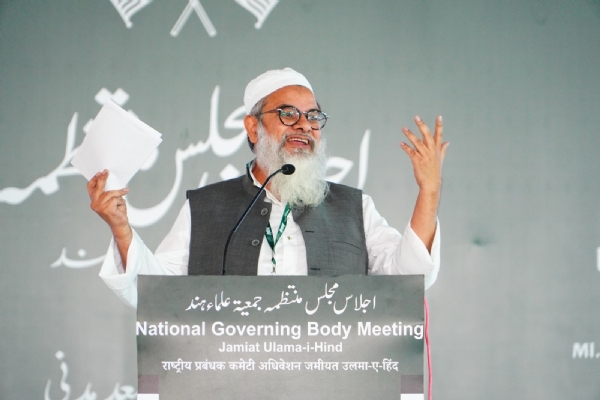
New Delhi, 31 October (H.S.): Jamiat Ulama-i-Hind president Maulana Mahmood Asad Madani has said that those attempting to turn Muslims into outsiders and second-class citizens in their own country are, in fact, enemies of the nation. He asserted that Muslims are citizens of India not at anyone’s mercy, but by virtue of their ancestors’ sacrifices and their contributions to the country’s freedom struggle.
Madani was addressing the two-day meeting of the Working Committee of Jamiat Ulama-i-Hind, held on October 30 and 31 at DLF Springfield, Pipaka, in the Mewat region of Nuh district, Haryana. The meeting deliberated extensively on the prevailing situation in the country, the Uniform Civil Code (UCC), Waqf properties, Palestine and the organisation’s activities.
Madani said efforts were being made to weaken the country’s democratic spirit and constitutional values. He claimed that more than 1,600 verified incidents of hate speech had been reported over the past year, with no First Information Reports (FIRs) registered in 87 per cent of the cases.
Criticising bulldozer actions, he said demolishing a citizen’s home or property without following due judicial process amounted to a violation of the Constitution, the rule of law and the dignity of the judiciary. He maintained that the administration should not assume the roles of both judge and executioner.
He further alleged that issues such as infiltration and ‘population jihad’ were being raised to divert public attention from pressing concerns, including unemployment, farmers’ problems and economic challenges.
Among the resolutions adopted by the Working Committee were demands for measures to curb hatred against Muslims and prevent mob lynching. The committee called for the appointment of nodal officers in every district in accordance with the guidelines laid down by the Supreme Court in the Tehseen S. Poonawalla judgment. It also demanded the establishment of special fast-track courts to deal with hate-motivated crimes.
The committee further proposed a reconsideration of the Waqf (Amendment) Act, 2025, and called for the establishment of an independent and empowered institution to safeguard and manage Waqf properties.
On the issue of Palestine, the committee called for the establishment of an independent Palestinian state, uninterrupted humanitarian assistance to Gaza, a ceasefire, protection of Al-Aqsa Mosque and accountability for those responsible for war crimes.
Through its declaration, Jamiat Ulama-i-Hind reiterated its commitment to national unity, communal harmony and the protection of the rights of all vulnerable and disadvantaged sections of society.
Madani urged young people to overcome despair and confront injustice with courage and determination. He said that protecting Islam was not merely a matter of slogans and speeches, but required individuals to incorporate Islamic teachings into their everyday lives.
The meeting was attended by prominent Islamic scholars and office-bearers from across the country, including Darul Uloom Deoband rector Maulana Mufti Abul Qasim Nomani, Maulana Salman Bijnori, Maulana Rahmatullah Mir Kashmiri and Maulana Salman Mansoorpuri, among others.
Several important books were also released on the occasion. At the conclusion of the meeting, the organisation directed its units, from the central level to local bodies, to prepare annual action plans and ensure their regular implementation.
---------------
Hindusthan Samachar / Jun Sarkar
18 Aug 2026