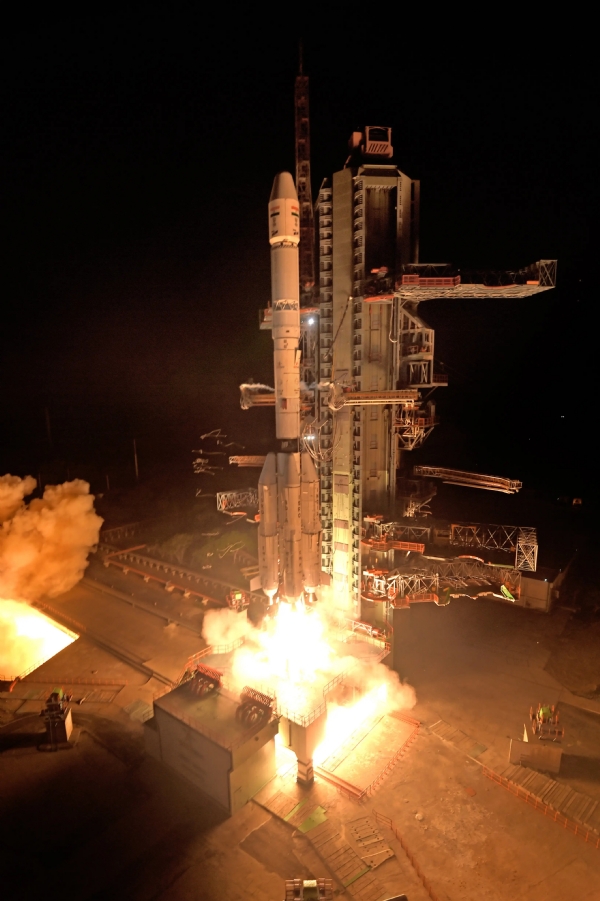
Sriharikota, 31 October (H.S.): The Indian Space Research Organisation (ISRO) on Friday night successfully launched its second-generation navigation satellite NVS-03 aboard the GSLV-F18 rocket, restoring the country's regional navigation system NavIC to its minimum operational configuration of four satellites.
The 50-metre-tall Geosynchronous Satellite Launch Vehicle (GSLV) lifted off at 11.51 pm from the second launch pad at the Satish Dhawan Space Centre, Sriharikota, following a 24-hour countdown. After a flight of approximately 18 minutes, the satellite was successfully injected into its designated Geosynchronous Transfer Orbit (GTO).
ISRO Chairman V. Narayanan said all vehicle systems performed as expected and the satellite had been precisely placed in the targeted orbit. He said NVS-03 would complement the three navigation satellites already in operation and restore Position, Navigation and Timing (PNT) services through the NavIC constellation.
NavIC, or Navigation with Indian Constellation, is India's independent regional satellite navigation system, providing positioning, navigation and timing services across the country and an area extending approximately 1,500 km beyond its borders. Its applications include real-time tracking of trains, vehicles and ships, besides other civilian and strategic uses.
Narayanan said the constellation was also an important component of the government's 'One Nation, One Time' initiative. The NVS-03 mission is expected to strengthen the infrastructure supporting Indian Standard Time (IST), following the notification of the Legal Metrology (Indian Standard Time) Rules, 2026.
The 2,232-kg satellite carries indigenous and procured atomic clocks, including an indigenous Rubidium atomic clock. It will transmit navigation signals in the L1, L5 and S bands. The satellite will subsequently use its onboard propulsion system to reach its designated geosynchronous orbital slot at 32.5 degrees East.
The targeted transfer orbit has a planned perigee of 170 km and an apogee of 37,023 km. ISRO adopted a special measure for the mission by flying the satellite with its pyrotechnic valves already open to ensure the reliability of the propulsion system.
The launch marked the 20th flight of the GSLV and was completed with a turnaround time of 56 days between successive GSLV missions, Narayanan said. He congratulated the ISRO team, industrial partners and academic institutions involved in the mission, adding that nearly 80 per cent of the budget had been channelled into Indian industries.
Union Minister of State (Independent Charge) for Science and Technology Jitendra Singh also congratulated ISRO on the successful launch, describing it as a step forward in strengthening India's indigenous navigation capabilities.
---------------
Hindusthan Samachar / Indrani Sarkar

18 Aug 2026