




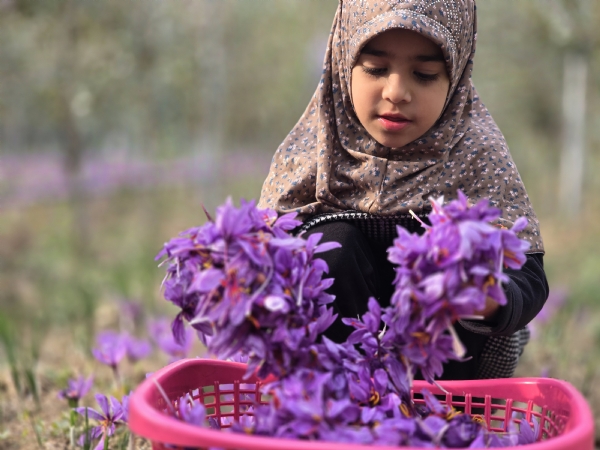
Srinagar, Oct 30 (HS): The harvesting season of saffron flowers, the Kashmir valley’s celebrated crop, has begun, and growers are hopeful of a better yield this year than in previous years, given the intermittent rain.
Saffron flowers are in bloom in the fields of Pampore, a town in Pulwama district of south Kashmir known for its saffron. Growers are busy picking flowers wherever the soil has moisture, and the work will pick up pace in the coming days.
The picking in the Valley begins in the last week of October and goes on until the end of November, and the season is treated as a festival.
Saffron is also grown in countries such as Iran, Spain and Afghanistan, but the Kashmiri variety is considered the finest, which keeps its demand and price relatively high. Kashmiri saffron is called “red gold” and is also counted among the world’s most expensive spices.
Growers hope for a better crop after the rain in the Valley in September and October.
Javid Ahmad Ganie, a grower from Samboora in Pampore who is associated with the J&K Saffron Growers Association, told Hindusthan Samachar: “It rained from time to time this year, which gives us hope of a better yield. In previous years, the lack of timely rain reduced the production.”
“Climate change has had a severe negative impact on this crop,” he said. “Saffron is grown on about 3,200 hectares in Pampore, but most of it has no corms, because under unfavourable weather conditions the corms have not developed for the past four years. With so much land lacking corms, the yield will naturally be low, but we hope for a better harvest on the land where the corms are present.”
Ganie said that the price of saffron i s also quite good compared with previous years, with 10 grams selling for Rs 3,000, which he called a good rate. “The saffron crop needs less water than other crops, but when it does not rain on time, the yield suffers. Soil moisture is very important for the growth of the corms,” he said.
While saffron is a source of livelihood for growers in the Valley, its fields are also a leisure attraction for visiting tourists. But the fields are shrinking with every passing year because of construction on them, indiscriminate removal of soil and high-density apple orchards planted on some of the land.
Expressing regret over the situation, Ganie said: “Saffron is our identity. It is a legacy of our elders, and it is our moral responsibility to keep it alive and to protect it. Kashmiri saffron is known across the world, and because of it, not only Kashmir but our country too is known in the world. We should not turn away from this crop of our ancestors, which is hundreds of years old.”
He said growers should create resources in line with the challenges of climate change to protect the crop. “We can cooperate with the government to benefit from modern technology and create artificial irrigation facilities, which can greatly reduce dependence on rain for irrigation,” he said. He appealed to the government, particularly the department concerned, to take steps on modern lines to ensure the crop’s survival and protection.
Another grower from Pampore, Irshad Ahmad Dar, also expressed hope of a better crop this year. “Last year, production fell by about 80 per cent because there was no rain, but this year it rained from time to time, so we hope for a better yield,” he told Hindusthan Samachar.
According to him, the picking has begun on a small scale and will increase in the coming days. Expressing sadness over the shrinking of saffron land, he said: “Structures are coming up on saffron land and soil is being removed indiscriminately, which is shrinking this land, and this is not good for the crop.”
“Another thing is that growers sell corms to outsiders, which fetches them good money, but this too can harm the crop,” he said. He appealed to the government to take immediate and concrete steps to protect the crop.
---------------
Hindusthan Samachar / Zahoor Hussain Bhat