New Delhi, 30 October (H.S.): India’s agricultural achievements, scientific advancements and technological innovations will receive greater international recognition through a major global research event scheduled to be held in the national capital next year, Dr. Mangi Lal Jat, Secretary of the Department of Agricultural Research and Education (DARE) and Director General of the Indian Council of Agricultural Research (ICAR), said on Friday.
The International Agricultural Research Partnership CGIAR and ICAR will jointly organise the 'CGIAR Science and Partnership Week' in New Delhi from April 12 to 17, 2027. The six-day event will bring together leading agricultural scientists, researchers, policymakers and other stakeholders from across the world to deliberate on strengthening global agricultural and food systems through scientific research, technological innovation and international collaboration.
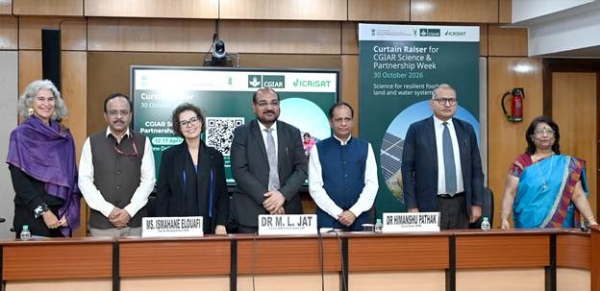
Addressing a press conference at the National Academy of Agricultural Sciences (NAAS), located at the National Agricultural Science Complex (NASC), Dr. Jat said the event would provide India with an important international platform to showcase its agricultural accomplishments and research capabilities. He added that detailed information regarding the programme, key sessions and speakers would be announced in the coming months.
India will host this major international gathering in 2027, with the objective of exploring ways to make agricultural and food systems more resilient, sustainable and climate-responsive. The initiative seeks to strengthen global cooperation by bringing together scientific expertise, technological innovations and international partnerships to address emerging challenges in agriculture.
The event will be jointly organised by CGIAR and ICAR, an institution under DARE, which functions under the Ministry of Agriculture and Farmers Welfare. It is expected to witness participation from agricultural scientists, researchers, farmers, policymakers, government representatives, start-ups, industry leaders and development organisations from across the globe.
Discussions will focus particularly on agricultural innovations that are already reaching farmers, alongside identifying strategies to expand the adoption and accessibility of these technologies and solutions to benefit a larger farming community.
Dr. Jat said India was a natural choice to host this prestigious international gathering, given its extensive agricultural research infrastructure and longstanding association with CGIAR. ICAR leads one of the world's largest national agricultural research systems, while Indian scientists have been collaborating with CGIAR for more than five decades across several areas of agricultural research and development.
Currently, ten CGIAR research centres are actively engaged in India, working in critical areas such as crop improvement, water management, livestock, fisheries, nutrition and agricultural policy.
India's contribution to agricultural research and development extends well beyond its national boundaries. Citing an example of international research collaboration, Dr. Jat highlighted how a conserved and shared germplasm accession of groundnut from the International Crops Research Institute for the Semi-Arid Tropics (ICRISAT) contributed to the development of varieties that are now cultivated in several African countries, including Malawi, Uganda, Mozambique and Zambia.
Similarly, the Hyderabad-based Centre of Excellence for South-South Cooperation in Agriculture is facilitating the exchange of useful agricultural technologies, scientific knowledge and successful practices among countries across Asia, Africa and Latin America.
CGIAR is a global agricultural research partnership comprising 15 international research centres and operating across more than 100 countries. Over the years, it has made significant contributions to agricultural development, global food security, crop improvement and the sustainable management of natural resources.
Its partnership with India, particularly through ICAR, has played an important role in enhancing crop productivity, strengthening food security and promoting the conservation of natural resources.
Referring to India's agricultural transformation following the Green Revolution, Dr. Jat emphasised that collaboration with international research institutions, including the International Maize and Wheat Improvement Center (CIMMYT), the International Rice Research Institute (IRRI) and ICRISAT, had significantly strengthened the country's food production capabilities.
India, which once faced food shortages and depended heavily on imports to meet domestic requirements, has emerged as one of the world's leading food producers and exporters. This transformation, he said, demonstrates the far-reaching impact of scientific research, technological advancement and international cooperation.
A key focus of the 2027 gathering will be to highlight India's agricultural priorities and successful innovations for the benefit of the Global South, particularly developing countries. Dr. Jat said India's foremost priority was to strengthen South-South cooperation and share its successful agricultural technologies, expertise and experiences with other developing nations, especially those in Africa.
He highlighted India's progress in climate-resilient agriculture, digital agriculture, AgriStack, farm mechanisation, millets, natural farming and sustainable agricultural practices. These areas, he noted, offer considerable opportunities for international collaboration, knowledge-sharing and technological exchange.
The conference will also deliberate on several emerging challenges and priorities across agricultural and food value chains. Key issues will include enhancing agricultural resilience to climate change, efficient water management, improving soil health, strengthening public-private partnerships, promoting agricultural start-ups, encouraging greater participation of women and young people, and recognising the role of the media in taking scientific knowledge and innovations to farmers.
CGIAR Executive Managing Director Dr. Ismahane Elouafi said the event would celebrate the achievements of the longstanding partnership between India and CGIAR while providing an opportunity to develop a forward-looking agenda for future agricultural cooperation.
She observed that India had demonstrated how a robust national scientific research system could drive large-scale transformation. Seeds, technologies and scientific knowledge originating from India were already benefiting farming communities across Africa and Asia.
The April 2027 gathering, she said, would provide an opportunity to expand this cooperation further and explore new possibilities for transforming agriculture through science and innovation.
Dr. Elouafi also underscored the importance of recognising the contribution of science and scientists to human well-being and strengthening global cooperation to build more resilient food systems. Referring to the successful first edition of CGIAR Science Week, held in Nairobi, Kenya, in April 2025, she expressed confidence that the New Delhi edition would provide fresh momentum to international agricultural partnerships and help develop solutions to emerging challenges in the sector.
ICRISAT Director General Dr. Himanshu Pathak said India's journey from a food-deficit nation to one of the world's leading food-producing and exporting countries was a testament to the transformative power of science, technology and international partnerships.
He said the CGIAR Science and Partnership Week 2027 would provide an opportunity to showcase India's agricultural achievements and innovations before a global audience. It would also facilitate learning from the experiences of other countries and encourage collective efforts to develop solutions to emerging challenges confronting agricultural and food systems.
The first CGIAR Science Week was organised in Nairobi, Kenya, in April 2025, during which CGIAR presented its existing research portfolio. Unlike an event focused solely on showcasing scientific achievements, the New Delhi edition will place particular emphasis on translating research into tangible outcomes and strengthening South-South cooperation through strategic international partnerships.
---------------
Hindusthan Samachar / Jun Sarkar
18 Aug 2026