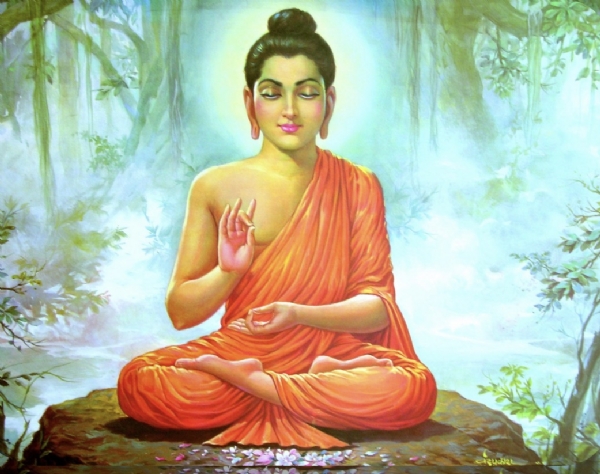
New Delhi, 30 October (H.S.): The sacred relics of Lord Buddha will be displayed for devotees at three prominent Buddhist centres in Arunachal Pradesh from October 31 to November 20, offering an opportunity for people to pay their respects and experience the state's rich Buddhist heritage. The exposition will be held at Tawang, Bomdila and Namsai.
Union Minister for Culture and Tourism Gajendra Singh Shekhawat will attend the inaugural ceremony on October 31 at the historic Gaden Namgyal Lhatse, popularly known as Tawang Monastery. The sacred relics, currently preserved at the National Museum in New Delhi, will be transported to the three locations as part of the exposition.
The Ministry of Culture is organising the event in collaboration with the Government of Arunachal Pradesh, the International Buddhist Confederation (IBC) and the National Museum. The initiative aims to provide devotees with an opportunity to pay homage to the sacred relics while showcasing the state's rich Buddhist traditions and India's Buddhist heritage. Buddhist monks, representatives of religious institutions, scholars and people from different walks of life are expected to participate.
The relics will depart from the National Museum in New Delhi on Friday night following special religious ceremonies. They will be transported aboard a special Indian Air Force aircraft from Palam Air Force Station in Delhi to Borjhar Air Force Station in Guwahati, before being flown by helicopter to Tawang.
Upon arrival, the relics will be received in accordance with traditional religious customs and installed at Tawang Monastery. The inaugural ceremony is scheduled to take place between 10 am and 11.30 am on October 31. The exhibition and associated programmes will be formally inaugurated on November 1 in the presence of Arunachal Pradesh Chief Minister Pema Khandu.
The exposition coincides with Lhabab Düchen, an important festival in the Tibetan Buddhist tradition that commemorates Lord Buddha's descent from the celestial realm to Earth. Devotees will be able to pay their respects to the sacred relics in Tawang from October 31 to November 7, followed by the T.G.L. Monastery, also known as Lower Gompa, in Bomdila from November 8 to 13. The relics will subsequently be displayed at the Golden Pagoda in Namsai from November 14 to 20. They are scheduled to return to the National Museum in New Delhi on November 21 via Tezu and Palam.
Special arrangements are being made to ensure the security and preservation of the relics throughout the exposition. The Ministry of Culture is coordinating transportation and other logistical arrangements with the Ministry of Defence, the Indian Air Force, the Arunachal Pradesh government and the National Museum. In view of the mountainous terrain and challenging geographical conditions, air and helicopter transport have been planned. However, the timing and arrangements will remain subject to weather, security and operational considerations.
The sacred relics are associated with the Piprahwa archaeological site in Uttar Pradesh's Siddharthnagar district, which is traditionally linked to ancient Kapilavastu and the Shakya community. In 1898, William Claxton Peppé excavated a stupa at the site, uncovering containers containing bone relics and precious objects.
Subsequently, the Archaeological Survey of India conducted further excavations between 1971 and 1977 under the direction of archaeologist K.M. Srivastava. Two additional relic containers were discovered during these excavations, containing 22 bone fragments traditionally associated with Lord Buddha. Of these, 20 are preserved at the National Museum in New Delhi, while two are housed at the Indian Museum in Kolkata.
A special exhibition titled 'Unearthing the Sacred Piprahwa' will also accompany the exposition. Organised by the International Buddhist Confederation, it will be presented at all three venues — Tawang, Bomdila and Namsai. The exhibition will highlight the excavations at Piprahwa, the discovery of the sacred relics, their historical significance and the Piprahwa jewels that were brought back to India in 2025. It aims to familiarise visitors with the traditions surrounding the Buddha's relics and the country's rich archaeological heritage.
An international conference on the theme 'Buddhism: Himalayan Region and Beyond' will also be held in Tawang on November 2. The conference, scheduled to take place at the Kalawangpo Convention Hall, will bring together Buddhist monks, scholars and representatives from India, Nepal, Sri Lanka, Myanmar, Malaysia, Indonesia and Germany.
The deliberations will focus on the spread of Lord Buddha's teachings following his Mahaparinirvana, the continuity of Buddhist traditions, the role of monasteries and religious institutions, and the relevance of Buddhist philosophy in contemporary society.
Participants will also discuss the historical and doctrinal continuity of Buddhism, preservation of Buddhist traditions in the Himalayan region and the role of Buddhist ethical teachings in modern life. Other areas of discussion will include cultural tourism, pilgrimage, skill development, sustainable livelihoods and the relevance of Buddhist thought in an increasingly globalised world.
Arunachal Pradesh is home to several distinct Buddhist traditions. Tawang and West Kameng are important centres of Mahayana and Vajrayana Buddhism, while Namsai and its adjoining areas are home to the Tai Khamti community and other Buddhist groups that follow the Theravada tradition. The exposition across Tawang, Bomdila and Namsai is expected to bring together communities belonging to these diverse traditions through their shared spiritual heritage.
The Central Government has previously organised exhibitions of sacred relics of Lord Buddha in Mongolia, Thailand, Vietnam, the Kalmykia region of Russia, Bhutan, Sri Lanka and Ladakh. The exhibitions held in Mongolia in 2022, Thailand in 2024 and Vietnam in 2025 witnessed the participation of large numbers of devotees.
In February 2026, the sacred Devnimori relics were taken to Sri Lanka, while an exposition of Lord Buddha's relics was organised in Ladakh in May 2026. Subsequently, the relics of two of his principal disciples, Arhats Sariputta and Mahamoggallana, were taken to Mongolia in May-June 2026.
---------------
Hindusthan Samachar / Jun Sarkar
18 Aug 2026